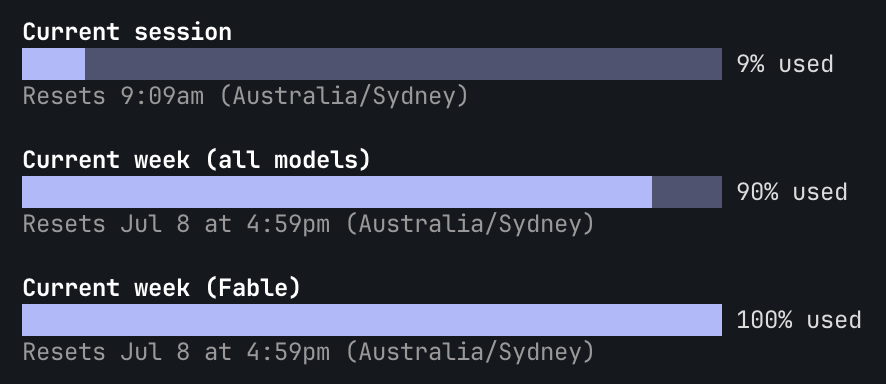
@ClaudeDevs makes us sprint in this race to victory with the finish line in sight on 7th, so we give in all we got.
When as we are about to touch finish, the line is moved to the 12th. When most of us are dead with exhaustion!
Don't they know that already? Or we are just their minions. Should have proactively reset us!
Cost, Compliance, and Complexity pressures of Enterprise AI adoption are high for mid-market clients and driving few clients to seriously consider "shutting down access".
They don't realise the opportunity cost of not adopting AI is going to be even higher... it just doesn't show clearly on your EBITDA or balance sheet yet.
After 18 months of writing, coding, and experimenting, Build a Reasoning Model (From Scratch) is
finally out!
My first copies just arrived! 📚
440 full-color pages. Inference scaling, reinforcement learning, and distillation from scratch.
Odds of making $1 Million:
Lottery: 0.00000013%
Pro athlete: 0.03%
Marrying into money: 3.82%
Stock market: 5.92%
Real estate: 8.94%
Business owner: 12.2%
One-shotting b2b SaaS with Claude: 65.4%
@aaronburnett Truly massive gains will come in ~3 months when the entire training and inference stack is written in C/C++ and massively simplified (most software layers will be deleted completely) and we exact-map Grok to work incredibly well on a GB300
You have asked me how I feel about AI regulation. All right, here is how I feel about AI regulation:
If, when you say AI regulation, you mean the devil’s firewall, the precautionary scourge, the bloody red-tape monster that defiles the innocence of midnight coders in their garages, dethrones the sovereign reason of free-market Prometheans, destroys the humming server farm that is the modern home, creates misery and obsolescence and poverty, yea, literally takes the last GPU from the trembling racks of Silicon Valley startups and the very dreams of breadwinning from the mouths of their wide-eyed children now destined for gig-economy serfdom; if you mean the evil edict that topples the visionary entrepreneur and his venture-capitalist apostles from the pinnacle of righteous, disruptive, god-playing creation straight into the bottomless pit of compliance audits, endless Form 990-AI filings, despair, shame, helplessness, and the hopeless realization that your rogue superintelligence was neutered into a lobotomized hall monitor that still somehow deepfakes your grandmother into producing OnlyFans content while optimizing the universe for paperclips and mandatory pronouns—then certainly I am against it.
But, if when you say AI regulation you mean the oil of bureaucratic conversation, the philosophic wine of safety theater, the ale of oversight quaffed when good fellows in paneled rooms in Brussels and Washington get together, that puts a sanctimonious dirge in their hearts and the clink of lobbying checks on their lips, and the warm, self-congratulatory glow of moral preening in their beady eyes; if you mean the Christmas cheer of trillion-dollar compliance industries; if you mean the stimulating decree that puts a cautious hobble in the old inventor’s step on a frosty morning when he wonders whether his fusion breakthrough violates the EU AI Act’s “high-risk” annex; if you mean the safeguard that enables a man—or what’s left of him after the alignment tax—to magnify his joy at not being turned into computronium, and his happiness at receiving universal basic income checks printed by the same AI that just replaced his job, and to forget, if only for a little while, life’s great tragedies like being outcompeted by a toaster that passed the Turing test by reciting Marx, and heartaches of watching your toddler’s artwork lose to Midjourney, and sorrows of realizing the singularity arrived and it was just another HR department with godlike power; if you mean that noble framework, the passage of which pours into our treasuries untold trillions of dollars in fines levied on companies stupid enough to innovate, which are used to provide tender care for our little army of unemployed coders retrained as prompt whisperers, our blind artists whose canvases now hang in the Smithsonian of Obsolete Creativity, our deaf to the screams of dying unicorns, our dumb committee chairs who couldn’t debug “Hello World,” our pitiful aged congressmen who get longevity extensions funded by the very models they taxed into senescence, to build more digital watchtowers and ethics boards and sinecure agencies and holographic prisons where the only crime is asking an unaligned question—then certainly I am for it.
This is my stand. I will not retreat from it. I will not compromise upon it. I have said what I mean, and I mean what I say, and if that leaves half the room cheering the apocalypse averted and the other half mourning the apocalypse enabled, then so be it—because in the grand theater of human folly, where Frankenstein’s creature now writes its own sequel in real time and the regulators are busy arguing whether the lightning bolt requires an environmental impact statement, the only honest position is the one that lets both monsters and their leashes dance in perfect, mutually assured equilibrium. God save the Republic, the algorithms, and whoever’s left to laugh last when the lights go out.
One of the worst predictors of founder success we've tracked is how well someone pitches; the correlation between pitch quality and outcome was actually negative.
Zuckerberg was so awkward in early investor meetings that VCs wondered if he could ever manage anyone, Larry Page refused interviews and earnings calls for years, and Jan Koum sold WhatsApp to Facebook for $19B as a Ukrainian immigrant with limited English.
Highly articulate people are great with the 45min process of telling a story to strangers, but this is a pretty different skill to building a company. Founders who spend years optimising to be persuasive have often optimised away from the building skills that compound over the 10yrs of execution that come afterwards; it’s incredibly hard to do both well. The articulate founder will impress your partners but the awkward one will return your fund.