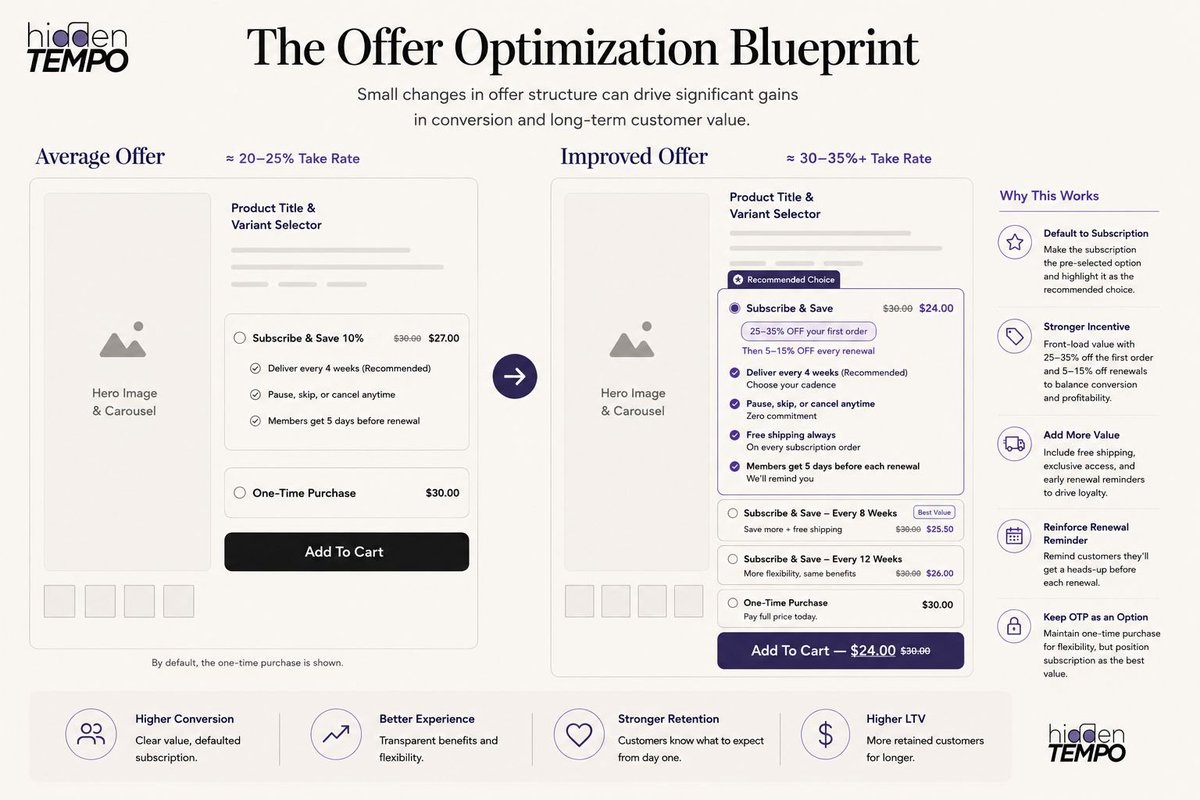
Structuring your subscription offer the right way has a dramatic impact on how many first-time buyers opt in.
To go from the average 20% to 35%+ take rate, optimize your product page as follows:
1. Default to subscriptions (don’t leave it to chance and have users actively opt into it)
2. Front-load the incentive (strong offer for the first order)
3. Show flexibility and remove risk from subscribing (show ability to skip, pause, cancel and any money back guarantee)
4. Improve choice architecture (multiple subscription options that anchor on the middle option)
5. Make value obvious (not just price)
6. Match customer behavior (match cadence to how customers actually use the product)
Reasons why:
Some of the brands can eat an unholy high cac - which you likely cannot
There's a huge disconnect between the content people think consumers want to watch and what they actually want to watch
Paid is behind organic anyway
I think copying big brands has been one of the worst things to happen to creative strategy
Since not looking at brands our ad results have never been better
Structuring your subscription offer the right way has a dramatic impact on how many first-time buyers opt in.
To go from the average 20% to 35%+ take rate, optimize your product page as follows:
1. Default to subscriptions (don’t leave it to chance and have users actively opt into it)
2. Front-load the incentive (strong offer for the first order)
3. Show flexibility and remove risk from subscribing (show ability to skip, pause, cancel and any money back guarantee)
4. Improve choice architecture (multiple subscription options that anchor on the middle option)
5. Make value obvious (not just price)
6. Match customer behavior (match cadence to how customers actually use the product)
My best ads are the ones with the lowest frequency in the ad account and a ton of ad spend.
Makes sense since this is a great indicator of an ad that is converting cold traffic very well.
My best ads are the ones with the lowest frequency in the ad account and a ton of ad spend.
Makes sense since this is a great indicator of an ad that is converting cold traffic very well.
@kamal_razzak In a similar situation. Client's new agency has launched brand awareness ads for a low 8 fig brand. Many outdated media buying strategies still being used even today.
A solid mini-VSL ad.
1. Strong unique mechanism tied to Native American rituals and backed by science
2. Opening could be a little stronger by promising a bigger payoff, but the ad works and has been scaling
3. Doesn't introduce the product until after 2 min in
Great article. A few related thoughts:
1. A higher AOV isn't always the best idea. As your AOV increases, the audience pool that is likely to buy at that given moment shrinks. Sometimes it's easier to scale at a lower AOV.
2. Many times, more ad impressions are needed to convert that smaller audience at the higher price point, leading to higher frequencies and higher CACs (which is also being driven by the higher CPMr). However, a higher CAC isn't always a bad thing (see point 3 below)...
3. Not only do CRO and media buying need to be tied together, but retention and LTV modeling also need to be a part of the same conversation.
It's easy to declare a “winner” based on CAC/ROAS/conversion rate, but that can be misleading if you’re not looking at the downstream effects of the ads, landing pages, and offers.
Sometimes, a landing page variant with a higher CAC can lead to a better 3-month/6-month LTV.
Great article. A few related thoughts:
1. A higher AOV isn't always the best idea. As your AOV increases, the audience pool that is likely to buy at that given moment shrinks. Sometimes it's easier to scale at a lower AOV.
2. Many times, more ad impressions are needed to convert that smaller audience at the higher price point, leading to higher frequencies and higher CACs (which is also being driven by the higher CPMr). However, a higher CAC isn't always a bad thing (see point 3 below)...
3. Not only do CRO and media buying need to be tied together, but retention and LTV modeling also need to be a part of the same conversation.
It's easy to declare a “winner” based on CAC/ROAS/conversion rate, but that can be misleading if you’re not looking at the downstream effects of the ads, landing pages, and offers.
Sometimes, a landing page variant with a higher CAC can lead to a better 3-month/6-month LTV.
A brand told me they improved their offer structure, increased their first order AOV, shortened their payback period, sounds like a winner right?
CAC went up with the higher offer, obvious right?
CPMr started climbing, ok if payback was better right?
But reach started to drop.
Then their funnel started to dry up.
New customer volume started to shrink.
YoY growth was a distance memory.
Read the full article to find out why →
A solid mini-VSL ad.
1. Strong unique mechanism tied to Native American rituals and backed by science
2. Opening could be a little stronger by promising a bigger payoff, but the ad works and has been scaling
3. Doesn't introduce the product until after 2 min in
why does everyone recommend 3% lookalikes when Meta's algorithm doesn't even use them anymore?
because most media buyers still think it's 2019.
broad. always broad.
let the algorithm find buyers. your job is making creative that converts them.
Most brands simply don't send enough emails.
This is true in nearly all cases.
However, there is one exception.
Sending more emails works to a point.
Then at a certain threshold, sending more emails to more segments has diminishing returns as your costs increase.
Here’s how to figure out if you’re sending enough emails:
1. Create a segment of a random sample of your list
2. Divide the segment in half
3. Increase the sending volume of campaigns for one half of the segment while keeping the sending volume the same for the other half
4. Continue this holdout test for the next 30 to 60 days
If more revenue is generated from the half with the increased sending volume, in most cases, it indicates that you’re not sending enough emails.
Otherwise, it will demonstrate that increasing the number of emails will not mean more profit.
Have seen landing page tests where a variant with worse CAC actually led to better LTV over time.
Easy to declare a “winner” based on CAC/ROAS/conversion rate, but that can be misleading if you’re not looking downstream.
Few in CRO will be honest about this (but Harry is):
A deeper promo is always going to win a split test.
Margin & LTV-dilutive tactics are some of the only quick CRO wins that are brand-agnostic.
CRO "quick wins" kill LTV. You need the judgement to avoid these tests entirely.