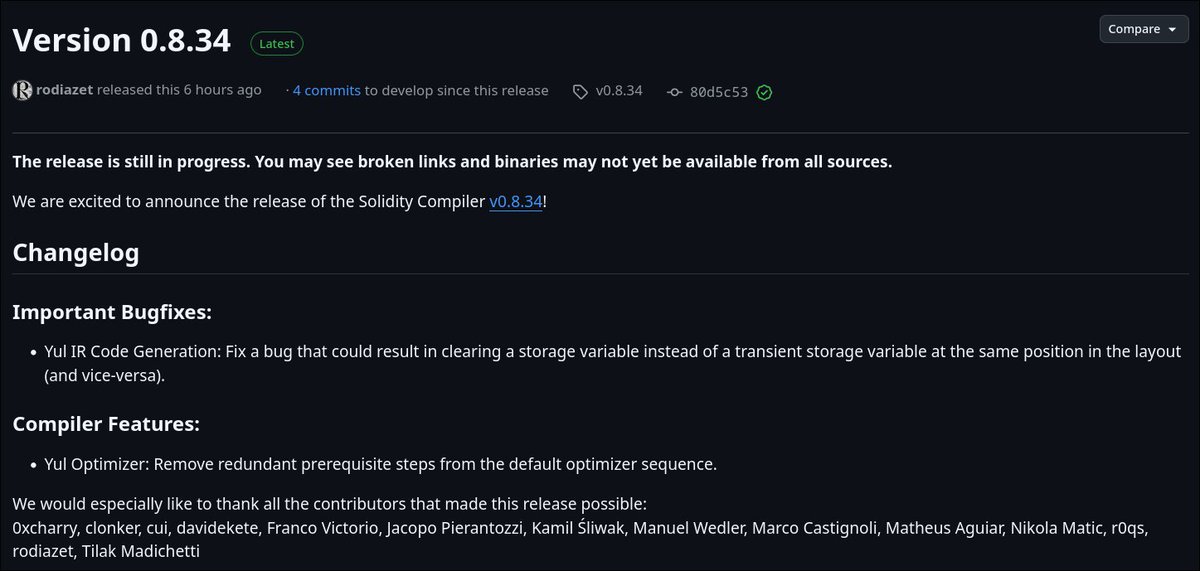
Solidity v0.8.34 out now.
This release fixes a high-severity bug in the IR pipeline affecting versions 0.8.28 through 0.8.33 (`--via-ir`, not enabled by default).
If your code does not use both `--via-ir` and delete on a transient state variable, your contract is not affected.
“The infrastructure that you have to provide to cope with the compliance, scale, and general structure and experience of a traditional finance player —
@CarbonDeFixyz, the single-sided order book curves that you provide — this not only complies with what a private equity or private debt [holder] would want… It goes beyond that. It allows them to effectively scale in and out of assets based on parameters they can define.
And this flexibility you have with no other solution in crypto.
Many of these things are such a novelty. But they really, for us, make such a strong case when we talk to these institutional players."
– Oliver Giera, Co-founder @Aureus_money
Every blockchain needs DEX infrastructure engineered for price alignment and efficient liquidity flow.
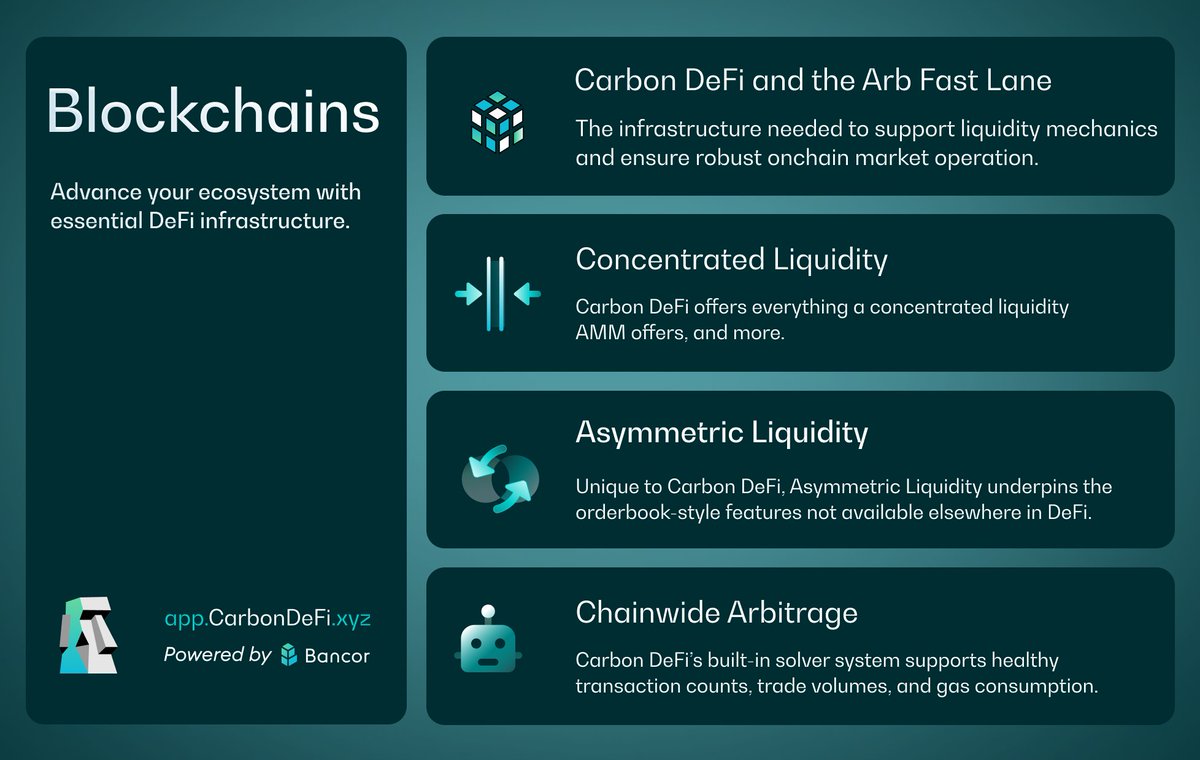
@CarbonDeFixyz + Arb Fast Lane combination is a unified liquidity engine that drives continuous onchain activity, increases gas consumption, and maintains price equilibrium across all major DEXs chainwide.
🗿 Carbon DeFi — a sophisticated orderbook-style DEX introducing new DeFi primitives, including one-directional trades, including range orders for scaling, linked orders for automated buy low, sell high trading strategies, and MEV sandwich attack immunity.
🤖 Arb Fast Lane — Carbon DeFi’s built-in solver system aggregates liquidity from all major DEXs to help efficiently fill orders, sustain trading activity, and maintain chainwide price parity.
🇭🇰 @MBRichardson87 and @Here2DeFi will be at @consensus_hk to discuss how this infrastructure can enhance your network's performance and liquidity efficiency.
📩 DM Jen, @Here2DeFi, to connect IRL.
Bancor is proud to collaborate with @tokengineering Academy and @EthCC on the TE Research Symposium (TERSE) at EthCC[9] 2026 in Cannes.
TERSE provides a technical commons to benefit builders, reviewers, and users alike, helping translate research into deployed systems with fewer misunderstandings – designed to strengthen how our industry communicates technical work in public: clear problem statements, explicit assumptions, defensible methods, results, and limitations, presented without promotional intent.
Project Lead, Dr. @MBRichardson87 has published a blog post outlining the rationale and submission expectations: https://t.co/OpQYNvnY3p
Submissions are now open. Deadline: 20 February 2026.
I'm still baffled that the Ethereum Core Dev community does not prioritize fixing the 2 most cited problem of EVM developers per the Solidity Lang survey despite our repeated efforts:
1. Stack too Deep: yes this is a Solidity skill issue a little bit but just add a SWAP/DUP17-32 opcode range and call it a day. You will burn some opcodes. It's fine, they are meant to be used. You're gonna have another PUSH0-style mismatch, this is also fine, it's not perfect but it's fine.
2. Lift the 24KB limit. I don't really care what you do, make it 32KB, 48KB, 128KB, 256KB, 512KB, do it all at once, incrementally, price it or not but do something! Now, not next year!
If you are scaling the L1, ensuring people can write contracts without stupid errors is P0.
If the system cannot handle an extra 8KB per bytecode which is a param that was set 10yrs ago literally then there's no chance you will be able to actually scale the L1.
Fix stack too deep and bytecode size limit! For the devs!