@InfraAddaofWB Yess green line. There's only 1 line coming from sector 5 right? Because I stay near kaikhali and work has been going on from a long time. It is connecting airport to sector 5. There's even a metro station gate being constructed outside my apartment between haldiram and kaikhali
@ShashankaRaja@InfraAddaofWB Yes started. Even work for constructing metro stations have started. And every night they're blocking roads to complete at full speed.
Something about Elon Musk’s aggressive push for Starlink in India deserves much more scrutiny.
Just sit back and look at what has happened over the last 24 hours.
Musk has repeatedly used his own social-media platform, X, to publicly pressure India over Starlink’s pending approvals. He has accused “certain oligarchs” of blocking Starlink to protect a “monopolistic chokehold” and has called the situation a “crime against the people of India.”
But here is the larger question:
Why is a foreign billionaire using his own social-media platform to aggressively shape public opinion in India around the regulatory approval of his own company?
This isn’t simply a businessman promoting his product.
Musk owns X.
Musk controls the company seeking permission to operate Starlink in India.
And Musk has enormous reach on X.
That creates a very unusual concentration of business interest + communication infrastructure + audience influence in the hands of one individual.
Imagine the possibilities.
If a government regulator does something Musk doesn’t like, he can immediately take the issue to hundreds of millions of people through a platform he owns.
He doesn’t need to buy advertising.
He doesn’t need a television network.
He doesn’t need a newspaper.
He already owns the platform through which the narrative can be created, amplified and repeatedly pushed.
And that is precisely why India’s Starlink approval should be looked at not merely as a telecom or business decision, but also through the lens of national security, data sovereignty and information influence.
To be clear, Starlink already has a licence to provide satellite communication services in India. What is still pending are important regulatory requirements including security clearances and spectrum-related approvals. The government has also stated that Starlink, Jio and OneWeb are broadly at the same regulatory stage and has rejected Musk’s allegation of discriminatory treatment.
So this is not about saying “Starlink should never be allowed in India.”
Satellite internet can genuinely provide enormous benefits, particularly in remote, mountainous, border and underserved areas.
The question is different:
What safeguards should India demand before allowing a company controlled by someone with such enormous technological and information influence to operate critical communications infrastructure?
We have already seen why governments worry about control over satellite networks during conflicts and emergencies. Indian authorities have previously raised questions about whether satellite services can be effectively monitored, controlled or restricted when national-security circumstances require it.
Now add another layer:
The same individual who controls the satellite network also owns one of the world’s most influential social-media platforms.
That combination deserves serious examination.
Today, Musk can use X to campaign for Starlink.
Tomorrow, if Starlink becomes critical infrastructure in India, what happens if the Indian government takes a position that conflicts with Musk’s interests?
Could the same enormous communication platform be used to influence public sentiment against a regulatory decision?
Could political pressure be generated through millions of posts and reposts?
Could narratives around government policy be amplified selectively?
Could a commercial dispute become an information battle?
I am not claiming that Musk will necessarily do any of these things.
I am saying that India should ask these questions before handing over access to critical communications infrastructure.
And perhaps the most important question is this:
If one individual can simultaneously own the infrastructure carrying information and the platform influencing the people receiving that information, how much power are we comfortable concentrating in one person’s hands?
This isn’t an argument against technology.
It is an argument for safeguards.
@DoT_India@AshwiniVaishnaw
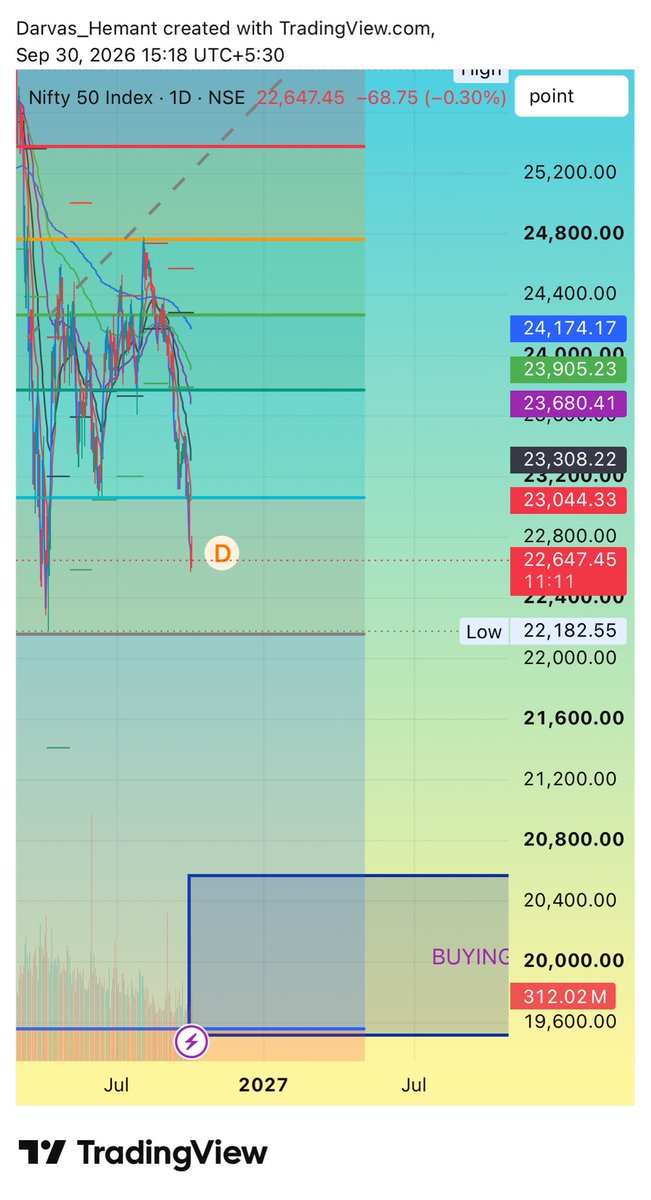
Again, the message remains clear: this is a SELL ON RISE market.
NIFTY is now around 22,647, with the structure continuing to remain weak.
The key levels on the chart:
🔴 23,044– 23,300 - immediate resistance zone
🔴 23,680–23,900 - major resistance
🔴 24,170+ - trend recovery only above this zone
On the downside, 22,180 remains an important support. A decisive break below it could open the door toward the 20,400–19,600 zone, which is the major buying zone marked on the chart.
Until NIFTY decisively reclaims the higher resistance levels, bounces should be treated as opportunities to reduce risk rather than chase the market.
SELL ON RISE.
Not BUY THE DIPS.
#NIFTY #StockMarket #IndianStockMarket #Nifty50 #Trading #MarketOutlook https://t.co/uH8P4OH9uJ
I'm from Bengal, saw 2021 firsthand—this felt impossible.
Credit to EC for a secure, disciplined election: SIR, CRPF, QR entry & strong security. A real shift.
Now hoping for fair and transparent results tomorrow.
#WestBengalElections#ElectionCommission#IndiaVotes
@Alampana100@TodaysChanakya But chankaya's polls have be very much correct, specially the 2021 one for west bengal. We might all be surprised so if there's any company that may benefit we can take a bet on it.
@investorniti Massive support for BJP, but in some booths the observor from tmc side was trying a lot to rig votes. What will happen will only be clear on 4th. But there's a massive saffron wave that's for sure.