SEO & Digital Marketing Professional with 20+ years of experience. I love helping small businesses grow and I can help you no matter what your budget is!
Dorothy was just the beginning.
We're exclusively debuting the official poster for Wizard of Oz horror movie GALE: YELLOW BRICK ROAD, which will have a one-night-only theatrical engagement on February 11, 2026.
Art courtesy of @creepyduckart.
Overthinking is what kills you ...
In contemporary art, few sculptures have captured the imagination quite like Thomas Lerooy’s “Weight of Thought.” This profound work, a part of Lerooy’s 2009 series for his Braindance exhibition, is a testament to the artist’s ability to intertwine classical motifs with modern existential dilemmas. The sculpture, with its exaggerated head and diminutive torso, stands as a powerful symbol of the burdens that knowledge and thought can impose on the human spirit.
The inception of “Weight of Thought” was born out of Lerooy’s personal struggle with indecision during the conceptualization of his exhibition. The artist describes his head as feeling “very big and heavy,” overwhelmed by the endless search for a unifying idea. It was this sensation of cognitive overload that Lerooy sought to encapsulate in bronze – a material as timeless as the human condition it represents.
Lerooy’s sculpture draws heavily from the aesthetics of Classical Greek and Roman art, yet it subverts these traditions to reflect contemporary concerns. The figure’s muscular body, reminiscent of ancient heroes, is ironically undermined by the oversized head, which tilts precariously, threatening to topple the entire structure. This juxtaposition speaks to the modern struggle of balancing the weight of our thoughts with the reality of our physical existence.
Over a decade later, “Weight of Thought” continues to resonate with audiences. Its themes of mental burden and the search for meaning have found new relevance in a world increasingly dominated by information overload and existential uncertainty. The sculpture has been embraced by various movements and individuals, from students grappling with academic pressures to activists within the Black Lives Matter movement, illustrating the universality of Lerooy’s message.
Lerooy’s creative process reflects a battle between internal and external forces. The artist’s internal struggle to exceed his mental capacities is externalized in the sculpture’s form. The head, swollen with thoughts, spills over with liquid – a visual metaphor for the overflow of ideas that cannot be contained within the confines of the mind.
Since its unveiling, “Weight of Thought” has taken on a life of its own, with the public layering their own meanings onto the artwork. Lerooy acknowledges this evolution, noting that the sculpture’s significance has grown beyond his original intent. It has become a canvas for the collective consciousness, reflecting the diverse experiences and interpretations of its viewers.
Thomas Lerooy’s “Weight of Thought” stands as a monumental piece within the landscape of modern sculpture. Its ability to encapsulate the human experience, with all its intellectual and emotional complexities, ensures its place in the annals of art history. As we continue to navigate the labyrinth of our own thoughts, Lerooy’s sculpture serves as a poignant reminder of the delicate balance we all must strike between the mind and the material world.
Artist : Thomas Leeroy
#archaeohistories
Witchcraft is an area of history that most people feel familiar with. From the Salem Witch Trials to the witches of Macbeth, the figure of the witch is embedded in our culture. The problem is that most of what we think we know is wrong.....
Not in English-speaking countries. Witchcraft was a felony in both England and its American colonies, and therefore witches were hanged, not burned. However, witches’ bodies were burned in Scotland, though they were strangled to death first.
About 30,000–60,000 people were executed in the whole of the main era of witchcraft persecutions, from 1427–36 AD, witch-hunts in Savoy (in the western Alps) to the execution of Anna Goldi in the Swiss canton of Glarus in 1782. These figures include estimates for cases where no records exist. Only 25% of those tried across the period in England were found guilty and executed.
Total number of people tried for witchcraft in England throughout the period of persecution was no more than 2000. Most judges and many jurymen were highly sceptical about the existence of magical powers, seeing the whole thing as a huge con trick by fraudsters. Many others knew that old women could be persecuted by their neighbours for no reason other than that they weren’t very attractive.
All four of the major western Christian denominations (the Roman Catholic, Lutheran, Calvinist and Anglican churches) persecuted witches to some degree. Eastern Christian, or Orthodox, churches carried out almost no witch-hunting. In England, Scotland, Scandinavia and Geneva, witch trials were carried out by Protestant states. Spanish Inquisition executed only two witches in total.
More accused witches were executed in the last decade of Elizabeth I’s reign (1558–1603) than under her successor, James I (1603–25). The first Witchcraft Act was passed under Henry VIII, in 1542, and made all pact witchcraft (in which a deal is made with the Devil) or summoning of spirits a capital crime. The 1604 Witchcraft Act under James could be described as a reversion to that status quo rather than an innovation.
In Scotland, where he had ruled as James VI since 1587, James had personally intervened in the 1590 trial of the North Berwick witches, who were accused of attempting to kill him. He wrote treatise Daemonologie, published in 1597. However, when King of England, James spent some time exposing fraudulent cases of demonic possession, rather than finding and prosecuting witches.
In England the majority of those accused were women. In other countries, including some of the Scandinavian countries, men were in a slight majority. Even in England, the idea of a male witch was perfectly feasible. Across Europe, in the years of witch persecution around 6,000 men – 10-15% of total – were executed for witchcraft. In England, most of the accusers and those making written complaints against witches were women.
Nobody was goddess-worshipping during period of witch-hunts or if they were, they have left no trace in the historical records. Despite the beliefs of lawyers, historians and politicians (such as Karl Ernst Jarcke, Franz-Josef Mone, Jules Michelet, Margaret Murray and Heinrich Himmler among others), there was no ‘real’ pagan witchcraft. There was some residual paganism in a very few trials.
The idea that those accused of witchcraft were midwives or herbalists, and especially that they were midwives possessed of feminine expertise that threatened male authority, is a myth. Midwives were rarely accused. Instead, they were more likely to work side by side with the accusers to help them to identify witch marks. These were marks on the body believed to indicate that an individual was a witch (not to be confused with the marks scratched or carved on buildings to ward off witches).
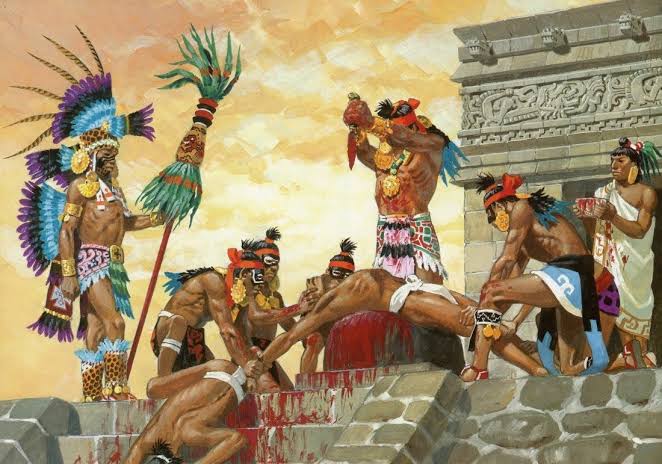
📷 : Spanish Inquisition persecuted those perceived as heretics by Catholic Church, but witchcraft was largely regarded as a superstition and wasn’t pursued as a heresy by officials except in rare cases.
#archaeohistories