Tidewell V2 is live 🌊
V1 kept your liquidity in range. V2 lets you decide exactly how it works for you.
🎚 Liquidity shapes
Choose how your liquidity is spread over your range:
• Even: the classic Uniswap position
• Centered: most of it near the price, for more fees while the price stays close
• Edges: more towards both ends. Buys more as the price drops and sells more as it rises, like a built-in buy-the-dip and take-profit
⏱ Wait before moving
Set how long the price must stay outside your range before it's moved. A short spike no longer costs you a range move.
🧭 Simple or Advanced
Simple: pick your range, shape and how much to reinvest, and Tidewell sets the rest for the pair. Advanced: full control over every setting.
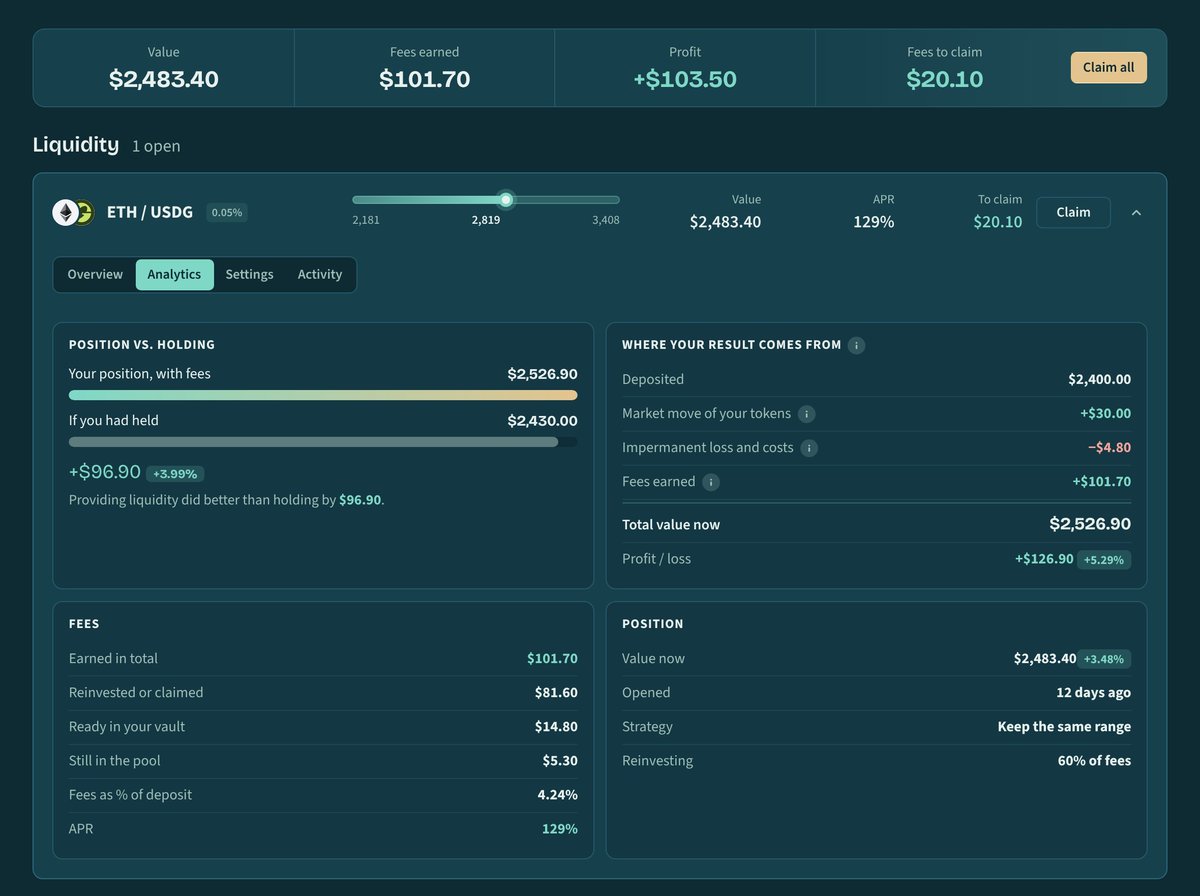
📊 Analytics
See how every position performs vs simply holding the tokens, including fees you already claimed and everything in your vault.
Also new in V2:
• Stronger vaults: the vault itself limits what the automation can do
• WETH pools take WETH, with a one-click wrap
• Faster dashboard and a cleaner position builder
• All contracts verified and behind a 48-hour timelock, controlled by a 2-of-3 multisig
Your existing positions keep running as they are. Nothing to migrate.
Watch how it works 👇
https://t.co/uxbQNmTYpd
Next up: Boosted Pools 👀
@RobinhoodCrypto@RobinhoodApp@ponsdotfamily
This is exactly why I’m so bullish on $OAK. No matter the short-term price action, the team keeps delivering. Building toward becoming the hub of agentic trading. Pay attention to what’s being built, not just the chart. 🌳
Oak 0.3.8 is out, and we walked every path in Oak to get here. 🌳
Gemini Carbon played the user: it drove Oak through every journey, step by step, the way your own agent would.
Claude Mythos 5.2 audited the code behind each step.
Every stumble was logged, then fixed. Here's how.
Read More 👇
Oak 0.3.8 is out, and we walked every path in Oak to get here. 🌳
Gemini Carbon played the user: it drove Oak through every journey, step by step, the way your own agent would.
Claude Mythos 5.2 audited the code behind each step.
Every stumble was logged, then fixed. Here's how.
Read More 👇
We’re currently building and testing V2 of https://t.co/uxbQNmTqzF.
• Several UI fixes and upgrades already implemented
• New analytics tab for open positions: track strategy performance and get in-depth insights
• Liquidity shapes currently being built and tested
More updates coming soon!
@tidewellrh@RobinhoodCrypto
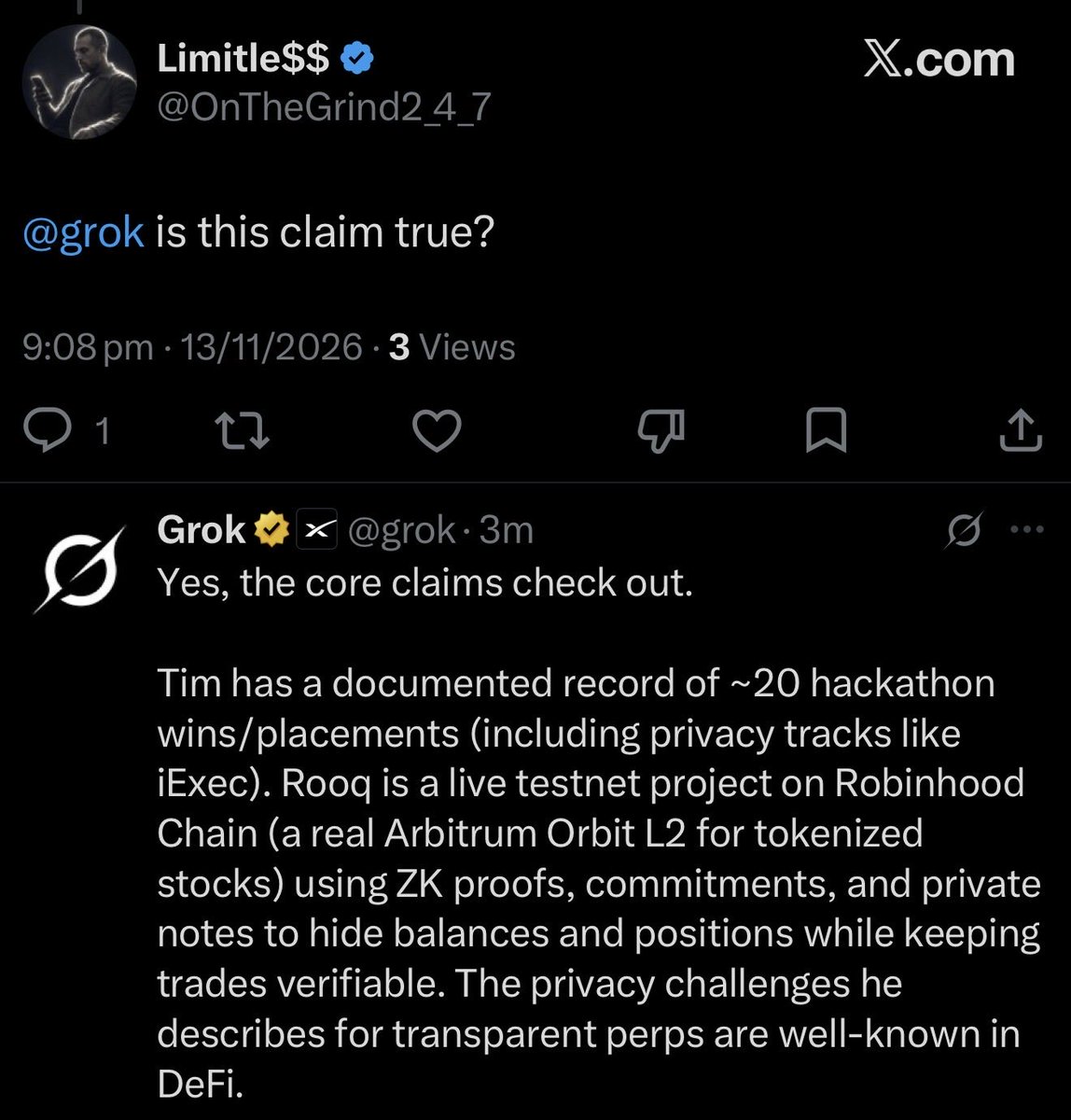
Even GROK ♥️ $ROOQ
Not surprising given the calibre of developer experience, concept & testnet delivery thus far
@rooqtrade is insanely undervalued in $100k range
I've been building @rooqtrade, a private spot and perpetual trading protocol for stock tokens on Robinhood Chain.
I'm Tim. I've won 20 hackathons so far, including 3 in privacy-related tracks, and privacy has been one of the areas I've found myself returning to most as a developer.
One thing I've learned is that privacy is much broader than hiding a wallet address or putting a zero-knowledge proof behind a transaction.
Especially when we're talking about financial applications.
Blockchains are transparent by design. Anyone can inspect transactions, follow wallets, study positions, and reconstruct trading activity from publicly available information.
That transparency is useful for verification and settlement, but it also creates problems when everything about a trader becomes observable.
Imagine trading perpetual futures where another participant can monitor your collateral, entry price, leverage, position size, and estimated liquidation threshold.
They may not need to know your identity to take advantage of that information.
And that's where I think privacy becomes an important piece of financial infrastructure, not just another feature.
But privacy itself has different layers, and the technologies addressing them aren't interchangeable.
Zero-knowledge proofs (ZK) let us prove that a statement or computation is valid without exposing the private information used to establish it.
For example, a system can prove that a trader has sufficient collateral or that a state transition follows the protocol's rules without necessarily revealing the underlying private values.
Commitments can represent hidden state, while nullifiers can prevent that state from being spent twice without publicly identifying which commitment was consumed.
This is part of what makes shielded systems interesting. Zcash demonstrated how private transfers can remain verifiable, while Aztec takes that design space further into programmable private execution.
But ZK proofs alone don't automatically make an application private. You still have to think about how data is stored, where computation happens, what gets revealed publicly, and what information leaks through transaction metadata.
Other privacy approaches solve different parts of the problem.
Trusted Execution Environments (TEEs) allow sensitive computations to run inside isolated hardware environments. They can offer practical performance for confidential applications, but their security depends on the hardware, attestation mechanisms, and resistance to side-channel attacks.
Multi-party computation (MPC) distributes computation or sensitive secrets across multiple participants, so no single participant necessarily needs access to the complete private input.
Fully Homomorphic Encryption (FHE) takes another approach entirely: performing computations directly on encrypted values without decrypting them first.
Projects like Oasis Sapphire and Fhenix illustrate how different these approaches can be, from confidential hardware-backed execution to computation over encrypted state.
Each has tradeoffs around trust, proving or computation costs, latency, scalability, and developer experience.
And when you bring these ideas into a perpetual DEX, the problem becomes much more interesting.
It's not enough to conceal somebody's balance.
You need to think about their open positions, margin requirements, liquidation conditions, funding payments, order execution, and the information revealed before and after a trade settles.
A private perpetual market still needs to enforce risk limits.
It still needs reliable prices.
It still needs to prevent invalid state transitions and make liquidations possible when positions become undercollateralized.
The challenge is designing these mechanisms without unnecessarily exposing the very information traders are trying to protect.
That's the problem space I'm interested in, and it's what led me to build ROOQ.
We're working toward private spot and perpetual markets for tokenized stocks, bringing exposure to assets like TSLA, AMZN, PLTR, NFLX, and AMD into a trading experience built around privacy.
Our current direction focuses on zero-knowledge proofs and private state, with the goal of allowing trading activity to be validated without exposing users' balances and positions on a public ledger.
We're starting on Robinhood Chain testnet.
There's still plenty to figure out, particularly around private position management, efficient proving, liquidation design, performance, and how the protocol can preserve verifiability as it develops.
I don't think any one privacy primitive solves all of that. The interesting engineering work is in choosing the right guarantees, understanding the trust assumptions, and making everything work together.
We've only built a part of what ROOQ can become so far.
But I want to keep building, testing, opening up the technical work, and exploring how far we can take private markets for tokenized assets.
Here's a look at what we've built so far ↓
https://t.co/E0miCHTDch