What is the transition from sickcare to healthcare going to actually look like?
While vaccine perception is mixed, there is burgeoning evidence that they might reduce the risk of diseases far beyond the original infection.
Shingles vaccine recipients were ~17-20% less likely to develop dementia over the following 6-7 years.
EBV infection is linked to a 32-fold higher risk of multiple sclerosis.
Large pharma seems to be taking notice. @EliLillyandCo $LLY recently agreed to acquire three vaccine developers for up to ~$3.8B.
My take: if one immunization can prevent both an acute infection and a downstream chronic disease, the economic case for prevention strengthens substantially.
As evidence continues to link common pathogens to chronic disease, I'd expect vaccines to play a growing role in the transition from sickcare, or treating disease after it manifests, to healthcare, preventing it before it begins.
Read my full take in @ARKInvest's weekly newsletter 👇
China’s rise in biotech has been fast. Really, really fast. By 2024, for the first time, Chinese companies launched more novel medicines than any other country.
And by novel medicines, I mean a new active substance launched for the first time anywhere in the world. The hard part of drug development. Not generics, not a new indication for an existing drug, not a “simple me-too” molecule.
This would have been hard to imagine even a decade ago. Until recently, China was largely known for supplying the ingredients to build medicines. Not the actual novel medicines changing treatment paradigms.
That's completely changed.
We estimate China hit roughly four times the efficiency rate of the US in 2023, with ~16 novel drugs per $10B of R&D. In 2020, the two were at rough parity.
And big pharma is rushing to license what China is producing.
In 2020, China's share of big pharma licensing deals was just 2%. By 2025 that was 39%. And for 1Q26 it's tracking at 50%.
My take is there's a mounting sense of urgency for reform in the US: restoring and improving funding, incentives, and efficiency in drug discovery and development. Indeed, the competitive pressure from China could be one of the most important catalysts for reform of the American biotech industry.
Read my full take in @ARKInvest's weekly newsletter 👇
One treatment. "Bad" cholesterol cut in half or more. No more daily pills.
That's the promise behind a new wave of therapies that edit a single gene inside the body to lower bad cholesterol or other lipids that contribute to cardiovascular risk. Last week, @EliLillyandCo $LLY and @editasmed $EDIT reported new data, adding to earlier results from @CRISPRTX $CRSP. The mounting evidence strengthens the case that gene editing is moving from rare diseases toward cardiovascular disease, the world's leading killer.
And the opportunity is enormous. Roughly 17 million Americans still can't get their cholesterol low enough on today's drugs and remain at higher risk of major cardiovascular events like heart attacks. ARK's research suggests a one-time treatment for them could create a ~$2.8 trillion opportunity in the US. For context, the statin Lipitor, one of the best-selling drugs ever, generated ~$225 billion in cumulative sales over ~20 years. Capturing even about one-twelfth of that opportunity would match Lipitor's success.
These are early data, but the direction is clear: gene editing is taking a real step from rare diseases toward one of the world's deadliest conditions.
Read my full take in @ARKInvest's newsletter👇
$1.2 quadrillion. That is what our research suggests the theoretical US longevity opportunity could be worth.
Amazing progress is happening in longevity research. And the longevity pipeline is already building from different angles. A few companies worth noting:
@InSilicoMeds, with the industry's first longevity board, is using generative AI to develop therapeutics that target the fundamental biological processes of aging.
@CRISPRTX and @EliLillyandCo (through the Verve acquisition) are both advancing in-vivo gene editing approaches targeting genes related to cardiovascular disease, the world's leading killer, potentially treatable with just a single dose.
Relation Therapeutics is using machine learning to map the causal biology of diseases like osteoporosis, one of the clearest manifestations of biological aging, to identify novel drug targets. A more favorable regulatory pathway is now opening for exactly these kinds of therapies.
No single breakthrough will define this. It is a compounding process.
See my full take in @ARKInvest's weekly newsletter👇
How old are you really? You probably know your chronological age. But what about your biological age?
Longevity gets lumped in with cosmetic products and speculative therapies. That framing misses what's actually happening in the science and the size of the opportunity.
Premature death claims ~46 million life-years in the US every year. Slowing biological aging by just 10% could be worth ~$930 billion annually, roughly double what the US spends on prescription drugs each year.
Three things worth understanding:
1. Biological age is increasingly measurable. New molecular tools like circulating protein signatures and chemical markers on your DNA are transforming age from a number on your birth certificate into a measurable biological state, making aging a more tractable target for scientific study and medical intervention.
2. Longevity-relevant treatments are already in the market, just not labeled that way. GLP-1s started as a diabetes drug. They are now approved for weight management and cardiovascular risk reduction and have become some of the most successful drug launches in history as new indications continue to expand their reach.
3. $1.2 quadrillion. That is what the theoretical US longevity opportunity could be worth. Not a forecast of a single therapy or market penetration, but a framework for understanding the scale of what is at stake, analogous to the computed economic value of electricity or computing in the early years of conceptualizing those models.
No single breakthrough is likely to define this. It is a compounding process and the science, measurement tools, and regulatory environment are all moving in the same direction to extend healthy human life.
Read my deep dive on the longevity opportunity on @ARKInvest's website👇
Aging is not just a fact of life. It is a measurable and increasingly targetable biological process. In a new blog, @Shea_ARK explores the science of longevity and what the opportunity could be worth.
https://t.co/bAJ0v2QRuG
It's been a quick rollover at the top of the FDA.
Three of the agency's top leadership positions have turned over within ~2 weeks of each other. FDA Commissioner Marty Makary is out after ~13 months amid an ambitious modernization agenda, not to mention significant reported internal and external tensions. CBER Director Vinay Prasad left at the end of April. Acting CDER Director Tracy Høeg is out as well.
So now what?
I think it’s fair to say that Makary's departure hasn't changed the structural case for FDA reform. Drug development still takes a decade or more, costs compound into the billions, and ~90% of candidates fail in clinical trials.
Add China's rapidly rising biotech capabilities challenging US leadership, and the urgency only grows.
The reforms Makary advanced, including shifting to a one-pivotal trial standard, reducing reliance on animal testing in favor of potentially more human-relevant approaches, and faster approval paths for certain rare disease drugs, should remain on the table. But how reform will continue, and at what pace, will depend on who comes next.
The trajectory of US drug development and US biotech leadership will depend importantly on that answer.
See my full take in @ARKInvest's weekly newsletter👇
What started out as a diabetes drug is now rippling into industries far beyond healthcare.
Fast food chains, alcohol sales, apparel retailers, among others. And fewer than 1 in 10 patients who could benefit from a GLP-1 may even be taking one.
And I don’t think GLP-1s will be an anomaly.
The oral GLP-1s just launched this year. @novonordisk and @EliLillyandCo's most recent earnings revealed that ~80% of patients starting oral pill formulations are new to the drug class entirely. Oral delivery is expanding the user base, not cannibalizing injectable users.
And the clinical reach keeps expanding well beyond diabetes — weight management, cardiovascular risk reduction, kidney disease, sleep apnea — establishing GLP-1s as an important longevity-relevant therapy with effects that exceed its original indication.
The consumer effects are already surfacing in household spending data and financial reports across industries that may seem far removed from healthcare. Fully untangling GLP-1 impact from broader affordability pressures is difficult. But the impact should intensify as adoption continues to broaden.
GLP-1s are likely an early example of a pattern that should recur with increasing frequency. As the convergence of AI and multiomics accelerates our understanding of biology and improves drug discovery and development, an increasing number of effective therapies targeting interconnected biological systems are likely to follow.
Medicine is shifting from managing symptoms to treating the underlying biology of disease. For industries built around chronic disease — and the consumer behaviors that drive it — the consequences should compound.
Read my full take in @ARKInvest's weekly newsletter. 👇
We just witnessed a major leap forward for gene editing. And we could get our first ever therapy that edits genes within the body approved by early 2027. The bigger implication: this helps validate a path for gene editing to expand from rare diseases into common diseases.
Last week, @intelliatx $NTLA reported positive Phase 3 data for its in-vivo gene-editing therapy for the rare disease HAE. If approved, it would be the first ever gene-editing therapy to reach the market.
The data: 87% fewer HAE attacks vs placebo. And in the crossover round, attack rates fell to near zero in both arms.
What's interesting is how the critiques have emerged — they pull in opposite directions on the same thread of permanence.
One says the edit is too permanent — why choose an irreversible gene edit when chronic prophylactics can reduce attacks ~70-90%? The other says durability isn't proven enough to justify the premium price typical of gene-editing therapies.
My take: both miss the bigger picture.
On the first, patient survey data shows the majority of HAE patients are highly concerned about lifetime medication and getting reimbursed access. A one-time treatment eliminates both concerns.
On the second, durability data are already building. Furthermore, the payer incentive is clear: chronic prophylactic therapies are expensive, and patients are on them for life. ARK's research suggests that even at ~$3M per patient — well below our modeled value-based price — a one-time HAE therapy could generate ~$52B in US healthcare savings over patient lifetimes.
Intellia's HAE treatment is just the leading edge of an emerging class of one-time, in-vivo gene-editing therapies that, in our view, could transform treatment for a wide range of diseases in the years ahead.
See my full take in @ARKInvest's weekly newsletter 👇
@C_Angermayer has been making this case for years — he seed-funded Compass in 2017 and founded atai in 2018 on the conviction that psychedelics could meaningfully address the global mental health crisis. Good to see the regulatory backdrop finally catching up.
What's coming this summer? Potentially the first FDA approval of a classical psychedelic for mental illness.
This is a bigger deal than many may realize, given the backdrop that has been building.
After years of stops and starts, multiple forces are aligning to set up the path for a completely novel class of medicines to finally reach patients with serious mental health conditions:
- Trump's EO shortens FDA review times from ~10 months to ~1-2 months, just the latest major catalyst for psychedelic therapies
- HHS and the FDA have signaled support for expedited psychedelic therapies over the past year
- Late-stage clinical data from Compass Pathways $CMPS @COMPASSPathway and AtaiBeckley $ATAI @CAngermayer showing meaningful efficacy in just one or two doses for treatment-resistant depression
- J&J's Spravato has already created the playbook for clinic-administered, supervised dosing —and proven the commercial potential with an annualized run rate of ~$1.9 billion
The first approval will mark the entry of an entirely new class. But I expect a wave of psychedelic therapies to follow that will transform the treatment landscape for serious mental illness – and the many millions of patients underserved by today's limited options will stand to benefit.
Read my full take in @ARKInvest's weekly newsletter ���
AWS. OpenAI. Anthropic. Nvidia.
All made major moves into the life sciences in the past few weeks through acquisitions, platform launches, enterprise partnerships, and board appointments.
The world's largest technology companies are converging on biology. And it's accelerating.
My take: AI could have the most transformative impact in biology and medicine relative to any other domain.
Why? Biological complexity is vast. Biology is becoming one of the largest data-generation engines on the planet. And conventional drug development still takes a decade or more, with ~90% of candidates failing in clinical trials.
That combination creates an environment where AI could have an outsized impact.
Which domain do you think AI will reshape the most?
See my full take in @ARKInvest's weekly newsletter 👇
Biopharma M&A is heating up. Little more than 3 months into 2026 and deal value has already crossed 40% of all of 2025.
With hundreds of billions in branded drug revenue facing patent expiry in the next few years, the pressure on large pharma to buy what it can't build in time isn't likely to go away.
But not all deals are the same.
Some are patent-gap plugs. Others are bets on platform optionality.
Near-term, the most obvious beneficiaries are companies with clinical validation that reduces development risk.
The larger opportunity — arguably misunderstood by the market — is in modalities like gene-editing that could shift treatment paradigms from chronic symptom management to single-dose functional cures.
In our view, early acquirers in paradigm-shifting modalities are likely to capture the largest long-term value.
See my full take in @ARKInvest's weekly newsletter 👇
AI is the most profound productivity unlock since the internet. ARK’s investment in OpenAI across three ETFs reflects our conviction that AI is driving step-function change across sectors and accelerating innovation.
One dose. Corrected protein. Emerging durability. FDA alignment on accelerated approval. $BEAM
@BeamTx’s emerging clinical data for a single-dose gene editing treatment that corrects a disease-causing mutation that can potentially lead to both liver failure and lung damage is compelling.
And the FDA seems to be taking notice. Alignment for a 12-month biomarker endpoint for accelerated approval.
Growing proof points that gene-editing data and FDA flexibility are signaling a new era for treating—and potentially curing—genetic diseases.
I wrote about this further in @ARKInvest’s newsletter this week 👇
@ARKInvest And on the gene editing front — $BEAM's latest clinical data adds further validation for in-vivo editing. One dose correcting a disease-causing mutation, and FDA aligning on path for potential accelerated approval. Wrote about it in
@ARKInvest’s newsletter posted today!
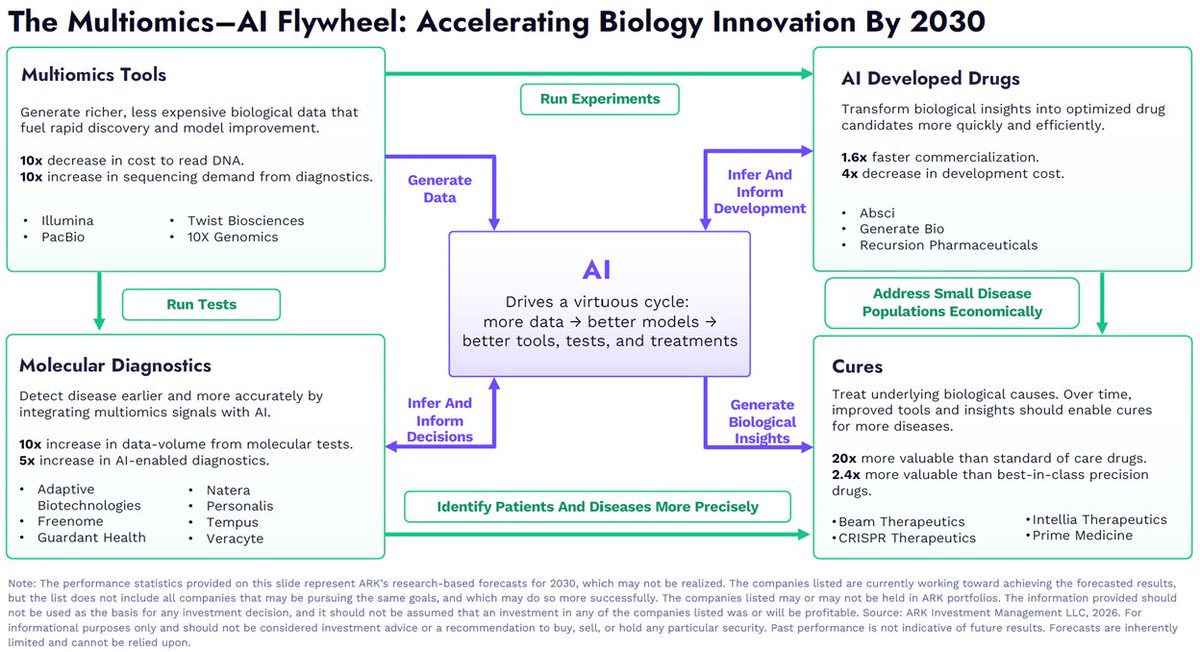
Biology is becoming one of the largest data-generation engines on the planet – and AI is poised to help transform the scale and complexity of this data to reshape healthcare. The multiomics–AI flywheel is real and accelerating.
I wrote a deeper look for @ARKInvest — the companies enabling and benefiting from it, key debates, and what comes next:
@TwistBioscience — making it possible to write and engineer DNA at unprecedented scale and precision
@TempusAI — 50%+ of US oncologists already connected, Tempus is building one of the deepest multimodal clinical-molecular data moats in healthcare
@RecursionPharma — AI-native drug discovery and development platform hitting clinical proof points, including in a disease with zero approved therapies
@CRISPRTx — scaling the first approved CRISPR therapy, now advancing gene editing from rare disease toward common diseases
Read more here! 👇
The convergence of AI and biology is not a future possibility. It's underway. Which companies do we see building the future of healthcare?
Read @Shea_ARK's The Multiomics–AI Flywheel: Why ARK Believes AI And Biology Are Converging To Reshape Healthcare https://t.co/qpmrwNTNch
@bhavik_mscit@ARKInvest Exactly. It's the convergence of these layers that matters. The flywheel isn't about any single data type in isolation, it's about what becomes possible when they're integrated and AI can help extract insights across them at scale.