COMPROMISE!
I pay ₹30,000 a month for a shared 2BHK-and that too in a less affluent, non-upscale neighbourhood.
And that’s excluding the ₹75,000 security deposit and ₹30,000 brokerage fee!
Rents should be regulated!
"We need supervisors, who ask, if you are OK before asking about data.
No paper, degree, fellowship, supervisor, institute or career is worth more than the person pursuing it."
We talk a lot about building better science. We need to talk just as seriously about building kinder places to do it.
No degree, paper, fellowship or career is worth more than the person pursuing it.
https://t.co/0dP5FwYtsQ
The sleepless nights you spent, countless hours of reading and writing, endless revisions, failed attempts, and constant rejections. Overall, the PhD has lows that rearly appear in a thesis.
Well written!
“ I worked through five Durga Puja during my six years of PhD. I worked through Christmas and many other holidays partly because that is simply who I am and also because work and research had become a kind of solace.”
https://t.co/N8ejpZBZvQ
My book SEASONS OF FURY is out today. It's the first narrative nonfiction that captures the rise of Islamophobia in the United States. The book spans seven decades and follows the lives of four families. Thank you to everyone who spoke to me to make this book possible.
I once wrote this short and simplified substack on my Newsletter, covering Carvalho (2013) that appeared in @QJEHarvard, to make the following point:
Any attempts to Ban or regulate Hijaab can turn out to be counterproductive.
Check it here!
https://t.co/VM0n3GqacX
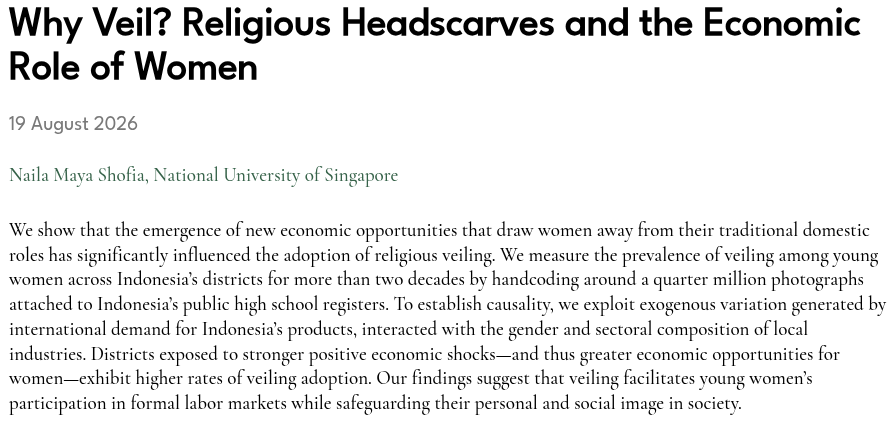
250,000+ hand-coded student photos reveal how religious veiling in Indonesia evolved alongside changing economic opportunities for women and social norms.
New paper by @NailaShofia1
https://t.co/vVk4BzPpM0
#REStud#EconX#EconTwitter
Let me be clear about my own views on Daron Acemoglu and The Economist's recent piece on him.
I've long been critical of Acemoglu's work, especially his work on institutions. After he was awarded the Nobel Prize together with Johnson and Robinson, I published an essay arguing that their work on institutions and development ignores colonial violence and wrongly identifies Western institutions as superior. I'll link the essay in the replies.
Critique comes with the territory of being one of the world's most famous economists. Acemoglu probably knows this and actually engages with his critics, constructively at times, as far as I can tell.
The Economist's piece on Acemoglu is not framed like a serious critique of his work — it's framed like a hit piece, trying to dig up anecdotal evidence for why Acemoglu is "overrated." It's a bizarre, sloppy article, and it's strange that they would publish something like that. Then again, perhaps it's a political move by The Economist given that Acemoglu has become more critical of unregulated capitalism.
And I don't think it's a coincidence that, in his response letter, Acemoglu takes issue with The Economist citing Noah Smith to make their case. While Smith's newsletter is popular, people on this platform who have engaged with Smith know that he directs childish and inane insults at people, and even entire ethnic groups. I've seen Smith refer to pro-Palestine protesters as "Palestine fucks."
So, yes, it's hard to read The Economist's critique of Acemoglu as anything more than a hit piece, and I fully support Acemoglu blasting the magazine for this unserious piece.
Zaira Wasim is strong! She speaks openly from her convictions, without worrying about pleasing everyone.
کہتا ہوں وہی بات سمجھتا ہوں جسے حق
نے آبلۂ مسجد ہوں نہ تہذیب کا فرزند
اپنے بھی خفا مجھ سے ہیں بیگانے بھی نا خوش
میں زہر ہلاہل کو کبھی کہہ نہ سکا قند
@ZairaWasimmm ❤️
Two economists mathematically proved that AI will destroy the economy.
Researchers from Wharton and Boston University published a terryfiying paper called "The AI Layoff Trap."
They mapped out the economic end-game of the AI transition, and it exposes a fatal flaw in competitive capitalism.
When a company replaces a worker with AI, it captures 100% of the wage savings.
But that displaced worker is also a consumer. When they lose their job, they stop buying things.
The company gets all the savings, but the loss of consumer demand is spread across the entire economy.
If there are 20 competitors in a market, a CEO only absorbs 1/20th of the economic damage their layoffs just created.
So every single rational CEO has a mathematical incentive to automate as fast as possible.
They can literally see the cliff approaching, and they still step on the gas.
It triggers an unavoidable Prisoner’s Dilemma. If you don't automate, your competitors will, and they will crush you on price.
It doesn't just hurt workers. It destroys the businesses, too.
The economy gets trapped in an automation arms race. Companies fire their workforce to stay competitive, until the entire consumer base is completely hollowed out.
At the limit, the paper concludes: “Firms automate their way to boundless productivity and zero demand.”
And the scariest part?
The researchers mathematically tested every popular fix.
Universal Basic Income? Fails. It raises the living standard but doesn't change the corporate incentive to cut jobs. Retraining? Fails. Worker equity? Fails.
The paper proves that more competition actually makes the collapse happen faster. And "better" AI makes the damage worse.
The only thing that mathematically stops the collapse is a targeted automation tax, forcing companies to pay for the purchasing power they destroy before they automate the job.
Today I read the new Stanford Encyclopedia entry on Capitalism by @chiaracordelli.
It is, simply put, a bad piece of scholarship.
I will illustrate it with just one passage using one of my most popular posts ever:
“A guide for students of economics: Ten statements that demonstrate that someone does not understand modern economics or what an equilibrium is, and that you can safely ignore everything else they say.”
https://t.co/eDSUoQXtlX
I quote from the entry when it talks about Hayek and Friedman.
“From all these exchanges, an “equilibrium,” perhaps a “general equilibrium,” spontaneously arises in a capitalist economy.”
Compare with my explanation (which builds on the tradition of Hayek and Friedman):
“Equilibrium is not meant to describe the daily state of the world. It is a conceptual device used to understand the outcome of our models under the assumptions we make.”
The entry continues:
“This in turn means that the factors of production that are capital and labor are employed in their most efficient proportions. Also, produced goods and services flow through markets to where, at the margin, they are most valued, making these markets efficient, too.”
Compare with my explanation:
“Equilibrium is often conflated with efficiency, but equilibrium merely reflects decentralized consistency, not welfare maximization. Market power, externalities, incomplete markets, nominal rigidities, and frictions routinely produce inefficient equilibria. I often teach a first-year macro graduate course, and not a single one of the equilibria I define is efficient.”
The article continues:
“Inherently, it has no real crisis tendencies that it cannot self-correct. Capitalism goes wrong when it is politically interfered with”
Compare with my explanation:
“Equilibrium is sometimes misinterpreted as a static state in which nothing evolves. In fact, many equilibria are sequences of probability distributions over states driven by shocks, policy rules, and endogenous responses. Learning dynamics (Bayesian updating, adaptive rules, experience-based expectations) can occur within equilibrium if the evolution of beliefs is self-consistent.”
And finally:
“Capitalism goes wrong when it is politically interfered with”
Compare with my explanation:
“Some interpret equilibrium as a laissez-faire concept. In fact, equilibrium analysis is the foundation of modern policy evaluation. Fiscal, monetary, and regulatory interventions work through equilibrium responses (prices, wages, interest rates, quantities) and must satisfy equilibrium conditions to be credible. Equilibrium is a tool for policy design, not a barrier to it.”
None of this is deep. I knew it as an undergraduate student in college. Hayek and Friedman were subtle economists who, yes, defended market economies but who understood economics much better than the author of the entry.
I recently argued that institutions waste their credibility by engaging in political activism instead of scholarship. How can I trust now the Stanford Encyclopedia of Philosophy’s entry on Hegel, for example, if the entry on Capitalism would fail my undergraduate course at Penn?
This is awesome and incredibly Innovative.
We need more of this LLM - advisor versions of many more influential people across different domains of Economics.
This whatever miss!
is telling us to forget everything of what we have historically endured. The audacity of framing it as merely diaspora advocacy is humanly unthinkable.
What is statistics in her definition?
Foreign news outlets rely heavily on diaspora advocacy organisations for quotations, statistics, and framing and many of the most well-known of these organisations were either founded by or formed their institutional memory around them.
I write for @ThePrintIndia