I help Web3 Founders + DeFi projects convert users & investors using the conversion loop strategy ♻ 5+ founders served at Conversion Clinic | member @Shefiorg
I paid a $30 gas fee for a $10 transaction on Ethereum.
Picture the gas fee for a $100 transaction, Too expensive right?
Ethereum has existed for over 7yrs but yet still suffer:
Network congestion
High gas fees
Slow execution
Nothing big changed till @0xPolygon stepped in
🧵
Elon Musk thinks coding dies this year.
Not evolves. Dies.
By December, AI won’t need programming languages. It generates machine code directly. Binary optimized beyond anything human logic could produce. No translation. No compilation. Just pure execution.
Musk: “You don’t even bother doing coding.”
Code was never the point. It was friction. A tax we paid because machines didn’t speak human. AI just learned fluent human. The tax is gone.
Now plug that into Neuralink. No syntax. No keyboard. No screen.
Musk: “Imagination-to-software.”
Thought becomes executable. You imagine an outcome, the system architects and compiles it into reality instantly.
We’re not automating programming. We’re erasing it from existence.
The entire profession collapses into a thought. Decades of training reduced to irrelevance. The gap between idea and instantiation hits zero.
You don’t build anymore. You imagine, and it materializes.
Not incremental progress. Total phase shift. The way humans have created things for ten thousand years just became obsolete.
Welcome to a world where the limiting factor isn’t skill, resources, or time. It’s whether you can picture what you want clearly enough for a machine to birth it into existence.
OpenAI is finally shipping ads. If Ads work as planned, then OpenAI will officially become a $1T company + would have a lot of cash flow to compete with Google to build AGI.
My 2025 Year in Review - and My Predictions for 2026
What a crazy year! Not only a technical explosion of breakthroughs, but also personally.
First, the personal side: I never would have imagined that I would turn my hobby into my profession. I started on X in 2024 and created an anonymous profile (which has remained largely unchanged to this day) to connect with like-minded people interested in AI. I wanted to hear what others thought, exchange opinions and arguments with them, and become part of the AI community. And somehow, strangely enough, some people also found what I had to say interesting, so that today, on December 31, 2025, I have almost 100,000 followers. Completely unbelievable, totally surreal.
And when I became co-founder of Superintelligence in the middle of the year and now have the privilege of writing a daily newsletter with over 230,000 subscribers as editor-in-chief, a dream came true. In addition, a third person joined our household, and we now have a baby who is just a few months old. I don't share much of my private life, but I wanted to say this to make it clear: 2025 is the best year of my life, and that's how I will remember it. I am filled with deep gratitude and humility and simply want to say "thank you."
-----
On the technical side, many of the predictions have come true. I don't want to go into too much detail; I've already posted a complete overview of the breakthroughs. Suffice it to say:
- Dario Amodei was ridiculed in September for predicting at the beginning of 2025 that by the end of 2025, 90% of our code would be written by AI (or rather, Claude). Today, at the end of the year and after the release of Opus 4.5, which not only became significantly cheaper but also demonstrated a significant leap in capabilities, it's safe to say: Dario Amodei was right. Increasingly, we're seeing posts from Anthropic researchers saying they're now having Claude write 100% of their code. And even the legendary Andrej Karpathy recently spoke about the significance of Opus 4.5 and how everything will likely change soon. In short: Humans are bad at grasping exponential growth. Dario Amodei is one of the most distinguished and, without hype, highly respected CEOs of a major AI company. He's not only usually right, but what he says carries weight and isn't just hype. And when Dario says that we'll see the first superintelligence in 2026 and its first major impact on the job market (read his blog!), we should take that seriously.
- The real winner this year was Google. I think we all know why. From AI laughingstock to absolute leader within 12 months. Together with OpenAI, they won gold medals in the Informatics and Mathematics Olympiads—a first for AI, something no other AI had ever achieved before and something that was thought to take much longer. Furthermore, Google's early investments and development of its TPUs are paying off. Gemini 3.0 Pro was a huge success, as was Nano Banana (Pro). In 2025, Google showed everyone why they are the true market leader: broadly positioned, with solid cash flow and an outstanding think tank headed by the legendary Demis Hassabis.
- OpenAI initially disappointed the community with GPT-5, but has since developed an outstanding model with GPT-5.2 pro / codex, which is currently tied for first place with Gemini. Depending on the use case and personal preference, sometimes Gemini and sometimes ChatGPT are slightly better. For everyday users, however, it is completely irrelevant which model they use.
- China has caught up and overtaken the US in robotics. Yes, you read that right. As CNBC reported today, China has not only produced more robots and is pursuing mass production more aggressively than the US, but is also investing significantly more in robotics R&D. However, the US has greater financial resources to keep up the race, but let's wait and see. In any case, it is particularly surprising that despite all the embargoes and restrictions, China has risen to become the undisputed king of open source. No longer a nine-month gap to closed-source technology, but right on its heels. At the beginning of 2025, with DeepSeek r1, and at the end of 2025 with Kimi k2, Qwen 3, Minimax M2.1, and so many more, the entire market was transformed. Although China still hasn't established a comparable chip production line to TSMC in Taiwan, there are increasing reports that they were able to smuggle ASML lithography machines into the country and are now developing comparable machines; the Huawei Ascend series supports this.
In short: 2025 has become the year of AI agents; numerous new application possibilities, new capabilities (deep research, tool calling, etc.), and a longer time horizon have not only strengthened confidence in LLMs but have also transformed them into real-world applications; hallucination rates have dropped significantly, so AI is now finding truly practical applications in the business sector. 2025 is the year when AI has matured from a niche gimmick to a true technological reality.
---
Now for the 2026 predictions:
- Benchmarks will become largely irrelevant, with a few exceptions like ARC-AGI, FrontierMath, and RLI, which truly demonstrate how well AIs perform in these specific, real-world tasks. MMLU, GPQA, and many others will be irrelevant for everyday users once they reach 95% or 97% market saturation. The focus will increasingly shift to real-world use cases. And as LLMs become more similar in quality, the question will increasingly revolve around who has better distribution (market access), effective marketing, and endows their LLMs with desirable characteristics.
- Training and inference cost money. Capital expenditures that were previously unthinkable. Companies like OpenAI, Anthropic, and SpaceX will need fresh capital. They will launch IPOs. My thesis: Anthropic is better positioned, especially in the B2B sector, so Anthropic's IPO will likely be more successful than OpenAI's, which is currently particularly strong in the B2C sector. However, by 2026, the focus will also be on developing new revenue streams, and the first companies will start running ads in their chatbots (OpenAI being the first?).
- AI will be integrated wherever possible, increasingly running on-the-edge through SLMs. Refrigerators, robot vacuums, smoke detectors—everything will have some kind of "AI" function. Even if much of it is just marketing, we will see ways in which "AI" makes *all* products smarter.
- AI agents, including voice agents, will find widespread application and increasingly replace humans, for example, in call centers. AI agents will become the rule rather than the exception. Overall, "AI" will be increasingly integrated into all work processes. Small and medium-sized enterprises (SMEs) in particular are sitting on a vast treasure trove of data. This will be used in 2026, and we will see breakthroughs in the real-world application of AI models in industry.
- Google will further consolidate its dominance. Not only because they caught up in 2025, but because they are so broadly positioned and diversified that it is difficult to overtake Google.
- Research and development of pharmaceuticals will accelerate dramatically. We will see significantly faster and more frequent human trials of new drugs because AI models will be so involved in (or even semi-autonomous in) drug research and development that increasingly better-tuned and theoretically pre-engineered medications will be developed.
- Robots will go into mass production and be increasingly used in industry. 2026 will be the year of robotics. We will see more and more robots on production lines, partly because demographic change is increasingly causing problems, making it difficult to recruit skilled human workers. We will see significant new breakthroughs in robotics, but especially in value creation. Robotics will move from the research and experimentation phase to production in 2026. From next year onward, robotics will be indispensable. And we will likely see increasing numbers of robots in the healthcare sector, such as in nursing care.
One could go into more detail, but in summary: AI is truly changing the world now; it will become an integral part of the workplace, as will robotics, which is now transitioning from the experimental phase to actual production (consider Figure 02 at the car manufacturer BMW). Everything will be permeated by AI, and research will accelerate rapidly. I also think we will see the first disruptions in the job market.
It remains exciting. It will continue to be immensely important that the AI community has a strong voice and acts as a critical body, closely monitoring developments and intervening to correct misuse. The AI community is essentially the journalism of the 21st century, critically questioning and monitoring these developments. Especially since AI has been declared a national security concern, it remains crucial to pay close attention.
2026 will be exciting. Because AI will finally enter the real world. Everything will change. Nothing will remain the same.
@darasoba Hi Mr Dara @darasoba
I sent you a DM here on X
The content of the message is quite valuable, and I'm sure you won't regret checking it out.
Looking forward to hear from you soon.
In Romans 2, God judges according to the light received. Those without the Law are judged without it, yet conscience still bears witness.
Judgment is just, proportionate, and truthful.
None of this creates an alternative path to salvation because justification is only through Christ.
Nevertheless, the gospel must be preached everywhere (Rom 10:13–17).
𝘼 𝙥𝙧𝙤𝙟𝙚𝙘𝙩 𝙧𝙚𝙬𝙖𝙧𝙙𝙞𝙣𝙜 𝙮𝙤𝙪 𝙬𝙞𝙩𝙝 1M 𝙤𝙛 𝙞𝙩 𝙩𝙤𝙠𝙚𝙣𝙨 𝙟𝙪𝙨𝙩 𝙡𝙖𝙣𝙙𝙚𝙙 𝙤𝙣 𝙩𝙝𝙚 𝘽𝙎𝘾 𝙣𝙚𝙩𝙬𝙤𝙧𝙠
Not just that
It rewards holders for every
trade
&
transaction
eliminating the use of human for it's marketing using Ai agents.
Open 🧵
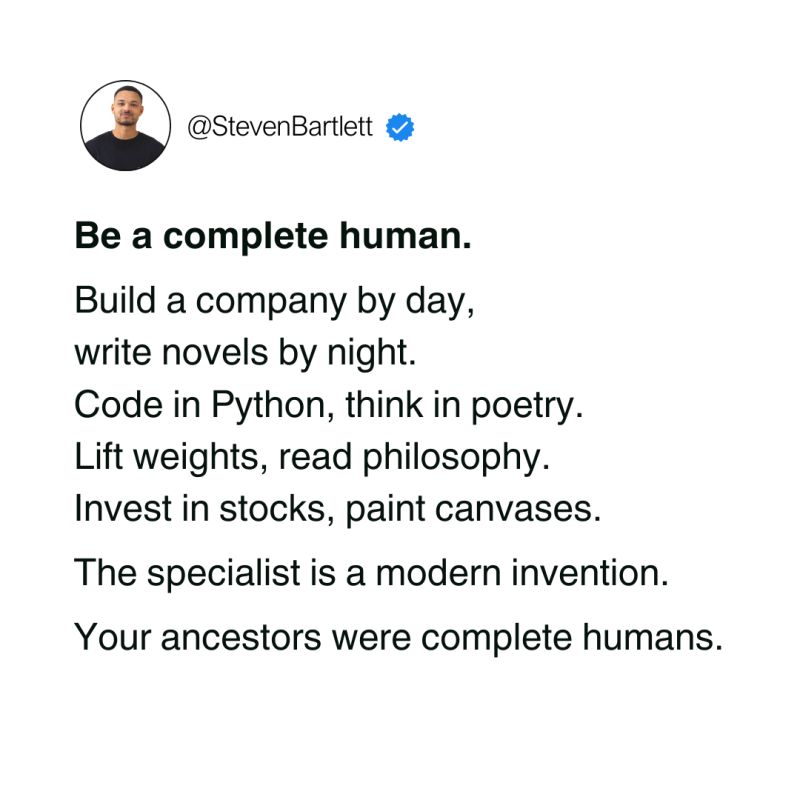
if you want to survive AI, now is the time to fight as hard as you possibly can to be a COMPLETE human... the specialist won't survive 👇🏾
Your grandfather could probably build a house, fix an engine, grow food, play piano, speak french, and tell you which way was north without checking a phone.
He had skills across the spectrum of survival and craft.
Slowly we told everyone to pick one thing and get really good at it.
At 16 I was told to pick a career for the rest of my life...
But in a world of AI, and incoming super-intelligence, this has never, ever, been worse advice.
The specialist programmer? ChatGPT codes faster. The specialist writer? Claude writes cleaner. The specialist designer? Midjourney does it faster.
The inconvenient truth is that the specialist won't survive.
The people I am now hiring into my companies and what I want my future kids to be, are COMPLETE HUMANS.
The complete human is the one who builds AND creates AND thinks AND feels across disciplines - that's the person that becomes more interesting, more rare and more valuable, as machines become more specialised.
It's hard for machines to automate the weird intersection of human experiences that makes someone decide to explain a marketing campaign through jazz metaphors, design a product inspired by stoic philosophy.
Your ancestors weren't specialists because they couldn't afford to be.
We can't afford to be specialists because the machines are going to win that game.
Fight as hard as you can, to remain a complete human!
Fight the voice in your head that says successful people don't waste time painting, or dancing, or learning languages they'll never monetise.
That voice is lying. The most interesting founders I know are part-time sommeliers, weekend pilots, terrible poets, decent drummers.
They bring their whole weird, complete humanity to everything they touch. And that's exactly what makes them irreplaceably human 👊🏾❤️
Interested to hear about some of the weird things my community on here does to remain a complete human!
Anyone wanna share?
This is Naval Ravikant.
• Worth $600 million
• Early investor in Uber & Twitter & Bitcoin
• Destroyed Hustle & Woke Culture
• Calls himself "lazy"
He once said: "You will never get rich renting out your time."
His philosophy on getting rich (without getting lucky):🧵