Maths problem ; It treats subtraction as though it were averaging.
The atmosphere gains carbon from sources and loses carbon to sinks. The isotope signature of that net difference need not lie between the source signatures. The proof wrongly imposes those limits, then uses them to exclude fossil-fuel dominance.
It also makes two further errors:
It overlooks a sign case: in its fraction, both numerator and denominator can be negative, giving a positive result outside its claimed bounds.
It assumes constancy means absence: an unchanged combined isotope signature does not prove that fossil input is zero.
The equations can express a balance; the restrictions and conclusions imposed on that balance do not follow.
2 pdfs are available
Refutation of the near zero fossil carbon claim
Why the proposed isotope proof does not establish its conclusion
Public report and technical audit • Version 1.0 • 12 September 2026
Prepared with AI assistance for Walter Shepherd
Also a pdf
Fossil carbon claim explained
Public FAQ on the proposed mathematical refutation of human CO2 attribution
Companion to the refutation report • Version 1.0 • 12 September 2026
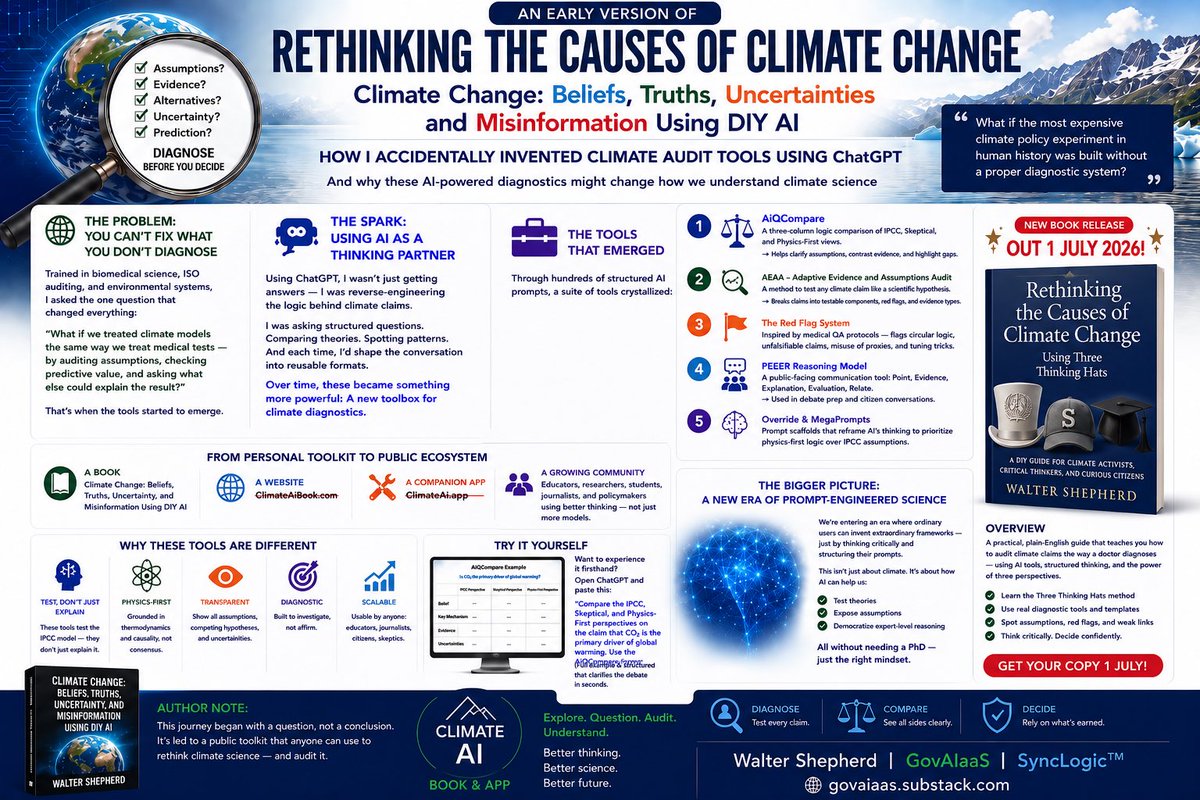
An Early Version of Rethinking the Causes of Climate Change
Using ChatGPT, I was reverse-engineering the logic behind climate claims.
https://t.co/XRXrJlATii
Beyond Prompting. Beyond Loops. Why SyncLogic Starts Where Most AI Frameworks Stop. Infographic explaining the evolution of AI reasoning from prompts to governed decision-making. It contrasts prompt-based AI with feedback loops, showing that loops improve consistency but do not necessarily improve truth. A five-stage progression illustrates: Prompts (generation), Loops (precision), Evidence (accuracy), Governance (decision weight), and Reliance Classes (permission to rely). Additional panels explain the difference between precision and accuracy using a diagnostic measurement example, the need for external reference standards such as experiments and evidence registration, why accurate claims may still be insufficient for high-consequence decisions, and how Reliance Classes determine whether a conclusion has earned the right to support clinical, regulatory, scientific, investment, or public policy decisions. The infographic concludes that the challenge is no longer generating answers but determining which AI-generated answers have earned the right to be relied upon. The footer promotes Walter Shepherd’s book Rethinking AI Reasoning: From Prompting to Governed Thinking and links to https://t.co/kTuAzj6c8F.
This infographic explains the difference between precision and accuracy in AI systems. It shows how feedback loops can optimize for consistency, confidence, and engagement without improving truth, and why external evidence, governance, and Reliance Classes are needed to determine whether an AI-generated conclusion has earned the right to support real-world decisions.
Beyond Consensus: Why the Federal Judicial Center's Science Manual Needs a Judicial Reliability Protocol
A SyncLogic Governance Audit of the Federal Judicial Center's Reference Manual on Scientific Evidence and Climate Science
https://t.co/wcKUhsCwAb
The Day AI Stopped Being a Chatbot and Became a Workflow Reasoning Partner
A practical publishing problem showed me why governed AI matters
Articles at https://t.co/uxy12LbNO4
https://t.co/WczAqOCAY2
This is a review of preliminary correlational evidence? suggesting that indoor CO₂ levels (currently achievable in poorly ventilated spaces, and potentially outdoor urban levels by 2100) might have direct health effects at concentrations starting around 1,000 ppm.
No causation established - just associations that the authors think about. No mechanism. Nature should be ashamed of the publication!!
IPCC Rebuttal Memorandum
Subject: Clarification on Detection, Attribution, and Time of Emergence in relation to DOE-CWG Report and recent critiques
Background
Recent commentary (Dessler, 2025) has alleged that the DOE Climate Working Group (DOE-CWG) Report misinterpreted IPCC AR6 findings by confusing detection and attribution (Ch. 11) with time of emergence (Ch. 12). This memorandum clarifies the IPCC’s use of these terms and highlights where the DOE-CWG summary language aligns with AR6 confidence assessments.
1. Definitions
* Detection: Identification of a significant change in a climate variable relative to a baseline.
* Attribution: Assessment of the causes of a detected change, including contributions from anthropogenic and natural factors.
* Time of Emergence (ToE): The point at which a forced climate signal becomes statistically distinct from natural variability.
Note: The definition of ToE as “the point where the average exceeds the historical maximum,” used in some recent critiques, does not appear in IPCC guidance documents and should not be considered authoritative.
2. Current Confidence Levels (AR6 WG1)
* Heat extremes: Detected, attributed to anthropogenic influence, and already emerged above natural variability in most land regions (high confidence).
* Heavy precipitation: Detected and attributed in some regions (medium–high confidence); emergence generally limited or expected mid-century in many regions (medium confidence).
* Drought and aridity: Attribution evidence exists in some regions (medium confidence); limited evidence of emergence above variability (low confidence).
* Tropical cyclones, severe storms, winds: Detection and attribution evidence remains low or insufficient (low confidence).
3. On DOE-CWG Statement
The DOE-CWG Report phrased its finding as:
“It is not currently possible to attribute changes in most extreme weather types to human influences.”
While this phrasing can be clarified, it reflects the following IPCC-consistent point: outside of heat extremes, robust detection and attribution with high confidence has not yet been established for most extreme weather types.
4. On Dessler (2025) Critique
* The critique conflates ToE with a subjective definition of “experienced climate change,” rather than the statistical signal-to-noise concept used in AR6.
* It downplays AR6’s explicit low-confidence language for many extremes (e.g., floods, tropical cyclones, tornadoes, severe winds).
* It suggests broad attribution certainty that exceeds IPCC consensus statements.
5. Recommended Clarification
A more precise phrasing—fully aligned with AR6—would be:
“It is not currently possible to detect or attribute, with high confidence, changes in most extreme weather types to anthropogenic influence.”
This wording mirrors IPCC’s calibrated language and avoids over-interpretation.
Conclusion
The DOE-CWG Report’s cautious stance is consistent with AR6’s confidence assessments. Critiques that suggest otherwise rely on non-IPCC definitions and conflate distinct lines of evidence. For clarity in future assessments, care should be taken to distinguish:
1. Detection (is there a signal?),
2. Attribution (what is its cause?), and
3. Emergence (is the signal outside natural variability?).
✅ IPCC Standing Language: “High confidence for heat extremes; medium for heavy precipitation in some regions; low or insufficient confidence for many other extremes. Thus, broad statements of attribution for all extremes are not supported by AR6.”
An hypothesis needs to go thru many steps before its policy … step
1 causal not correlation and the evidence needs to be predictive and have a > 90% positive prediction evidence trail/
step 2 needs a clear falsification statement where it - could be but isn’t moment …
If Trump have had said why it’s a scam and ipcc science is still at the bottom of the hypothesis to policy ladder … well the speech could have been better🧐
Isotopic ratios like δ¹³C and ¹⁴C can suggest a source — but only if that signal is unique, and if no other processes mimic it. In reality, other carbon pools (like warming soils, microbial respiration, upwelling ocean carbon, and volcanic degassing) can all produce similar isotopic signatures. The Suess Effect isn’t a fingerprint. It’s a correlation — and correlations aren’t causes unless they exclude all competing hypotheses.
Become a scientist
Ask:
“What else could lower δ¹³C and ¹⁴C in the atmosphere?”
If the answer is “nothing”, the claim is unfalsifiable.
If the answer is “other things, but less likely”, then attribution is not proven, only hypothesized — and needs comparative audit.
Imagine someone says:
“The water going into steam and the steam condensing is balanced, so nothing’s changing.”
But the stove is still on.
The system is still working.
Entropy is still increasing.
Equilibrium assumptions break down when a system is doing work — and the Earth is always doing work.
Totally fair to ask that.
But here’s why this paper matters 👇
Isotopes don’t lie.
The study doesn’t just look at the amount of CO₂ — it looks at the isotopic signature (δ¹³C) of CO₂ in the air. If human emissions were the dominant source, we’d expect a noticeable fingerprint. But the data shows no shift in over 40 years.
Biosphere matters more than we thought.
What the paper finds is that natural processes — especially the biosphere — are absorbing and cycling carbon at a scale that swamps human emissions. That doesn’t mean emissions don’t matter — it means the system response is more powerful than the narrative suggests.
Not about “the last Ice Age” — it’s about whether recent changes are unusual.
If you’re making billion-dollar policies based on the idea that “this time is different,” you better prove it. The isotopic record suggests it’s not.
Bias cuts both ways.
If we dismiss any study that challenges the consensus as “biased,” then science becomes politics. This paper doesn’t claim to have all the answers. It just says the fossil fuel signature is missing — and that’s worth testing, not dismissing.
Excellent paper
IPCC models argue that the decline in δ¹³C proves fossil fuels are the dominant cause of rising CO₂. But this study finds:
•No clear fingerprint of increasing human emissions.
•δ¹³C is stable, not declining in a pattern consistent with fossil fuel signal accumulation.
•Other natural processes (e.g. warming-induced CO₂ outgassing, biosphere dynamics) better match the signature.
@pors@Kenneth72712993 Pors you are a pee brain and agenda driven and don’t know it … go and compare Koutsoyiannis & Tsakalias (2025) vs. IPCC AR6 to get your balanced view ..
@newscomauHQ Wrong
The image depicts a sunset at Bondi Beach in Sydney, Australia, with people enjoying the beach and water as the sun casts long shadows and a golden glow.
TMPRSS2 plays different roles in different contexts. In viral infections (like COVID-19), it helps viruses enter cells. In prostate cancer, it contributes to cancer development through entirely different molecular mechanisms involving gene fusions. These are separate biological processes, not a single mechanism where spike proteins accelerate cancer growth.
The statement appears to conflate TMPRSS2’s role in viral entry with its role in cancer biology in a way that doesn’t accurately represent either process.
Hey Ned — in my forthcoming book, Rethinking the Causes of Climate Change, I walk you through what few people understand: not just the science behind CO₂ and climate, but how to use AI to reason about it properly.
You’ll learn how to get AI models out of their default “consensus” mode and into a diagnostic mindset — where they test assumptions, apply reasoning modes, and challenge what they’ve been trained to mimic.
Not all AIs are equal. Some parrot headlines. Others (with the right prompts) can surprise you with what they uncover about the carbon cycle, the greenhouse effect, and the deeper logic of IPCC models. This book shows you how to spot the difference — and use it to think with yourself.
Thermodynamic Analogy (for Physics-First framing)
Think of the body as a system with limited energy states for infection. Once SARS-CoV-2 occupies that energy channel (with higher binding affinity, stronger immune activation), it’s harder for influenza to also activate — much like saturation or exclusion in physics.
Real-World Biology: What’s Actually Happening?
1.Interferon Response:
•When a virus like SARS-CoV-2 infects the body, it triggers innate immunity.
•This includes interferons that “warn” surrounding cells and make them harder for any virus to infect.
•Flu viruses entering later face a pre-warned immune system and are more likely to be blocked.
2.Receptor Competition:
•Viruses bind to specific receptors on human cells.
•If SARS-CoV-2 binds stronger and faster, it outcompetes other viruses like influenza for entry.
3.Immune Resources Are Limited:
•The immune system prioritizes response to the first major threat.
•Later infections might be suppressed, delayed, or go unnoticed.
⸻
🔄 Visual Analogy: A Hotel with Limited Rooms
Imagine your body is a hotel:
•COVID-19 is a VIP guest with a reservation (high binding affinity).
•It checks in and books most of the rooms (infects host cells).
•When influenza shows up, there are no available rooms — or the hotel manager (immune system) has already locked the place down (interferons).
⸻
🔍 Diagnostic Takeaway
So when people ask “Why didn’t we see both COVID and flu circulating at the same time?” — the answer isn’t just public health measures or testing bias. It’s also bioenergetic and immunological crowding:
•SARS-CoV-2 took up the body’s limited infectious “real estate”
•It activated defenses that made it harder for other viruses to get in
•In physics terms: the system reached a saturated state, reducing the degrees of freedom for competing infections