Pakistan finds itself in a diplomatic sweet spot, wooed by US President Donald Trump, China and the Middle East, despite New Delhi's efforts. Analysts say the Indian government's missteps are partly to blame. https://t.co/8ZAjO1ZfoC
Today, three of the world’s most credible institutions spoke.
World Bank. IEA. S&P Global.
All three said the same thing.
Here’s what they said — and what it means. 👇
Let me piece together key developments of the past few hours to understand where things stand.
If all went as per plan, the US & Iranian negotiators would have been in a huddle today (Wednesday), seeking to thrash out a potential deal.
Pakistan was confident as it had done a lot of spadework through backchannels since the first round ended without a breakthrough.
Where did things go wrong?
Until yesterday afternoon, the plan was already finalized. Steve Witkoff & Jared Kushner were set to fly first from Miami. Vice President JD Vance's plane was ready to take off.
The press corps accompanying Vance were instructed to be ready for departure around 9:00 am Washington time (6:00 pm PST).
Not that the plan was final but multiple sources said security assets & details put on the ground in Islamanad were typical accompanying the US President's movement. That meant the US was ready if Trump decided to fly in.
But then things began to fray. The US side, which shared some new proposals via Pakistan with Iran, wanted a clear response from Tehran before Vance left for Islamabad.
The US wanted the second round to show some headway, if not reach a final settlement.
Initially, Iran was inclined to give consent. That was the reason Pakistan had put in place all the security arrangements. The US advance teams had landed.
But as the stage was set for talks, Iran, first through state media, and then officially, started backtracking.
One assessment is that the hardliners within the setup were not happy with the potential deal. They saw it as a document of surrender.
The Iranian precondition for a US naval blockade was not the real sticking point. What I have been hearing is that the US was willing to lift the blockade during talks as a confidence-building measure.
Now, what happens next?
The extension in the ceasefire is a relief, and at least there won't be an immediate escalation.
Messages have still been exchanged. Efforts are on to salvage the last-minute deal.
The problem, however, is the slow communication channels between the Iran Supreme Leader and the negotiating team.
It is said the Iran Supreme Leader's only contact person is Ghalibaf, and messages have been exchanged through couriers. Hence, there is no immediate response from Tehran to the ceasefire extension.
It is not over until it is over!
Side note: Some of the people I saw on my timeline trying to provoke me, let me tell them I am not supposed to say what and when. I am not in the business of minute-by-minute updates or relying on tickers. I work at my own pace.
Pakistan is making last-ditch diplomatic efforts to salvage US–Iran talks, with officials from both civilian and military leadership engaging all sides and urging them to uphold a fragile truce agreed two weeks ago.
Al Jazeera’s @osamabinjavaid and @KimberlyHalkett
reports.
Retired US Army General Mark Kimmitt tells Al Jazeera that an extension of the ceasefire between the US and Iran is expected, as both sides seek to avoid war, but warns that real progress is limited, saying talks could lead to a prolonged “frozen conflict”.
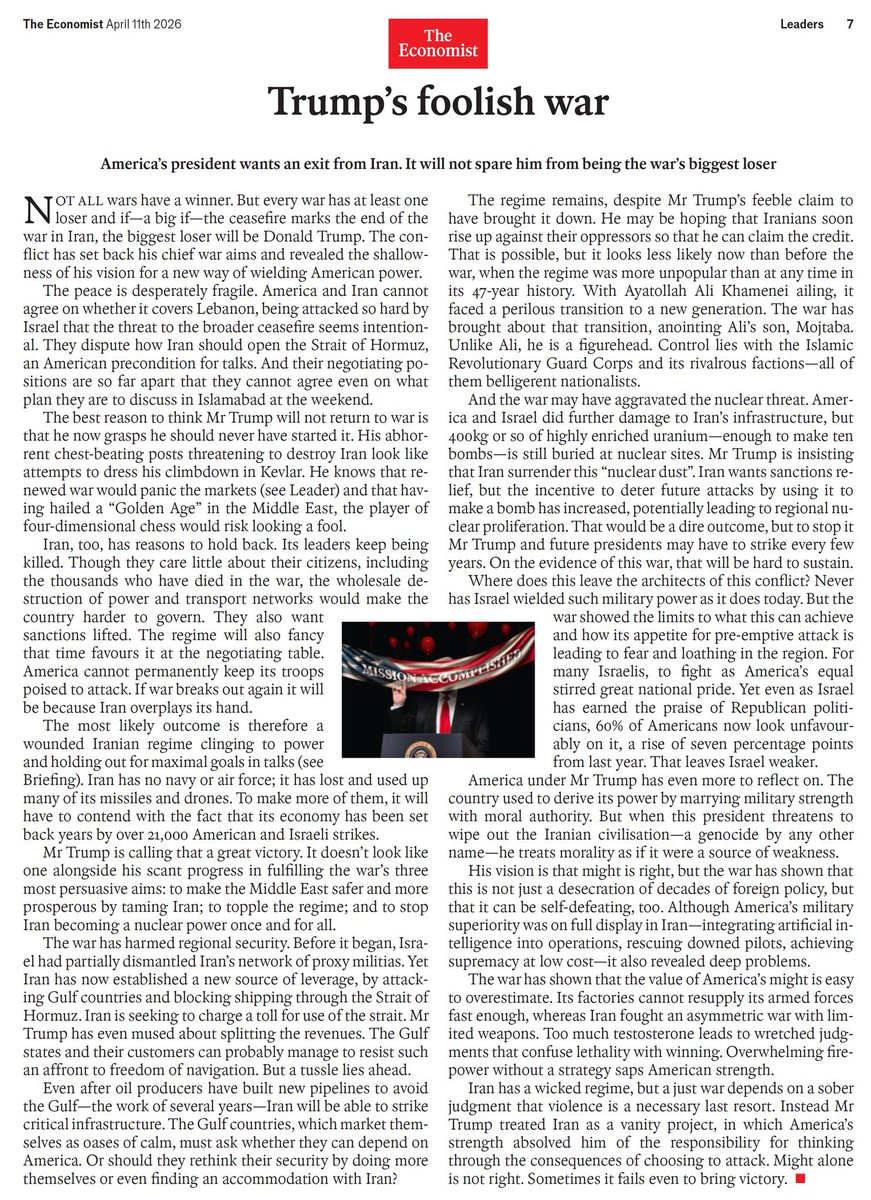
The Economist (April 11):
-Even if the war ends, it weakens rather than strengthens the US.
-Core disputes remain unresolved, making any ceasefire fragile.
-Iran’s regime survives, adapts, and retains leverage.
-The nuclear risk has likely increased, not decreased.
-Military power has limits; force without strategy does not deliver durable outcomes.
@nadeemhaque@Benazir_Shah This country is for elities, by the elities and of the elities. Common people are treated as third grade citizens with no rights and access to justice. If you or your family don't belong to judiciary, burecracy, armed forces, powerful politicians, then your life is hell.
We are told that security in the Middle East requires defeating Iran, security in East Asia requires defeating China, and security in Europe requires defeating Russia. We never discuss security in terms of how to learn to live together by harmonising interests and managing competition. This is by design. This is hegemonic peace, in which security depends on defeating rivals rather than managing a balance of power.
Subsequently, security relies solely on deterrence rather than reassurance; diplomacy is dismissed as appeasement; peace agreements are temporary and deceptive; and war is peace. Our rivals do not have legitimate security concerns, as their policies are allegedly always motivated by aggressive, irrational, or expansionist behaviour.
We have convinced ourselves that our liberal hegemony is a force for good, and that our opponents oppose our dominance because they reject our benign values of freedom. Discussing the security concerns of adversaries is believed to “legitimise” their policies, which is treasonous. The world is divided into good guys (liberal democracies) and bad guys (autocracies). We should not ask how defeating Russia, as the world's largest nuclear power, is a rational security strategy, or why our governments refuse to even speak with Moscow to discuss the European security architecture and end the war. Our governments have relabelled nuclear deterrence as nuclear blackmail to signal that there can be no more constraints.
All empires can become irrational during decline. Leaders take greater risks to avoid decline, legitimacy crises at home must be distracted with enemies abroad, outdated strategies from a bygone era of strength are still embraced, and there is a tendency to double down on narratives of being indispensable, representing universal values, and dismissing all opposition as illegitimate and dangerous. Are we the fanatics?
"What drives Pakistani hospitality is not generosity in the Western sense. It is honour. Hosting someone, even a stranger, even with a cup of tea you cannot really afford, is an act of personal dignity. The host is not doing you a favour. They are doing something for themselves: fulfilling a code that says a guest in your presence is your responsibility, your privilege, and your reputation. "
في كواليس المفاوضات التي احتضنتها باكستان، لم يكن المشهد عادياً. على مدار 21 ساعة متواصلة، عاد الوفد الأمريكي إلى Donald Trump ست مرات لطلب التوجيه، في إشارة واضحة إلى حساسية اللحظة وثقل القرارات المطروحة. لم تكن هذه مجرد جلسات تفاوض، بل اختبار حقيقي لإرادة الطرفين في الانتقال من حافة التصعيد إلى أفق التسوية
في المقابل، حضرت إيران إلى الطاولة بعقلية مختلفة تماماً. فهي ترى أن الزمن يعمل لصالحها، وأن قدرتها على تهديد ممرات استراتيجية مثل مضيق هرمز تمنحها ورقة ضغط لا يمكن تجاهلها. بالنسبة لها، العالم لا يستطيع تحمل إغلاق هذا الشريان الحيوي لفترة طويلة، وهذا ما يفسر تمسكها بشروطها دون تنازلات كبيرة، حتى وإن كان الثمن داخلياً باهظاً
أما الولايات المتحدة، فرغم تفوقها العسكري الساحق، إلا أنها تقف أمام معادلة أكثر تعقيداً. فالحروب في هذا العصر لا تُقاس فقط بالقوة، بل بتكلفتها السياسية والاقتصادية. وواشنطن تدرك أن أي انخراط طويل قد ينعكس داخلياً، خاصة في ظل حسابات الرأي العام والضغوط الاقتصادية
وهنا تتشكل المفارقة:
طرف يملك الوقت لكنه لا يكترث بالخسائر الداخلية، وطرف يملك القوة لكنه لا يملك رفاهية الوقت
لهذا، يبدو أن الحسم العسكري ليس خياراً واقعياً لأي من الطرفين. فالحرب، إن استمرت، ستتحول إلى استنزاف مفتوح، بينما الحل الحقيقي يظل رهين طاولة المفاوضات، مهما طال الطريق إليها
ويبقى السؤال المعلّق:
هل يتم تمديد وقف إطلاق النار لإعطاء الدبلوماسية فرصة أخيرة ؟
أم أن جولة جديدة من التصعيد ستندلع، قبل أن يُدرك الطرفان مجدداً أن لا مفر من العودة إلى الحوار ؟
في مثل هذه الأزمات، التاريخ يخبرنا أن السلام لا يأتي دفعة واحدة بل يولد غالباً بين جولات من التوتر، حتى يصل الجميع إلى قناعة واحدة: لا غالب في الحروب الممتدة، ولا بديل عن التفاهم
Signs of the end times
Sahih Bukhari 7121
Sahih Bukhari 1036
Sahih Bukhari 5590
Musnad ahmad 10191
Ibn Majah 2271
Abu Dawood 4057
Tirmidhi 2260
Sahih muslim 2673a