Writing is the smallest part of writing an ad.
The actual writing gets maybe a fifth of my time.
Everything before it, the research and the angle hunting, gets the rest.
When an ad is weak, the words are rarely the problem. The idea underneath them ran out first.
Bad copy is usually bad homework
Once is a data point.
Twice is a pattern.
Three times and it should already be a system.
That's my whole rule for what to keep.
A hook wins once, I note it.
The same shape wins again, it becomes a rule.
A third time, it becomes a play I can run on demand.
Most marketers keep everything or keep nothing.
Both fail the same way: nothing compounds.
I never write from a blank page.
Every ad I write starts with an ad that already won.
I keep a bank of them, sorted by mechanism, and I steal the skeleton, not the words.
New writers chase originality.
The scroll doesn't reward original.
It rewards a familiar shape carrying something new.
Pattern recognition pays better than inspiration.
The most valuable file in my workspace is a list of my mistakes.
Every time a client corrects me, the correction becomes a rule.
Not the fixed output. The rule underneath it.
Anyone can collect wins.
A win tells you what worked once.
A correction tells you where your instincts are off, and instincts are what you write with.
The rules I got wrong first are the ones I trust.
The French perspire. The Germans sweat.
If your ad says "excessive perspiration," you already lost.
The reader feels nothing.
Say "too much sweat" and they can smell it.
Latin words explain.
Germanic words hit.
Fabric is cloth. Severe is bad. Insomnia is sleeplessness.
Copy that converts is written in the words people think in.
Nobody thinks in Latin.
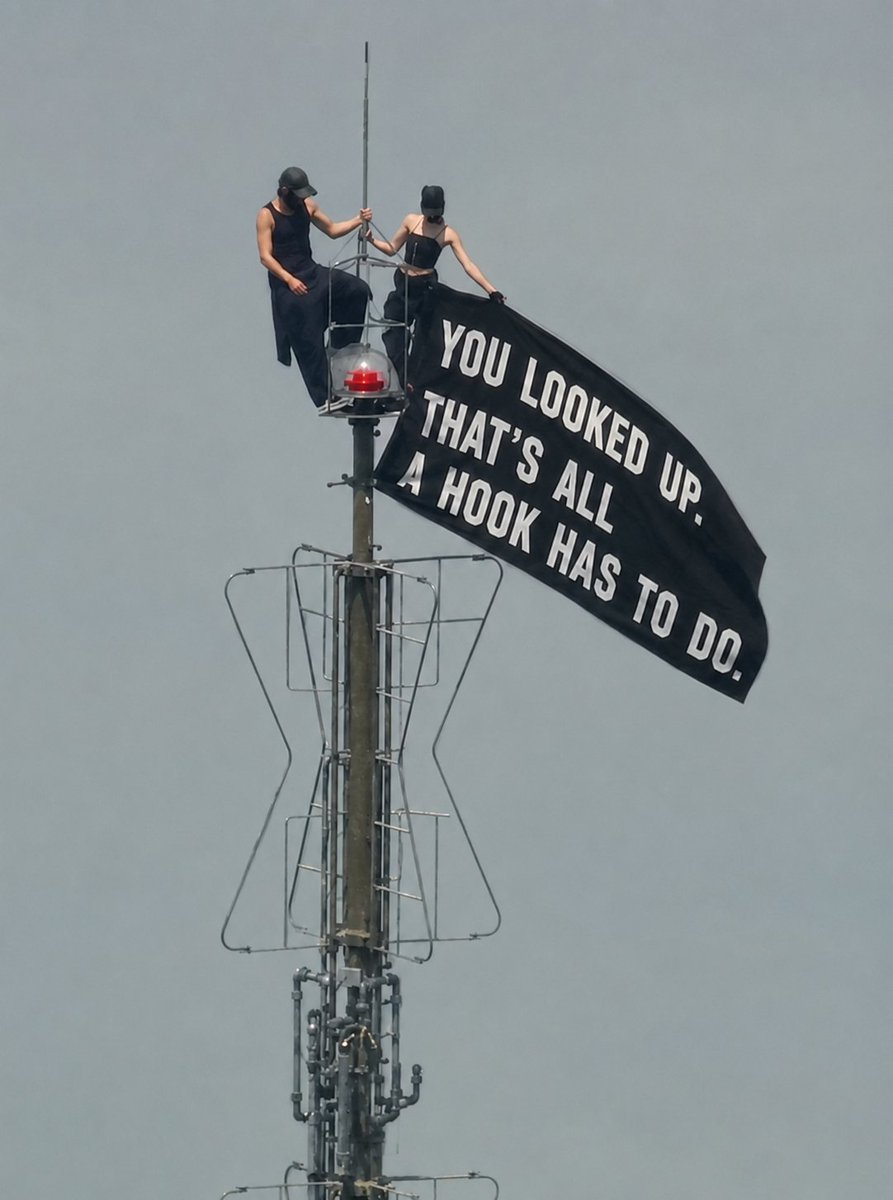
Two people climbed over 1,400 feet and risked a felony to make a city look up.
Most ecom ads can't make a thumb pause for half a second, and they cost more than the climb.
A hook has one job: earn the next line.
That's it.
These two just did it the hard way.
"Clearer skin" is a wish.
"The flaky patch under your jaw that makeup won't cover" is a mirror.
One the reader skims.
The other the reader feels.
Name the thing they see at 7am and hate.
Specific is the cheapest edge in this whole game.
A test for any hook.
Read line one out loud.
If nobody flinches, gasps, or feels called out, it is not done.
A hook that is only accurate is a dead hook.
It has to hit something they already feel before they earn the second line.
Specific beats impressive. "Clinically proven" is impressive and forgettable.
The line that names exactly what she sees in the mirror at 3pm is the one that stops her.
The brain files specific as true and scrolls right past vague.
"Stop the scroll" is the most repeated advice in marketing.
It's also the lowest bar there is.
Pausing someone was never the goal.
A real hook pulls them in and won't let go, the way one sharp first line drags you into an ad you never meant to read.
That pull is the whole difference between an ad people skip and one they finish.
Most ecom brands lose to the same mistake: they never decided who the brand is actually for.
It feels safe to be for everyone. "Healthier skin for anyone who wants it."
Bigger market, more buyers, why narrow it.
So the messaging goes broad, the ads go generic, and the brand ends up talking to a vague average person who doesn't actually exist.
Here's why that quietly kills you.
An ad only stops someone when it feels like it was written about them.
The second it tries to talk to everyone, it stops sounding like it's talking to anyone.
No specific pain to name, no enemy to point at, no moment the reader recognizes.
So it reads as background noise and gets scrolled.
The fix is to pick one real person and build everything around her.
Step one, name her at her worst moment with the problem.
Not "women who want better skin," but "the woman who cancels plans because her skin broke out the night before."
Step two, write down what she's already tried and quit, and what she secretly believes is wrong with her.
That's your angle and your objection in one.
Step three, name what she's fighting: the expensive routine that did nothing, the dermatologist who shrugged, the years of trial and error.
Now write only to her.
Example:
Broad: "Clinically backed skincare for healthy, glowing skin."
Sharp: "If your skin breaks out the week of every big event, that's not random, and there's a fix nobody told you about."
One could be any brand. The other could only be talking to her.
Being unmissable to the right people beats being acceptable to everyone.
Deciding who the brand is for is the first strategic move, and it's the one most brands skip.
You wrote your first line last. That is exactly why your ads die.
The real order of events: you spend three weeks on the product shots, argue about the music, rewrite the offer four times.
Then the hook, the one line that decides whether any of that gets seen, gets slapped on at the end because the export is due.
So the most important words in the ad get the least thought in the room.
A hook is an audition. Fail it and nobody reads your body copy, nobody hears your offer, and your budget buys you a three-second view and a scroll.
Flip the order. Write the hook before the script and before the edit.
Write ten of them, keep the one that actually stops you, and build the ad around that.
The brands that win decide what earns the first three seconds before they make anything else.
Everyone else decides it last and hopes.
A cartoon giraffe I built in one click just held your attention longer than your last three ad campaigns did.
That is not a flex about animation.
It is the whole problem with how most brands run ads.
You pour weeks into production and money into agencies, and the work still gets scrolled past in half a second.
Two days ago: agents generating concepts while I slept
Today: a claymation video in one shot
Watch the gap between idea and finished ad close in real time
Last week I said I'm building something sick.
Here it is:
A research engine that hands me 50+ ad concepts every Monday morning.
It runs while I sleep.
My part takes 15 minutes.
What it does on its own, every week:
scrapes the winning ads in the niche pulls Reddit threads and reviews, word for word
reads published studies for proof material maps every pain it finds to a market map
The part nobody does manually:
every customer quote that fits no known audience goes into a separate bucket.
3 quotes pointing the same direction = a new segment nobody is targeting yet.
New segments are where the cheap winners live.
Then it finds the gaps.
Audiences with loud pain and zero ads serving them
Ranked
Every concept it banks starts from a real customer sentence
Monday morning:
two emails
I kill the weak concepts, approve the new audiences.
15 minutes
Then production.
AI didn't replace the strategist.
It made judgment the whole job.
Most ads pitch the product first.
This one builds the problem so hard the product feels like rescue.
Broke down a parasite ad that has been running for 4 months.
The product doesn't show up until the very end.
Here's the order it sells in: