CNN, BBC, Zoom and Fox News Among 186 Websites Hit by Crypto Malware Attack
A crypto malware attack has turned scripts used by major websites into potential tools for stealing cryptocurrency and payment card details.
Dubbed OPTIMJACK, the supply-chain attack reportedly compromised Optimizely, a platform used for website testing and personalisation. Security researcher Scott Helme identified at least 186 infected websites, including CNN, BBC, Zoom, Fox News, Salesforce and GitLab.
The injected JavaScript could replace cryptocurrency wallet addresses when users copied them, redirecting transfers to attacker-controlled wallets. It could also capture payment card information entered on affected sites.
The disturbing part? The websites did not necessarily need to be hacked directly. A compromised third-party script was enough to expose their visitors.
Helme later reported that the cleanup was progressing, with only one infected JavaScript file remaining in his latest update.
A reminder that even trusted websites can carry compromised code.
Three days after an FAA failure disrupted thousands of flights, another airline systems breakdown is hitting travelers. This time, it's United Airlines.
United has confirmed a widespread technology outage affecting departing mainline flights. Some aircraft are being held at gates or on the tarmac because crews cannot access critical takeoff data, including final weight-and-balance information needed to clear departures.
United Express flights and aircraft already in the air are not affected, according to the airline's updates.
The timing is brutal. Friday's FAA ground stop disrupted roughly 15,000 flights across the country. Now United is dealing with a separate systems failure, with no confirmed restoration time in the latest reports.
United says its teams are working to restore service and has apologized to affected passengers.
How many more flights can the US aviation system afford to lose to technology failures?
Your money may be safe in the bank. But try accessing it when the banking app stops working.
Chase, Bank of America, Wells Fargo and U.S. Bank were among the institutions hit by a wave of online banking complaints on Monday.
Chase alone drew more than 4,600 Downdetector reports. Customers reported login failures, app problems and delayed transactions. Zelle users also flagged transfer difficulties.
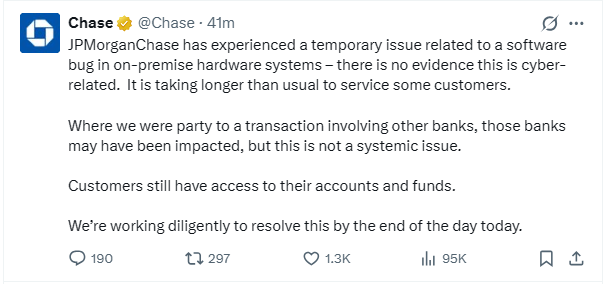
Chase blamed a technical issue, saying it was not a cyberattack and customers still had access to their accounts and funds.
No common cause has been confirmed across the affected institutions.
Were you able to access your bank account normally on Monday?
SHIB Holder Base Surpasses 1.7 Million
1.7 million SHIB holders. Nearly 1 quadrillion tokens. And the Shiba Inu community keeps growing.
Shiba Inu has reached 1,700,099 holder addresses, adding another milestone to its expanding on-chain footprint.
The network's reported total supply stands at approximately 999.98 trillion SHIB. The top 100 wallets account for 83.05% of that supply, while millions of tokens remain distributed beyond the largest addresses.
A growing holder count is an encouraging sign of SHIB's expanding reach. It doesn't guarantee price appreciation, but it shows the token continues to attract and retain a substantial wallet base.
1.7 million addresses and counting. Who's still building their SHIB position?
Harvard just watched its Bitcoin ETF holdings climb 42% to $144 million without selling a single share in Q3.
The university's latest disclosure shows it maintained its Bitcoin ETF position as its market value surged, adding another notable institutional name to the list of major investors holding exposure to Bitcoin.
One important distinction: the 42% increase reflects the value of the holdings, not necessarily additional shares purchased.
Harvard isn't rushing for the exit.
Are institutional investors becoming more comfortable holding Bitcoin through market swings?
What if someone could drain a multisig wallet without getting its owners to approve a transaction?
A suspected $6.45 million exploit hit a Gnosis Safe wallet, with the attacker moving approximately $4.3 million in USDC and $1.7 million in syrupUSDC.
But the breach wasn't attributed to a flaw in Safe's core contracts.
On-chain analyst Specter traced the drain to permissions already granted through a third-party Zodiac Roles module. Safe said a role member's private key was likely compromised. No wallet owner signed the transaction.
The attacker has since used roughly $813,000 to buy Monero (XMR) on Hyperliquid. Specter also traced another $1.2 million flowing into XMR through Wagyu.
The incident affected one multisig, not Safe's entire wallet infrastructure.
For crypto holders and institutions, the warning is clear: multisig protection is only as strong as the permissions and keys attached to it.
Do you regularly audit the permissions granted to your crypto wallets?
Two alleged crypto scammers accused of costing investors $92 million were hiding in a Bangkok luxury condo. Then Thai police showed up.
A 52-year-old man and a 28-year-old woman, wanted by Chinese authorities since December 2025, were arrested on November 12.
Investigators say the pair allegedly ran a crypto investment pyramid scheme that cost victims more than 3.2 billion baht.
Their Thai residence permits have been revoked. Deportation to China is being arranged.
$92 million in alleged losses.
How do crypto scams keep attracting investors despite warnings?
What if the biggest money-maker in crypto isn't a trading platform, but a stablecoin issuer collecting interest on money it doesn't pay holders to keep?
Tether has generated more than $20.5 billion in cumulative fees, according to data from DefiLlama, including roughly $117.7 million in the past seven days.
But there's a catch: this isn't trading revenue.
Tether makes most of its money from the reserves backing USDT, particularly interest earned on US Treasury bills and other fixed-income assets. USDT holders don't receive that yield. Tether keeps the returns.
That creates an unusually powerful business model: issue a dollar-pegged token, invest the backing reserves and collect the interest.
Holding the world's largest stablecoin doesn't mean sharing in the income generated by its reserves.
Would you hold USDT if Tether shared some of that interest with its users?
Shibarium Has 99.965% of Its Network Capacity Untapped
Shibarium is live. Blocks are rolling. And network utilization is sitting at just 0.035%.
Here's the latest snapshot:
• 1,294 transactions today
• 11.5-second average block time
• 1.51 gwei gas
• 1.35B indexed transactions
• 268.87M indexed addresses
• Explorer indexing: 88% complete
The bullish angle? Shibarium has enormous room to absorb activity without today's network congestion becoming a bottleneck.
More users. More apps. More transactions. That's the growth story worth watching for the SHIB ecosystem.
SHIB is bouncing. But is the recovery real?
Shiba Inu climbed nearly 4% as buyers stepped in after a weekend sell-off pushed it toward $0.00000370. Its market cap is back around $2.32B, with 24-hour volume near $56M.
The rebound comes after a brutal stretch: SHIB is still down roughly 10% over the week and about 95% below its October 2021 peak.
There’s some encouraging news. Binance’s latest reserve snapshot showed SHIB backing at 100.04%, while regulated SHIB price contracts have opened another route for traders to gain exposure without holding the token.
But neither changes the supply math. Burns remain tiny relative to SHIB’s circulating supply, and its daily chart still carries bearish technical signals.
A bounce is not a breakout.
Are you buying this dip, or waiting for SHIB to prove it can hold the recovery?
Democrats wanted token launch accountability written into crypto law.
Sen. Cynthia Lummis says they got it. Then they voted no.
The Wyoming Republican says the CLARITY Act included binding rules to prevent token creators from hiding behind shell companies when launching projects.
But the bill remains stalled after its September Senate procedural defeat, with Democratic objections extending to Trump's crypto interests and stablecoin yield provisions.
For US crypto markets, the fight leaves a bigger question hanging: how much longer will regulatory uncertainty last?
Was this a policy disagreement or a political standoff?
Amazon just lost 40 internet satellites in a rocket launch that lasted barely 10 minutes.
ULA's Vulcan rocket suffered an anomaly Sunday after lifting off from Cape Canaveral, failing to deliver Amazon Leo's satellites into orbit.
The payload loss marks ULA's first mission failure since the company was formed in 2006.
The setback comes after Vulcan spent roughly nine months grounded following earlier rocket booster problems. This was supposed to be its return to flight.
Amazon had roughly 396 Leo satellites already in orbit. Now, its constellation expansion takes another hit.
ULA says the cause is under investigation. No explanation yet for what went wrong.
40 satellites gone. Nine months waiting. And Vulcan is back under scrutiny.
What does this mean for Amazon's race against Starlink?
SHIB Just Hit a 14-Month Bearish Signal. Is $0.0000037 the Bottom or Just a Stop on the Way Down?
Shiba Inu has flashed its first daily death cross since September 2025, and the timing couldn't be worse.
The 50-day moving average has slipped below the 200-day average, a bearish signal traders watch for signs of sustained selling pressure.
SHIB sank below $0.000004 on Saturday, touching $0.0000037 after four consecutive days of losses. It's down roughly 14% over the past week.
The sell-off isn't happening in isolation. Nearly $2 billion in leveraged crypto positions were liquidated in a single day, while shrinking stablecoin supply points to money leaving the market.
A death cross doesn't guarantee another crash. But with SHIB already near multi-year lows, bulls have little room for error.
Are you waiting for a reversal signal, or does SHIB's current price already look attractive?
64,000 Bitcoin Mining Machines Hijacked. The Attackers Got No Bitcoin.
Imagine controlling 13 EH/s of Bitcoin mining power and walking away without mining a single block.
That's what reportedly happened after attackers redirected roughly 64,000 mining machines to OCEAN, a Bitcoin mining pool, and replaced their payout address with one they controlled.
The hijacked hashrate briefly pushed OCEAN's reported capacity close to 50 EH/s.
CoreX Hosting said the incident appeared to have ended by November 15, with the affected hashrate falling to around 100 PH/s.
The attackers received no block rewards. But miners lost the revenue their machines could have earned while mining for someone else's payout address.
A possible compromise of Luxor Commander, mining fleet management software, has been raised as a suspected entry point. That link remains unconfirmed.
64,000 machines redirected. Zero blocks mined. Who actually paid the price?
Think the flight chaos ended when the FAA reopened US airspace? Not quite.
A nationwide ground stop lasting more than four hours on Friday left airlines scrambling to put aircraft, crews and passengers back where they belonged.
The FAA traced the disruption to aging telecommunications equipment overwhelmed during routine maintenance at a remote site. A router generated more than 1,000 connection attempts every four to five seconds, triggering instability across multiple air traffic control facilities.
Transportation Secretary Sean Duffy said investigators found no evidence of a cyberattack or foreign interference.
But the disruption didn't disappear when the ground stop lifted. A former senior FAA official warned that airlines could need up to 48 hours to restore normal operations.
The FAA projected 4,000 to 5,000 cancellations on Saturday, with airlines expecting schedules to stabilise by Sunday.
And the bigger problem remains: America's air traffic control network is still relying on ageing infrastructure that officials say needs a major overhaul.
Would you trust the system to handle another major disruption this weekend?
Can a rocket the size of a skyscraper come back from space and be caught by the tower that launched it?
SpaceX just proved the answer is yes.
During Starship Flight 15, the company successfully caught Ship 42, the spacecraft's upper stage, using the launch tower's giant mechanical arms, nicknamed 'chopsticks'.
It's the first time an orbital Starship has survived its return from space and been caught at the tower.
The spacecraft also deployed 26 Starlink V3 satellites during the mission.
There was a setback, though. The Super Heavy booster failed to make its planned tower return after a guidance issue forced an offshore diversion. It was subsequently lost near the Gulf of Mexico.
Still, recovering the upper stage marks a major step towards SpaceX's goal of making the entire Starship system reusable, potentially allowing faster launches and lower mission costs.
SHIB Is Fighting to Hold $0.0000041. A Break Below Could Put $0.0000027 in Sight.
Is Shiba Inu setting up for a rebound, or could another 30% drop be coming?
Crypto chart analyst Ali Charts says SHIB has already corrected roughly 34% and is approaching the lower boundary of a descending channel on its three-day chart.
The level to watch is $0.0000041.
A hold could open the door to a recovery towards $0.0000051. A decisive breakdown, however, could expose SHIB to further losses towards $0.0000033 or even $0.0000027.
The wider picture isn't encouraging. ShibArmy Terminal data shows weakening momentum, extreme market fear at 20 and a 78% drop in SHIB burn activity against its seven-day average.
SHIB is now approaching a technical level that could determine whether buyers manage a rebound or sellers push the price lower.
Would you buy SHIB at these levels, or wait for it to reclaim $0.0000041 first?