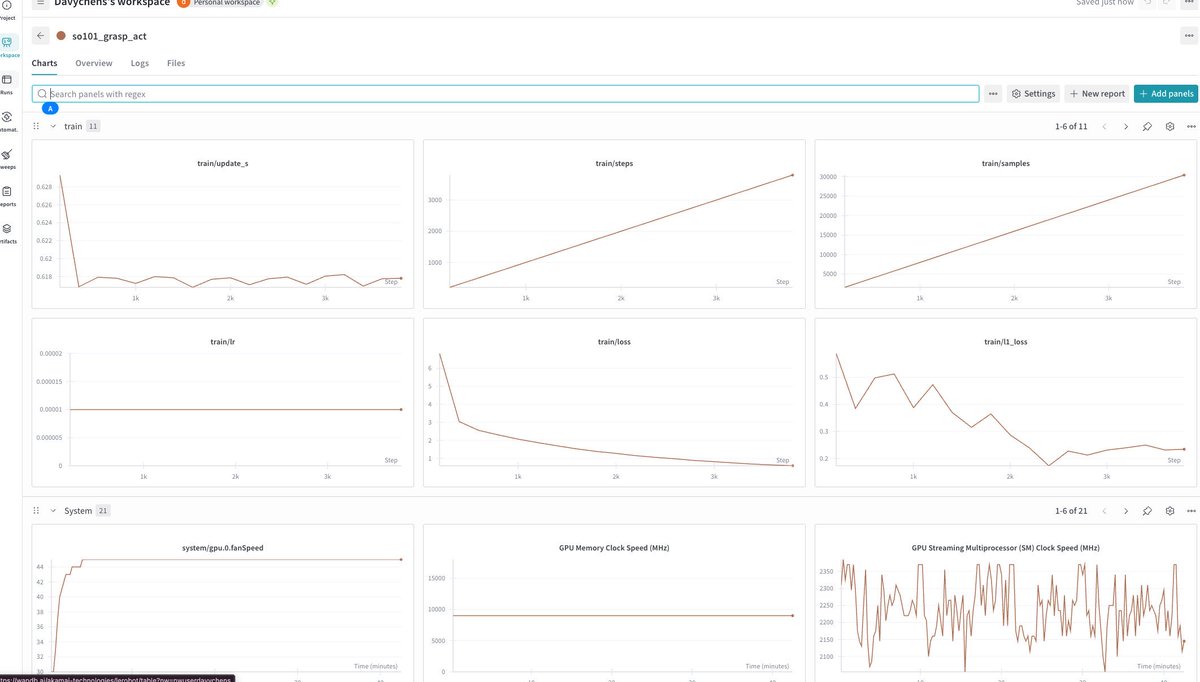
Trying Physical AI on Akamai with NVIDIA RTX 4000 Ada — running robot imitation learning in the cloud.
Progress so far 👇
1️⃣ Teleop with my daughter ✅
2️⃣ Live vision input ✅
3️⃣ Imitation learning ✅
4️⃣ VLA fine-tuning ✅
5️⃣ Pick-and-place ✅
6️⃣ Adding wheels and Jetson Orin ← now
Next up 🔜
• Dual-arm control
• Cloud-based VLA inference
#Robotics #PhysicalAI #LeRobot #EdgeAI #SoARM101
1) Compute efficiency
Chinese models have never been solely focused on scaling compute. Look at how Qwen has demonstrated the ability to reduce training costs by 10x. The real competition isn’t just about who can spend more on compute, but also about who can extract more intelligence from every dollar spent.
2) Distillation and training data
Distillation is one of the cheapest ways to generate high-quality training data. There will be more brokers for high quality data.
3) System 1, System 2 and the economics of intelligence
Robotics need both System 1 (fast, reactive intelligence) and System 2 (deliberate reasoning).
You don’t necessarily need a trillion-parameter model with only a few billion parameters activated for every task. Sometimes, a sufficiently capable small model is all you need.
Rather than becoming dependent on two or three large AI companies, deploying smaller, purpose-built models is precisely where Chinese open models shine.
4) Open weights change the rules
No one can simply cut off access to open-weight models once they have been released and distributed.
5) You don’t always need a BMW. Sometimes a Toyota is exactly what the market needs.
Chinese models don’t necessarily need to catch up with every frontier model on every dimension.
Once basic intelligence requirements are met, increasingly advanced intelligence doesn’t necessarily translate into proportionally greater business value.
The global debt crisis has never been worse.
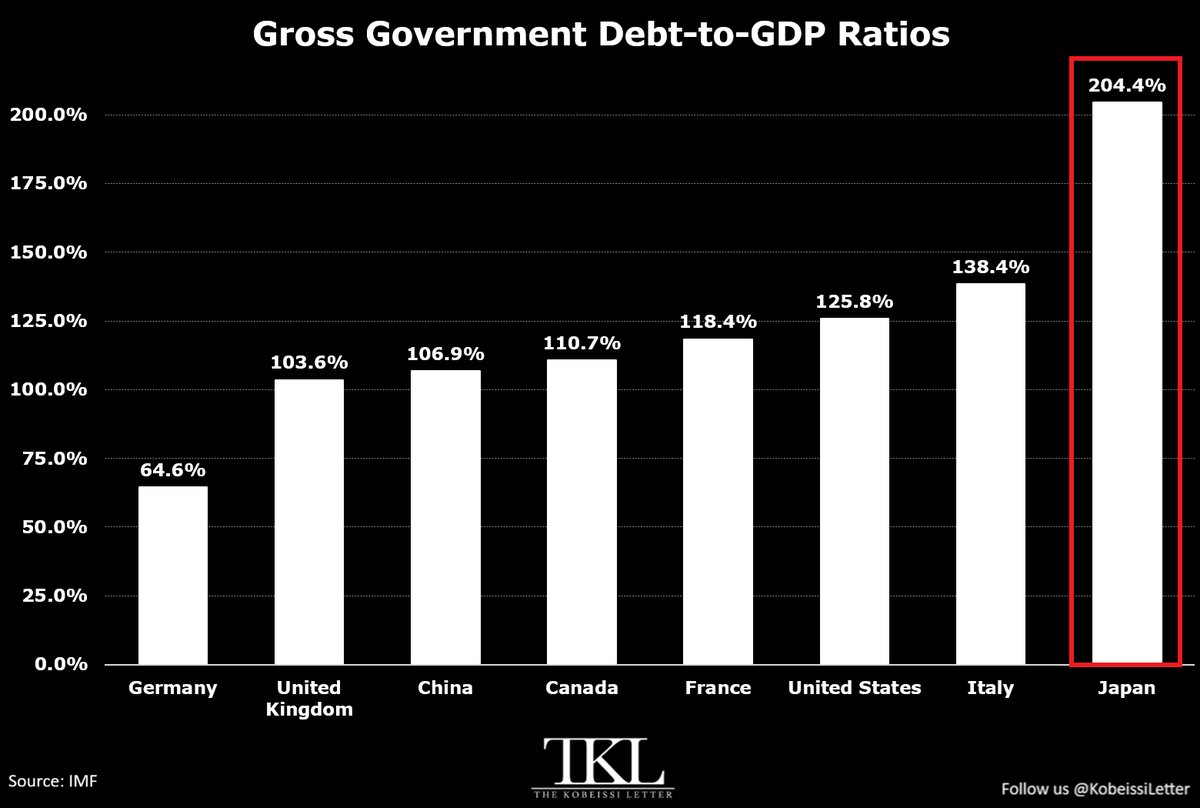
Japan now has a gross government Debt-to-GDP ratio of 204.4%, the highest among any major world economy.
Italy follows at 138.4%, while the United States stands at 125.8%, which is only below the ~132.0% record set during the 2020 pandemic.
At the same time, France’s gross government Debt-to-GDP ratio is 118.4%, while Canada’s, China’s, and the UK’s are 110.7%, 106.9%, and 103.6%, respectively.
By comparison, Germany is the only major economy below 100.0%, at 64.6%.
The current average among advanced economies is 108.2%.
The world economy is drowning in debt.
Most enterprise workloads are narrow enough that don’t need massive numbers of active parameters. Unless a model is highly sparse, it is wasting GPU compute and memory bandwidth on capabilities the workload rarely uses.
The real competitive advantage is proprietary data + the data flywheel. With closed models, enterprises have limited control over how their private data improves the underlying model. With smaller open-weight models, they can fine-tune, evaluate, and continuously improve models using their own proprietary data.
The long-term moat isn’t model size. It’s how effectively you turn private data into continuously improving intelligence.