A gift to the Chinese developer community for anyone building agents on @LangChain:
After 2 books on the ecosystem, I open-sourced the third — Deep Agents in Action. 8 chapters live and counting, on the Agent Harness: planning, context engineering, sub-agents, Skills, memory.
Most agent pattern lists today sort by one axis only. That's why "Plan-and-Execute" means three different things across Ng, Anthropic, and LangChain.
A coordinate system fixes this without anyone changing vocabulary.
Not a new list. A grid the existing lists fit inside. 4/
Most AI agent failures in production aren't model failures. They're design failures.
The model does its job. The system around it is what breaks: wrong scope in prompts, wrong signal in memory, wrong authority granted to tools, observability silent at the worst moments. 2/
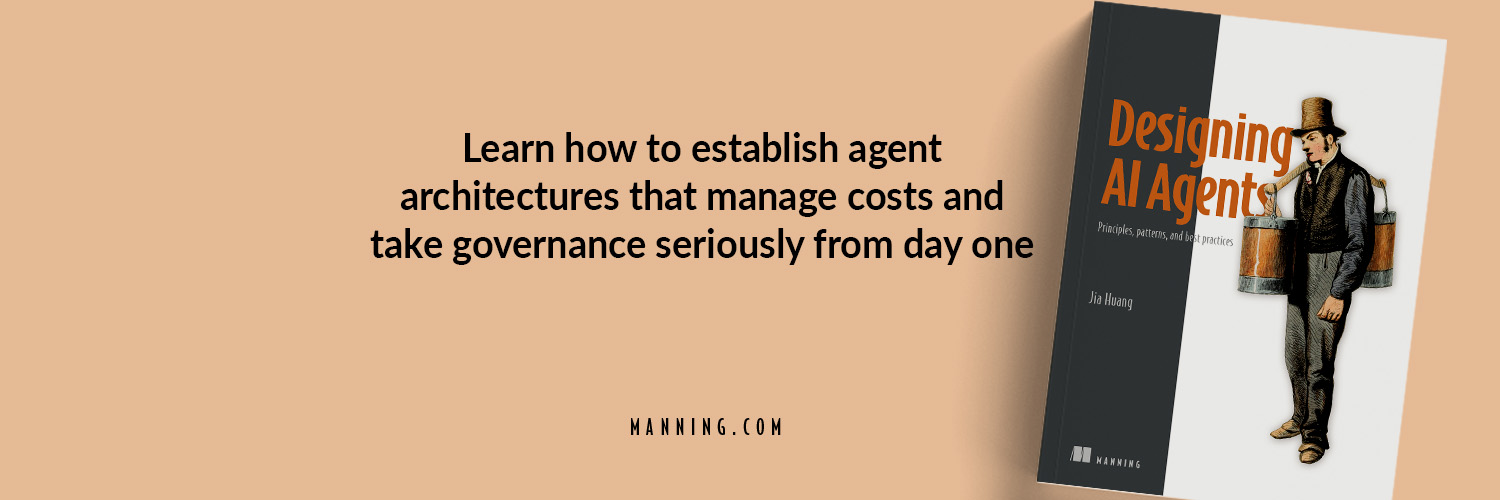
Designing AI Agents hit #1 on Manning's Bestseller list for May 31.
Thanks to everyone who picked up the book in launch week.
A short thread on what the book argues. 1/
Companion resources, all open:
📄 Position paper (arXiv:2605.13850) — established the framework timestamp two months before MEAP
🧩 Framework catalog: https://t.co/nmlnUNjYmU
🛠 Book runtime (Argus): https://t.co/i3BLQ9YXtA
8/8
All of this in Designing AI Agents (@ManningBooks).
MEAP launches today. Ten chapters, twenty-eight patterns, four real-world case studies, reference appendix with the full matrix.
Sitewide 50% off through June 9 to mark the launch:
https://t.co/o7B5l14Tkh
7/
Operationalized through the Pattern Selection Card:
ASSESS what cognitive functions the task needs → ROUTE to topology that fits constraints → SELECT named patterns at those intersections
"I'm building an agent for X" becomes a candidate pattern list in 15 minutes.
6/
Most "agent design" today picks a topology and assumes the cognitive function is obvious. It usually isn't.
The result: copies a template, adds memory, adds a planner, adds a critic, works in demos, fails in production.
The cause isn't the framework.
4/
Different failure modes. Different testing strategies. Different cost curves. Same diagram.
A pattern is not a topology. A pattern is not a cognitive function. A pattern is the intersection.
3/
There are two ways to describe an agent system.
Execution diagram — boxes, arrows, who calls whom. Cognitive description — what the agent perceives, remembers, decides, acts on.
Most write-ups pick one axis and stop. Neither alone identifies the agent.
1/
There are two ways to describe an agent system.
Execution diagram — boxes, arrows, who calls whom. Cognitive description — what the agent perceives, remembers, decides, acts on.
Most write-ups pick one axis and stop. Neither alone identifies the agent.