🚀 Welcome to TheShiftAI
We help enterprises & startups unlock the power of AI through:
🔹 AIFirst Strategy & Roadmaps
🔹 Custom AI Products
🔹 Fine-Tuning LLMs
💡 Let’s build AI that works for your business.
📞 Talk to us → https://t.co/1BRs1GOeFe
Most industrial AI projects do not fail because the AI fails.
They fail because the foundation fails.
The pattern is surprisingly consistent:
✅ Proof of concept works
✅ Business case gets approved
✅ Leadership gets excited
Then the project reaches the plant.
And reality shows up.
• Data isn't as clean as expected
• Systems don't connect the way people assumed
• OT access is more restricted than planned
• Governance constraints emerge
• Operators weren't involved early enough
The model wasn't the problem.
The environment was.
Many organizations treat AI as the starting point.
In reality, AI is the last layer.
Below it sits:
→ Data quality
→ System integration
→ Operational context
→ Security
→ Adoption
If those layers are weak, the AI inherits the weakness.
That's why so many projects become permanent pilots.
Not technology failure.
Foundation failure.
The most successful industrial AI programs don't start with better models.
They start with better foundations.
Before asking:
"Which AI should we deploy?"
Ask:
"Is the foundation ready to support it?"
#IndustrialAI #OperationalAI #ManufacturingAI #EnterpriseAI #AIStrategy #SmartManufacturing #Industry40 #DigitalTransformation #OperationalExcellence #ManufacturingLeadership #ConnectedOperations #AIAtScale
Your best plant manager is retiring in 18 months.
Most companies think the risk is knowledge loss.
The bigger risk is judgment loss.
Not the SOPs.
Not the manuals.
Not the documented procedures.
The real value lives in things that were never written down:
• Hearing a problem before sensors detect it
• Recognizing patterns others miss
• Connecting today's quality issue to next week's delivery risk
• Knowing where to look before anyone knows there's a problem
That's not documentation.
That's accumulated judgment.
And manufacturing is about to lose a lot of it.
Retirements are accelerating.
The people replacing these leaders are being asked to make decisions that once required decades of context.
This is why operational AI matters.
Not because it replaces experienced leaders.
But because it can help create operational memory.
When decisions connect to outcomes over time, systems begin to learn the patterns behind exceptional judgment.
The goal isn't replacing expertise.
It's preventing decades of experience from leaving with the people who built it.
If your best plant manager left tomorrow...
How long before the impact showed up in your results?
#Manufacturing #OperationalAI #IndustrialAI #KnowledgeManagement #OperationalExcellence #ManufacturingLeadership #WorkforceDevelopment #SmartManufacturing #Industry40 #FutureOfWork #DigitalTransformation #OperationalIntelligence
The biggest intelligence gap in manufacturing is not between plants and technology.
It's between what the plant knows and what the business understands.
Every second, a manufacturing operation generates thousands of signals:
• Asset temperatures
• Vibration patterns
• Cycle time deviations
• Quality variations
• Energy consumption trends
• Operator actions
• Production decisions
The information exists.
The problem is that very little of it reaches the people whose decisions it should inform.
Not because data is unavailable.
Not because technology is missing.
Because there is no effective translation layer between operational reality and business decision-making.
A CFO sees a margin variance.
The operational conditions that created it may have appeared weeks earlier as process drift on the plant floor.
A COO reviews downtime numbers.
The failure signature may have been visible days before the asset stopped.
Leadership reviews declining delivery performance.
The scheduling decisions behind it were made shift by shift long before the outcome appeared in a report.
Most manufacturers don't have a data problem.
They have a translation problem.
The challenge isn't collecting more information.
It's transforming operational signals into business intelligence while decisions can still be influenced.
Because intelligence only creates value when it reaches:
→ The right person
→ In the right language
→ At the right moment
The plant already knows more than the business can see.
The question is:
How wide is the translation gap between your plant floor and your boardroom?
#OperationalIntelligence #OperationalAI #IndustrialAI #ManufacturingAI #Manufacturing #SmartManufacturing #Industry40 #DecisionIntelligence #ManufacturingLeadership #DigitalTransformation #OperationalExcellence #ConnectedOperations
Most plants have a Digital Twin.
Very few have one that actually understands what is happening right now.
The demos look impressive.
3D models.
Live sensor overlays.
Animated equipment.
Real-time dashboards.
But most Digital Twins were built as visualization systems.
Not intelligence systems.
They show what sensors report.
They do not understand what the signals mean.
A temperature spike appears on a machine.
The Digital Twin can show it.
But can it answer:
• Why did it happen?
• Which production order is affected?
• Which material batch is involved?
• Has this happened before?
• What maintenance history matters?
• What risk is forming?
• What should happen next?
Usually not.
Because showing an event and understanding an event are very different capabilities.
That's the gap between a Digital Twin and an operational intelligence layer.
One is a display system.
The other is a decision system.
The future of industrial software isn't better visualization.
It's systems that understand operational relationships in real time.
When a signal changes, they can connect:
Asset → Production → Maintenance → Quality → Financial impact
And help people decide what to do before the business feels the consequences.
The question is no longer:
"Can we see what's happening?"
It's:
"Can we understand what it means?"
That's where the next generation of Digital Twins will be won.
#DigitalTwin #OperationalIntelligence #OperationalAI #IndustrialAI #ManufacturingAI #SmartManufacturing #Industry40 #ConnectedOperations #DecisionIntelligence #EnterpriseAI #DigitalTransformation #ManufacturingLeadership
A defect becomes more expensive every minute it survives.
Not because the defect changed.
Because more of the business absorbs its consequences.
At the production line, it's a process correction.
After shipment, it becomes:
• Warranty costs
• Logistics expenses
• Customer impact
• Lost trust
Most quality failures are discovered too late because organizations detect defects—not the conditions that cause them.
The signals usually appear much earlier:
• Temperature drift
• Tool wear
• Material variability
• Changes in machine behavior
The problem isn't missing data.
It's disconnected operational context.
Operational AI changes that.
Not by inspecting more aggressively.
By connecting operational signals to downstream quality outcomes before defects physically exist.
So:
• A process deviation becomes a quality risk signal.
• A machine anomaly becomes a prediction of future cost.
The next competitive advantage in manufacturing quality may not come from inspecting more parts.
It may come from identifying defects while they still exist only as operational signals.
#Manufacturing #QualityManagement #OperationalAI #IndustrialAI #ManufacturingAI #OperationalIntelligence #QualityAssurance #OperationalExcellence #SmartManufacturing #Industry40 #ContinuousImprovement #DigitalTransformation
The biggest manufacturing AI advantage in 2030 may not come from better models.
It may come from better foundations.
Most organization focus on the visible layer of AI:
• Predictive maintenance
• Agentic workflows
• Autonomous planning
• Real-time intelligence
But the real constraint usually sits underneath:
• Disconnected systems
• Inconsistent KPIs
• Missing operational context
• Isolated datasets
The first AI use case often succeeds.
The fifth becomes difficult.
The tenth becomes expensive.
Because the organization does not have an AI problem.
It has a foundation problem.
Operational intelligence changes this.
Not by adding more tools.
By creating a connected operational layer across production, maintenance, quality, finance, and supply chain systems.
So every future capability becomes easier to deploy and scale.
The manufacturers that win over the next decade may not be the ones buying the most AI.
They may be the ones quietly building the operational foundation that compounds over time.
#ManufacturingAI #IndustrialAI #OperationalAI #SmartManufacturing #Industry40 #EnterpriseAI #DigitalTransformation #OperationalExcellence #ManufacturingLeadership #IndustrialTransformation #AIStrategy #FactoryOperations
Predictive AI identifies problems.
Agentic AI helps coordinate responses.
That difference matters more than most organization realize.
In many plants today:
• An alert fires
• Someone notices it
• Maintenance investigates
• Scheduling adjusts production
• Work orders get created manually
The prediction is fast.
The organizational response is slow.
Not because people are ineffective.
Because humans are still acting as the integration layer between disconnected systems.
Operational AI changes that.
Not by improving prediction accuracy alone.
By reducing the coordination burden around operational decisions.
So:
• Maintenance history adds context automatically
• Inventory checks spare availability instantly
• Production schedules identify intervention windows
• Constraints are evaluated before escalation begins
The next industrial AI advantage may not come from better predictions.
It may come from removing cognitive friction from operational decision-making.
#AgenticAI #OperationalAI #IndustrialAI #ManufacturingAI #SmartManufacturing #Industry40 #OperationalExcellence #PredictiveMaintenance #FactoryOperations #DigitalTransformation #EnterpriseAI #ManufacturingLeadership
Most industrial AI projects do not fail in the pilot phase.
They fail when scaling across plants.
Plant 1 succeeds.
The metrics improve.
Leadership approves expansion.
Then the rollout reaches a different environment:
• Different PLCs
• Different SCADA systems
• Different operational behaviors
• Different maintenance cultures
The model did not fail.
The assumptions behind the architecture did.
That is the hidden challenge in manufacturing AI.
Most organization think they have a scaling problem.
What they actually have is a variability problem.
Operational AI changes this.
Not by rebuilding every deployment from scratch.
By creating a common intelligence layer above plant-level differences.
So the system understands operational reality consistently across heterogeneous environments.
The next generation of manufacturing AI leaders may not be the companies with the best pilot.
They may be the companies that architect for variability before scaling begins.
#ManufacturingAI #IndustrialAI #OperationalAI #SmartManufacturing #Industry40 #DigitalTransformation #OperationalExcellence #ManufacturingLeadership #FactoryOperations #EnterpriseAI #IndustrialTransformation #AIAtScale
One of the biggest operational risks in manufacturing happens during shift handover.
Not because people are careless.
Because operational context is still transferred manually.
A machine “doesn’t sound right.”
A process drift gets mentioned verbally.
A quality concern never reaches the formal log.
Small details disappear between shifts.
Individually, they seem minor.
Collectively, they become:
• Quality escapes
• Downtime
• Unexplained production variance
Most organization transfer information.
Very few preserve operational understanding.
Operational AI changes that.
Not by adding more meetings.
By creating a continuous operational memory across shifts.
So the system understands:
• What changed
• What remains abnormal
• What requires attention immediately
• Which operational risks are still active
The next manufacturing advantage may not come from faster communication.
It may come from eliminating the loss of operational context altogether.
#Manufacturing #OperationalAI #IndustrialAI #ShiftHandover #OperationalExcellence #SmartManufacturing #Industry40 #FactoryOperations #KnowledgeManagement #ContinuousImprovement #ManufacturingLeadership #DigitalTransformation
Most EBITDA bridges explain the past.
Very few help influence the future.
By the time finance finishes reconciling:
• Volume variance
• Mix variance
• Cost variance
• Margin shifts
…the operational conditions that created them have already changed.
Because EBITDA movement starts much earlier:
• A yield drop
• An energy spike
• A quality hold
• A production disruption
Small operational events become financial outcomes weeks later.
Operational AI changes that.
Not by improving reporting.
By connecting operational signals directly to financial impact in real time.
So:
Yield loss → Volume pressure
Energy drift → Margin exposure
Quality event → Forecast risk
The next financial advantage in manufacturing may not come from faster reporting.
It may come from reducing the time between operational change and executive understanding.
#ManufacturingFinance #CFO #EBITDA #OperationalAI #IndustrialAI #FinancialPlanning #DecisionIntelligence #Manufacturing #OperationalExcellence #DigitalTransformation #Industry40 #ExecutiveLeadership
Most supply chain disruptions are not sudden.
The risk signal usually appears long before production feels the impact.
The supplier issue existed.
The inspection process detected it.
The material risk was visible.
But the operational response came too late.
So by the time the issue reaches production:
• Schedules are already committed
• Labour is allocated
• Customer deliveries are locked
• Recovery costs begin compounding
That is the hidden visibility gap in manufacturing supply chains.
Operational AI changes this.
Not by creating another supplier dashboard.
By connecting material quality signals directly to operational consequences.
So the organisation can understand:
• Which orders are affected
• Which lines become exposed
• Which inventory alternatives exist
• Which response creates the lowest operational cost
The next supply-chain advantage may not come from more visibility alone.
It may come from reducing the time between risk detection and operational response.
#OperationalAI #IndustrialAI #Manufacturing #FactoryOperations #SupplyChainManagement #SupplyChainVisibility #OperationalExcellence #Industry40 #SmartManufacturing #DecisionIntelligence #ManufacturingLeadership #DigitalTransformation
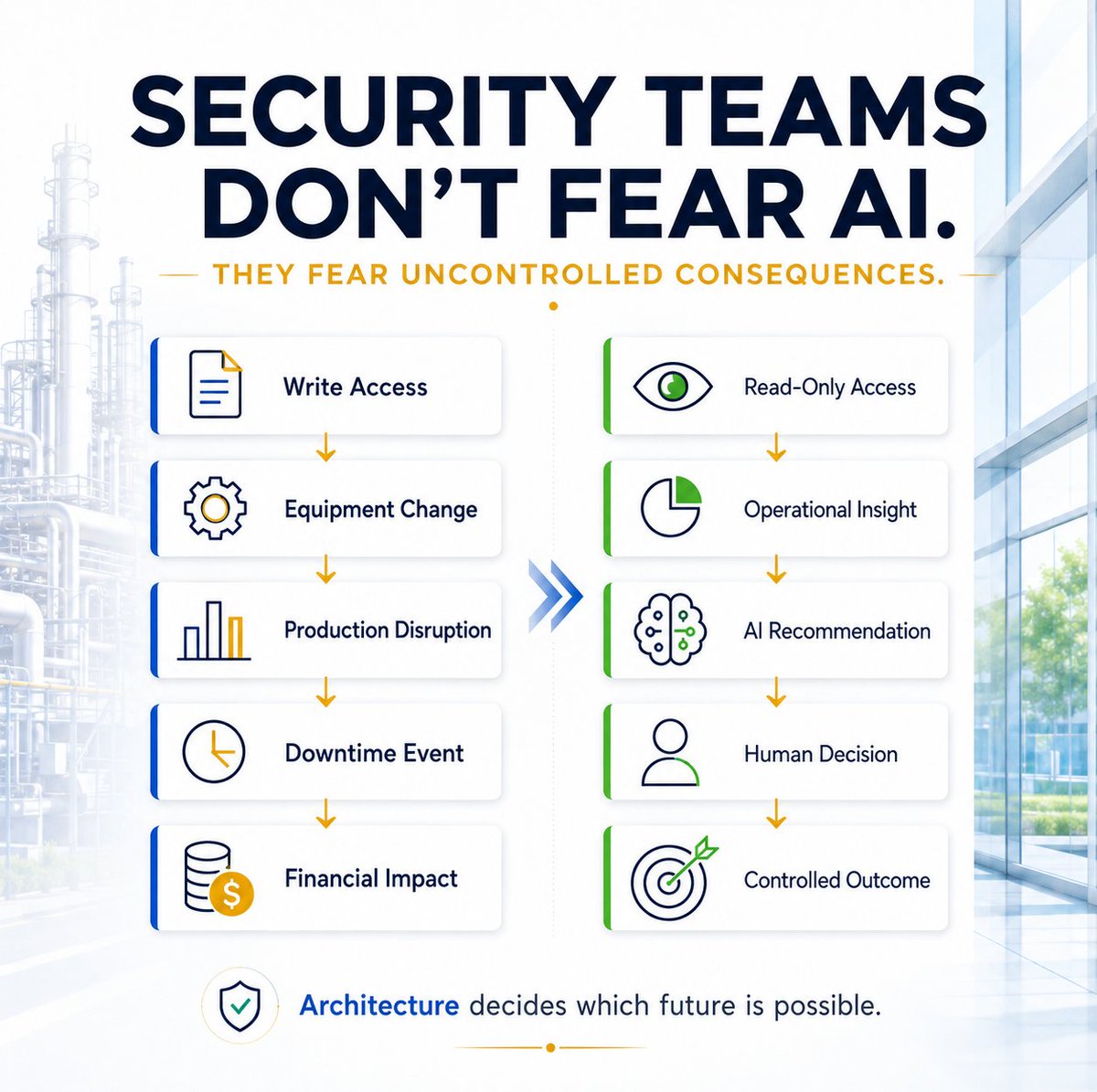
Most CISOs are not resisting AI because they dislike innovation.
They are resisting unknown architecture risk.
In manufacturing, cybersecurity is not just an IT issue.
It is an operational issue.
A compromised production environment can impact:
• Downtime
• Safety
• Physical operations
• Production continuity
So security teams ask very different questions about AI:
• Can it write into systems?
• Can it control assets?
• Can it access OT environments?
• Can it create new operational pathways?
Most vendors answer with certifications and policies.
But CISOs trust architecture more than promises.
That is why read-only industrial AI architectures matter.
Passive.
Segmented.
Operationally isolated.
The AI layer observes.
It does not control.
The next generation of industrial AI adoption may not depend on model sophistication alone.
It may depend on reducing architectural uncertainty enough for security teams to trust deployment safely at scale.
#CISO #Cybersecurity #OTSecurity #IndustrialCybersecurity #IndustrialAI #OperationalAI #ManufacturingAI #Industry40 #EnterpriseSecurity #DigitalTransformation #RiskManagement #ZeroTrust
Most industrial AI projects do not fail because the models are weak.
They fail because the models lack operational context.
Manufacturing environments are full of disconnected identifiers:
• Asset IDs
• Batch numbers
• Production orders
• Temperature readings
• Maintenance notifications
To humans, the relationships are obvious.
To AI models, they are just isolated labels unless context connects them.
That is the hidden problem in many enterprise AI initiatives.
The model receives data.
But not operational understanding.
Operational AI changes that.
Not by making models larger.
By connecting operational entities into a living contextual system.
So:
Temperature spike → Asset → Maintenance history → Production impact → Financial consequence
The next generation of manufacturing AI advantage may not come from deploying bigger models.
It may come from building stronger contextual intelligence underneath them.
#IndustrialAI #OperationalAI #ManufacturingAI #AI #Industry40 #SmartManufacturing #DigitalTransformation #EnterpriseAI #ManufacturingLeadership #OperationsManagement #OperationalExcellence #FactoryOperations
The real cost of workforce turnover rarely shows up in HR dashboards.
It shows up in operational performance.
A new operator completes onboarding.
But operational effectiveness still takes months.
During that time:
• Scrap increases
• Cycle times slow
• Supervisor intervention rises
• Quality variability grows
Because manufacturing expertise is not just process knowledge.
It is operational judgment built through experience.
Knowing how machines behave.
Recognizing abnormal conditions.
Making small adjustments before problems escalate.
Most organizations track training completion.
Very few track time-to-operational-effectiveness.
Operational AI changes that.
Not by replacing workforce training.
By making institutional expertise available in real time.
So new operators can access operational knowledge the organization already learned years ago.
The next workforce advantage in manufacturing may not come from hiring more talent.
It may come from reducing the time between onboarding and operational impact.
#Manufacturing #OperationalAI #IndustrialAI #WorkforceAnalytics #WorkforceDevelopment #SmartManufacturing #Industry40 #OperationalExcellence #ManufacturingLeadership #KnowledgeManagement #FactoryOperations #FutureOfWork
Most manufacturers do not lack innovation ideas.
They lack the ability to validate them fast enough.
A process change works on one line.
A material substitution improves yield.
An energy initiative reduces consumption.
But then the difficult questions begin:
• Was the improvement actually real?
• Did operator behavior influence the result?
• Was the equipment condition different?
• Would the outcome repeat elsewhere?
So organizations spend weeks reconstructing context after every trial.
Operational AI changes that.
Not by generating more ideas.
By connecting production outcomes directly with:
• Process parameters
• Equipment behavior
• Material variability
• Operating conditions
So the system understands not only whether an improvement worked…
…but why it worked, where it works, and whether it can scale confidently.
The next manufacturing advantage may not come from generating more innovation.
It may come from learning from experimentation faster than competitors.
#Manufacturing #OperationalAI #IndustrialAI #SmartManufacturing #Industry40 #ContinuousImprovement #OperationalExcellence #ManufacturingInnovation #ProcessImprovement #DigitalTransformation #FactoryOperations #InnovationManagement
Most manufacturing finance problems are not caused by missing data.
They are caused by slow operational understanding.
Finance sees the variance.
Operations sees the disruption.
Engineering sees the process issue.
But connecting those signals still takes days.
So organizations spend more time reconstructing causality than acting on it.
Operational AI changes that.
Not by generating more reports.
By connecting financial outcomes directly to operational context.
So a margin decline stops being just a number.
It becomes traceable instantly:
• Which asset changed
• Which shift was affected
• Which process drift occurred
• Which material issue created the impact
The next generation of manufacturing finance advantage may not come from better reporting.
It may come from reducing the time between economic signal and operational action.
#Manufacturing #ManufacturingFinance #OperationalAI #IndustrialAI #SmartManufacturing #Industry40 #OperationalExcellence #FinanceTransformation #DigitalTransformation #FactoryOperations #ManufacturingLeadership #DecisionIntelligence
Most workforce systems track activity.
Very few explain operational impact.
HR systems can tell you:
• Who worked
• Who completed training
• Who reports to whom
• Who has the certification
But they rarely explain:
• Which operators improve yield
• Which expertise reduces downtime
• Which training changes production outcomes
• Which workforce gaps create operational risk
So manufacturers still rely on proxies like tenure, titles, and supervisor observations.
Not because they lack workforce data.
Because workforce systems were never designed to connect people with operational performance.
Operational AI changes that.
Not by monitoring employees more aggressively.
By identifying which human capabilities consistently influence operational outcomes.
The next workforce advantage in manufacturing may not come from hiring more people.
It may come from understanding which expertise actually drives plant performance — and scaling it systematically.
#Manufacturing #IndustrialAI #OperationalAI #SmartManufacturing #Industry40 #DigitalTransformation #ManufacturingLeadership #FactoryOperations #FutureOfWork #OperationalExcellence #IndustrialTransformation
Most quality investigations do not suffer from missing data.
They suffer from disconnected systems.
Quality records exist.
Production history exists.
Machine telemetry exists.
But they rarely connect fast enough to explain causality in real time.
So when a defect appears, organizations manually reconstruct the operational chain:
• Inspection records
• Production activity
• Machine conditions
• Material usage
• Shift behavior
Hours turn into days.
Not because the information is unavailable.
Because operational context is fragmented.
Operational AI changes that.
Not by replacing quality systems.
By connecting production, process conditions, equipment state, materials, and inspection outcomes into one operational graph.
So a defect becomes traceable instantly:
Batch → Machine → Shift → Operator → Material lot → Process conditions
The next generation of manufacturing quality may not depend on more inspection points.
It may depend on reducing the time between defect detection and operational understanding.
Most manufacturing execution problems are not caused by poor decisions.
They are caused by slow operational adoption of decisions already approved.
Engineering updates the process.
SAP reflects the new BOM.
Leadership assumes execution has changed.
But the plant may still be running yesterday’s conditions.
Because operational change still depends on:
• Emails
• Meetings
• Shift handoffs
• Manual coordination
• Updated instructions
That delay creates hidden operational risk.
Yield drift.
Quality escapes.
Rework.
Inconsistent execution across plants.
Operational AI changes this.
Not by replacing engineering workflows.
By connecting engineering intent directly to live plant execution.
So process changes become operationally visible immediately:
• Which work centres are affected
• Which operators need guidance
• Which production orders are impacted
• Which machine settings require adjustment
The next manufacturing advantage may not come from making changes faster.
It may come from synchronising operational execution faster than competitors.
Most manufacturing AI projects do not fail because the models are weak.
They fail because the implementation path introduces operational risk.
Plants are not software sandboxes.
Downtime impacts revenue.
Cybersecurity impacts physical operations.
Architecture decisions affect production continuity.
So when organisations hear:
• Replace the ERP
• Rebuild the architecture
• Centralise everything first
…the business hesitates.
Not because it doubts AI.
Because the deployment model feels disruptive.
That is why architecture matters more than models in industrial AI.
The fastest path to operational intelligence is often not rip-and-replace transformation.
It is a read-only intelligence layer above existing systems.
Secure.
Passive.
Operationally invisible.
The ERP stays intact.
The historian remains the system of record.
OT environments stay protected.
But operational context becomes connected across the enterprise.
The next generation of manufacturing AI adoption may not be won by the most aggressive transformation programmes.
It may be won by the architectures that create the least operational friction.