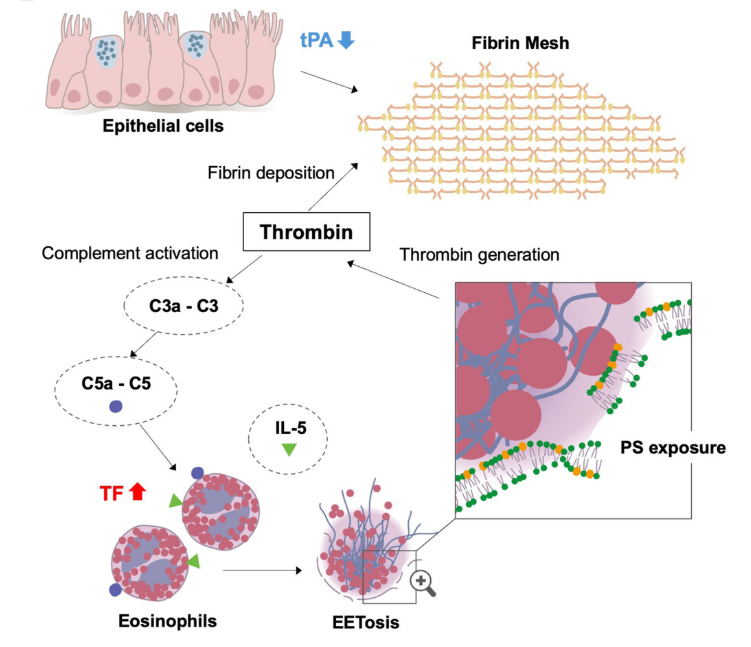
Open Access: Complement–Eosinophil Crosstalk Links Complement Activation to Fibrin Deposition in Eosinophilic Chronic Rhinosinusitis. First author: Ryo Hasegawa; corresponding authors: Shigeharu Ueki, Yoshimasa Imoto
Read the article here: https://t.co/Qu0JDfBF1k
In this study, Hasegawa et al. investigate the molecular mechanisms involved in eosinophilic chronic rhinosinusitis (#ECRS), a refractory endotype of chronic rhinosinusitis with nasal polyps (CRSwNP), by analyzing sinonasal tissue samples from patients with ECRS, non-ECRS CRSwNP, and control uncinate tissue. Their findings support the presence of a complement-eosinophil-coagulation in ECRS nasal polyps.
Watch the video abstract presented by the authors here: https://t.co/qj3yhW4GuC
#Allergy_journal
Read more articles published in #Allergy on #rhinitis here: https://t.co/D6F87lRTnj
Human and mice eosinophils are also different. Mouse eosinophils have low ROS-producing capacity and are less prone to ETosis.
Animal research is not always king: researchers should explore the alternatives https://t.co/Ru7zXHk3b5
How can it be that @EOSMAN_tweets#EosMan won’t be featured at #ATS2025 thoroughly enjoyed the talk by @CPorsbjerg / and specially on the importance of activating and degranulating eosinophils in severe asthma @EosinophilSoc
When a person has elevated numbers of #eosinophils, without a known cause, they may have an eosinophil-associated disease. This week is National Eosinophil Awareness Week. Share this video to help educate others! See more activities at https://t.co/39WzdLO5If. #neaw#eosaware