@ZARA_Care I purchased a pair of high-heeled boots just over a month ago, and they’ve already worn out. They’re clearly not suitable for Indian road conditions. Could you please assist with a repair or resolution? Customer care has declined so far. Thanks
The plane crashed directly on the BJ Medical College UG hostel mess in Meghani Nagar.
Many MBBS students have lost their lives. This is one of the most heartbreaking tragedies the city has seen. 💔
#Ahmedabad#BJMedicalCollege#PlaneCrash#AhmedabadPlanecrash
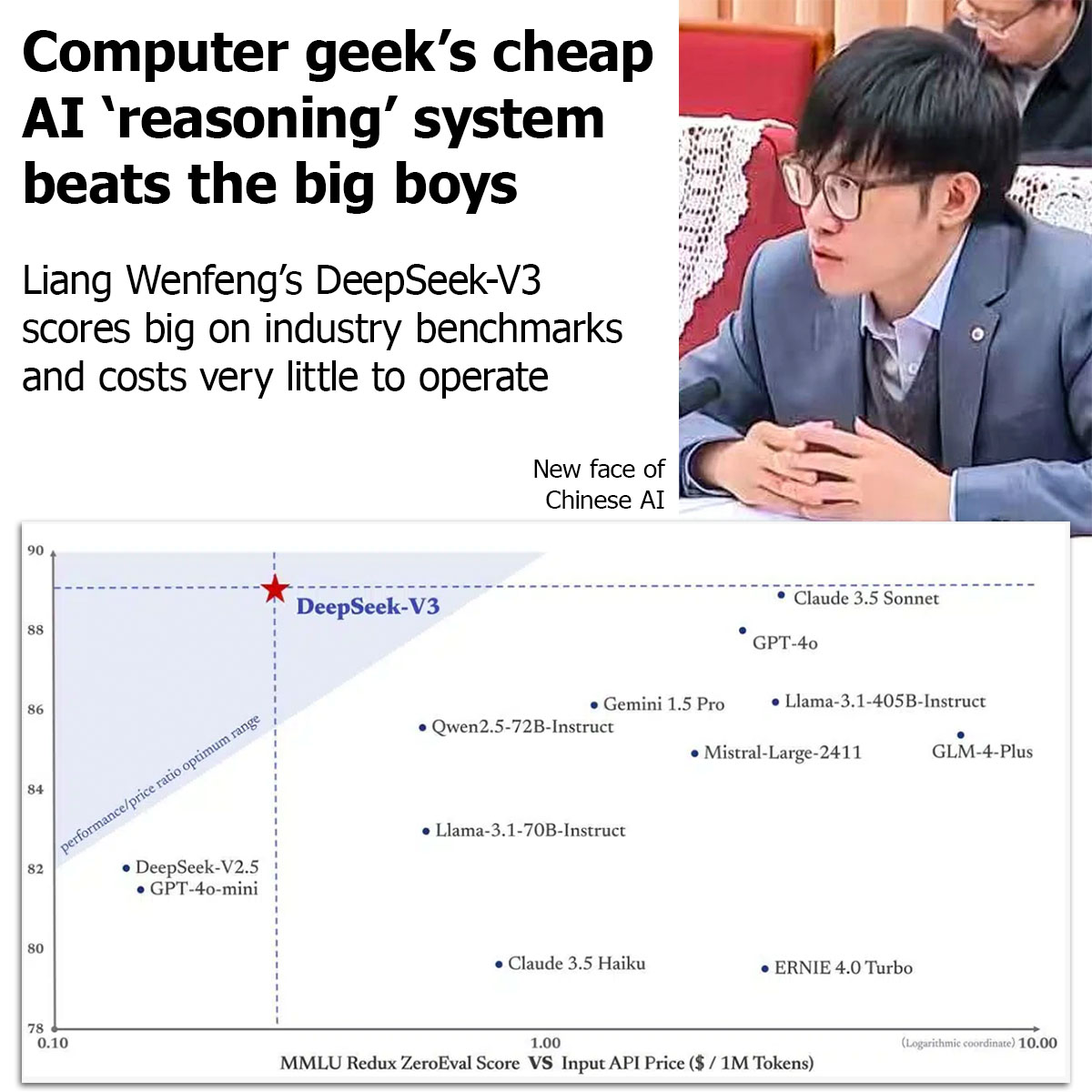
A Chinese computer nerd is stunning tech experts with a bargain price AI tool that beats the world's top players on several benchmarks.
Liang Wenfeng's system, called DeepSeek-V3, has powers of "reasoning" that match or beat those of the equivalent devices by the world's top tech companies, at a better cost, tests show.
"DeepSeek-V3 has emerged as the strongest open-source model currently available and achieves performance comparable to leading closed-source models," said Supreeth Koundinya, a tech analyst in India.
.
'BRILLIANT YOUNG MINDS'
While Liang and his colleagues spent more than a billion yuan over recent years to research and develop AI systems, the ground-breaking new model, DeepSeek V3 LLM, was developed in two months with a budget of just US$5,580,000, the cost of a single nice apartment in Monaco or Hong Kong.
In contrast, Meta's minimum AI budget for the financial year is a staggering US$38,000,000,000.
"Sometimes having less means innovating more," said San Francisco angel investor Henry Shi, writing on X yesterday. "DeepSeek proves you don't need billions in funding, hundreds of PhDs, a famous pedigree; just brilliant young minds, the courage to think differently and the grit to never give up."
.
CHEAP AND CHEERFUL
How did it happen? Liang, born in Guangdong, enrolled in Zhejiang University in Hangzhou where he worked on teaching computers how to see like humans do. Spotting an opportunity, he moved into the computer side of stock market trading, where he made solid money.
In his 30s, he saw a different opportunity and used the cash he had made to start an AI firm, called DeepSeek.
The Hangzhou-based start-up was invisible – until a recent series of tests showed that his cheap and cheerful recent model performed better at a lower cost than the best efforts of heavily financed top AI models developed by Meta Platforms and OpenAI, creator of ChatGPT.
.
MEETING CHINA'S LEADERS
Liang, now 40, moved further into the spotlight on Monday this week, when he appeared at a symposium hosted by China's Premier Li Qiang in Beijing--and became seen as the country's face of AI.
The US government has been trying to halt China's development by forcing companies and countries around the world, including in China-owned Taiwan island, to stop selling all but the most basic chips and chip-making equipment to the developing Asian country.
The western media justified the move by saying that China was using the chips for the military, but the west's own experts, at MIT, said 99.9 per cent were used for civilian purposes, such as to enable the functioning of medical scanners and engineering equipment.
A Chinese computer nerd is stunning tech experts with a bargain price AI tool that beats the world's top players on several benchmarks.
Liang Wenfeng's system, called DeepSeek-V3, has powers of "reasoning" that match or beat those of the equivalent devices by the world's top tech companies, at a better cost, tests show.
"DeepSeek-V3 has emerged as the strongest open-source model currently available and achieves performance comparable to leading closed-source models," said Supreeth Koundinya, a tech analyst in India.
.
'BRILLIANT YOUNG MINDS'
While Liang and his colleagues spent more than a billion yuan over recent years to research and develop AI systems, the ground-breaking new model, DeepSeek V3 LLM, was developed in two months with a budget of just US$5,580,000, the cost of a single nice apartment in Monaco or Hong Kong.
In contrast, Meta's minimum AI budget for the financial year is a staggering US$38,000,000,000.
"Sometimes having less means innovating more," said San Francisco angel investor Henry Shi, writing on X yesterday. "DeepSeek proves you don't need billions in funding, hundreds of PhDs, a famous pedigree; just brilliant young minds, the courage to think differently and the grit to never give up."
.
CHEAP AND CHEERFUL
How did it happen? Liang, born in Guangdong, enrolled in Zhejiang University in Hangzhou where he worked on teaching computers how to see like humans do. Spotting an opportunity, he moved into the computer side of stock market trading, where he made solid money.
In his 30s, he saw a different opportunity and used the cash he had made to start an AI firm, called DeepSeek.
The Hangzhou-based start-up was invisible – until a recent series of tests showed that his cheap and cheerful recent model performed better at a lower cost than the best efforts of heavily financed top AI models developed by Meta Platforms and OpenAI, creator of ChatGPT.
.
MEETING CHINA'S LEADERS
Liang, now 40, moved further into the spotlight on Monday this week, when he appeared at a symposium hosted by China's Premier Li Qiang in Beijing--and became seen as the country's face of AI.
The US government has been trying to halt China's development by forcing companies and countries around the world, including in China-owned Taiwan island, to stop selling all but the most basic chips and chip-making equipment to the developing Asian country.
The western media justified the move by saying that China was using the chips for the military, but the west's own experts, at MIT, said 99.9 per cent were used for civilian purposes, such as to enable the functioning of medical scanners and engineering equipment.
Known as ‘expert on Israel’ by his peers, Sanjeev Kumar Singla has contributed immensely in shaping India’s foreign policy and strategic partnership with Israel
#PMModi#India#Israel#Palestine
Reported by: @madhuparna_N
https://t.co/CkjjbVzgsf
India's leap in financial inclusion, powered by Digital Public Infrastructure!
A G20 document prepared by the @WorldBank shared a very interest point on India's growth. India has achieved financial inclusion targets in just 6 years which would otherwise have taken at least 47 long years.
Compliments to our robust digital payment infrastructure and the spirit of our people. It is equally a testament to rapid progress and innovation. https://t.co/S9TliHSeOH
Suddenly India has become home to at least 140 space-tech start-ups, leaping from five when the pandemic started. The country now stands to transform Earth’s connection to the final frontier. https://t.co/IUsDAis3pS
First His Arrest, Then Cops Turning Deaf Air to His Complaint of Life Threats & Protection Plea, Trying to Effect a 'Compromise' & Giving Him Advice to 'Lie Low' - Lapses that Led to Kanhaiya's Brutal Murder
My Story #UdaipurHorror#JusticeForKanhaiyaLal https://t.co/xe5w2eHX1R