Proud Family physician. Dad & husband. dedicated for helping patients. like soccer.@LFC fan.
Once you stop learning, you start dyeing.
KFMMC. Dhahran. KSA 🇸
Older adults who started statins, including patients with prefrailty at baseline, had a lower risk for incident frailty than those who did not.
“New statin initiation may lower the risk of incident frailty. Future studies are warranted to evaluate the benefits of statins in the primary prevention of frailty,” the researchers concluded. https://t.co/EwrnRcGGce
Elevated pre-stroke risk for atherosclerotic cardiovascular disease (ASCVD) was linked to worse cognitive outcomes in the decade after stroke, including faster global cognitive decline and an increased risk for dementia, a new study showed. “These findings imply that intervening on vascular risk factors before stroke might lower post-stroke dementia risk, potentially by reducing stroke severity or other mechanisms,” the investigators of the study wrote. https://t.co/UHLNuXeU91
C-peptide is the key surrogate for beta cell function in recent onset stage 3 T1D; restoring its use as a primary endpoint is essential to accelerate approval of disease-modifying therapies worldwide.
Read ➡️ https://t.co/ILW6yPYlmj
@AmDiabetesAssn@ADA_DiabetesPro@ADA_Pubs
Successful Endometriosis excision surgery is a major milestone — but recovery doesn't stop there.
Long-term healing is influenced by nutrition, sleep, gut health, movement, stress management, and correcting nutritional deficiencies built up over years of chronic inflammation.
HbA1c ≥5.7% defines dysglycaemia and high risk for type 1 diabetes but HbA1c rises with age — independent of glycaemia. Are we overestimating progression risk in adults? 🧵👇 #Type1Diabetes#HbA1c
Read here ➡️ https://t.co/XNO1cS3sPe
@AmDiabetesAssn@ADA_DiabetesPro@ADA_Pubs
The latest Double Take video outlines the five risk factors for cardiovascular disease and reviews strategies for blood-pressure control to reduce morbidity and mortality. Watch on YouTube: https://t.co/FWVyknc6Vp
The ramp up of cancer immunotherapy is remarkable. Now we're seeing vaccines achieve some cures or remissions in the most refractory cancers: pancreatic, melanoma, glioblastoma, renal, triple-negative breast cancer.
✓ out the new Ground Truths (link in profile)
Kidney disease (CKD) and heart failure (HFrEF, HFpEF): recent advances and current challenges: conclusions from @goKDIGO Controversies Conference ca. 2026 from @Kidney_Int#Nephpearls#Cardiorenal
👉 https://t.co/VPlVfQLLxj
A man spends 50 years teaching at MIT.
He knows his time is running out.
So he records one last lecture — everything he knows, distilled into a single hour.
He died 5 months later.
This is that lecture.
The most important hour you'll watch this week. 👇
Bookmark it for later
To an exceptional surgeon,
Thank you for your years of dedication, compassion, and hard work. Your care and kindness have touched countless lives, and your legacy will always be remembered. Wishing you a retirement filled with happiness, good health, and beautiful new beginnings.
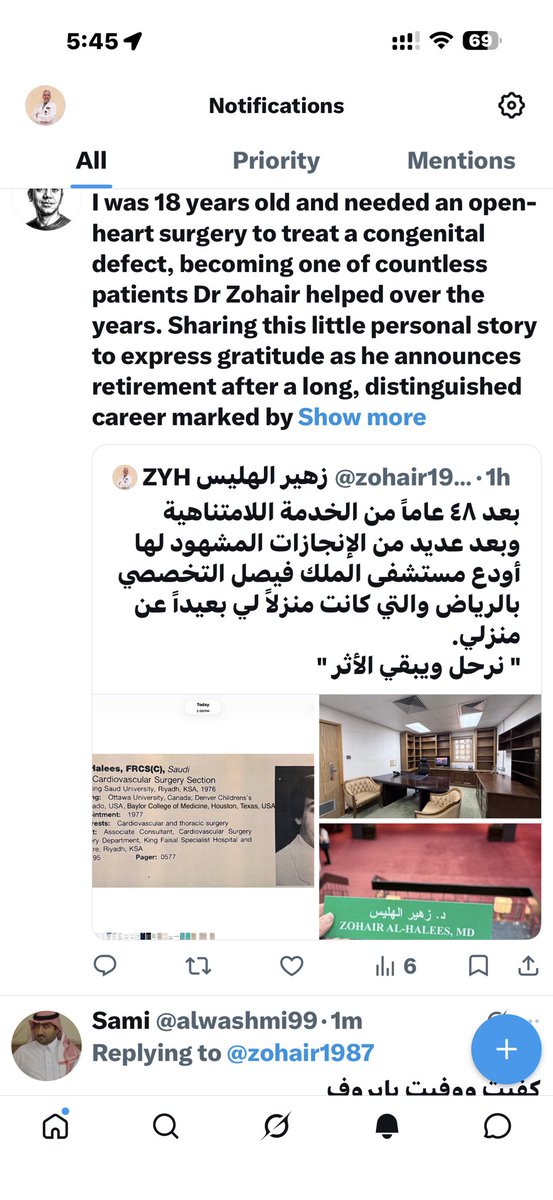
After 48 years of dedicated service with so many accomplishments,I bid a heartfelt farewell to KFSHRC-Riyadh which was my home away from home.
"We depart but the legacy endures"
@zohair1987 To an exceptional surgeon,
Thank you for your years of dedication, compassion, and hard work. Your care and kindness have touched countless lives, and your legacy will always be remembered. Wishing you a retirement filled with happiness, good health, and beautiful new beginnings.
Two new studies have identified risk factors that may be associated with the increasing incidence of colorectal cancer among younger Americans. Because the majority of cases are sporadic, evidence suggests modifiable, nongenetic factors such as inflammatory bowel disease, severe obesity, and history of oral antibiotic exposure play an important role. Review the full study findings from Digestive Disease Week 2026: https://t.co/kBd5jAJ2Z6
📊 JAMA Clinical Guidelines Synopsis: #HelicobacterPylori infection is a leading cause of chronic #gastritis, #peptic#ulcers, and #gastric#cancer.
The American College of Gastroenterology guideline for adults in North America recommends bismuth quadruple therapy for 14 days as first-line treatment in treatment-naive patients, due to superior eradication rates compared with proton pump inhibitor (PPI) triple therapy.
https://t.co/qaAazlwrfS
The recording from today's Baim Grand Rounds with @AnnMarieNavar titled "Lipoprotein(a): What We Know and What's on the Horizon?" is now available on the Baim website. You can find it here: https://t.co/f3LzV8cZyA
A community college professor taught the same study skills lecture for 30 years, and the video quietly became one of the most watched educational recordings on the internet.
His name is Marty Lobdell. He spent his career as a psychology professor watching students fail not because they were lazy, but because nobody had ever taught them how their brain actually works under the pressure of learning something hard.
The lecture is called "Study Less Study Smart." Over 10 million views. Passed around in Reddit threads, Discord servers, and university study groups for over a decade. And the core insight buried inside it has been sitting in cognitive psychology research for years, waiting for someone to explain it in plain language.
Here is the framework that completely changed how I think about effort.
Your brain does not sustain focus the way you think it does. Studies tracking real students found that the average learner hits a wall somewhere between 25 and 30 minutes.
After that, efficiency doesn't just decline. It collapses. You're still sitting at your desk, still looking at the page, but almost nothing is going in.
Lobdell illustrated this with a student he knew personally. She set a goal of studying 6 hours a night, 5 nights a week, to pull herself out of academic probation. Thirty hours of studying per week. She failed every single class that quarter.
She wasn't failing because she lacked effort. She was failing because she had confused time spent near books with time spent actually learning. The 25-minute crash hit her at 6:30pm every night. She spent the next five and a half hours sitting in the wreckage of her own focus and calling it studying.
The fix sounds almost too simple. The moment you feel the slide, stop. Take five minutes. Do something that actually gives you a small reward. Then go back. That five-minute reset returns you to near full efficiency. Across a six-hour window, the difference is not marginal. It is the difference between thirty minutes of real learning and five and a half hours of it.
The second thing he taught destroyed something I had believed about how memory actually works.
Highlighting feels productive. Going back over your notes and recognizing everything feels like knowing. But recognition and recollection are two completely different cognitive processes, and your brain is very good at making you confuse them.
You can see something you've read before and feel completely certain you understand it, even when you couldn't reconstruct a single sentence from memory if the page were blank.
He proved this live in the room. He read 13 random letters to his audience. Almost nobody could recall them. Then he rearranged the same 13 letters into two words: Happy Thursday. The whole room got all 13 without effort.
Same letters. Same count. The only thing that changed was meaning.
The brain stores meaning. Not repetition. The moment new information connects to something you already understand, the retention changes entirely.
This is what the cognitive psychology literature calls elaborative encoding, and it is the mechanism underneath every effective study technique.
The third principle was the one that hit me hardest, and the one almost nobody applies.
Lobdell cited research showing that 80 percent of your study time should be spent in active recitation, not passive reading. Close the material. Say it back in your own words.
Teach it to someone else, or to an empty chair if no one is around. The struggle of retrieval is where the actual learning happens. Reading your notes again is watching someone else do the work.
His parting line has stayed with me longer than almost anything else I have read about learning.
He told the room that if what he shared didn't change their behavior, they hadn't actually learned it. It would just live in their heads as something they had heard once and felt good about.
He was right. And most people leave every lecture exactly like that.
The students who remember everything aren't putting in more hours.
They stopped confusing the feeling of studying with the fact of it.