My biggest lesson: distributed systems are defined by their failure behavior—not by how many technologies they use.
Next: stronger delivery acknowledgement, partition safe deduplication, graceful cache failures, and integration testing.
Code: https://t.co/1ztjU0raRo
#BuildInPublic #Django #Kafka #BackendEngineering
I’m building ChatPulse, a terminal-based chat platform, as a practical way to learn backend and distributed-systems engineering in public.
Check it out: https://t.co/qc2alpKP1F
Users can authenticate, create or join rooms, and chat directly from the CLI. 🧵
Redis also forced an important design decision:
It can accelerate membership checks and cache room data, but PostgreSQL must remain the authority for authorization.
A cache outage should not silently change who is allowed to access a room.
I have been using Omarchy for just two days, and the experience has been exceptional. The keyboard-first workflow, polished defaults, and fast navigation make Linux feel focused and productive. A great setup for developers. 🚀
PS: The wallpapers and themes are super exceptional.
Looks like I gotta stop obsessing over writing better code and start learning infra, architecture, and how to leverage multi-agent loops.
The code might be ephemeral now, but the complexity definitely isn’t. 😅
Time to level up from code monkey to intent architect. 🚀
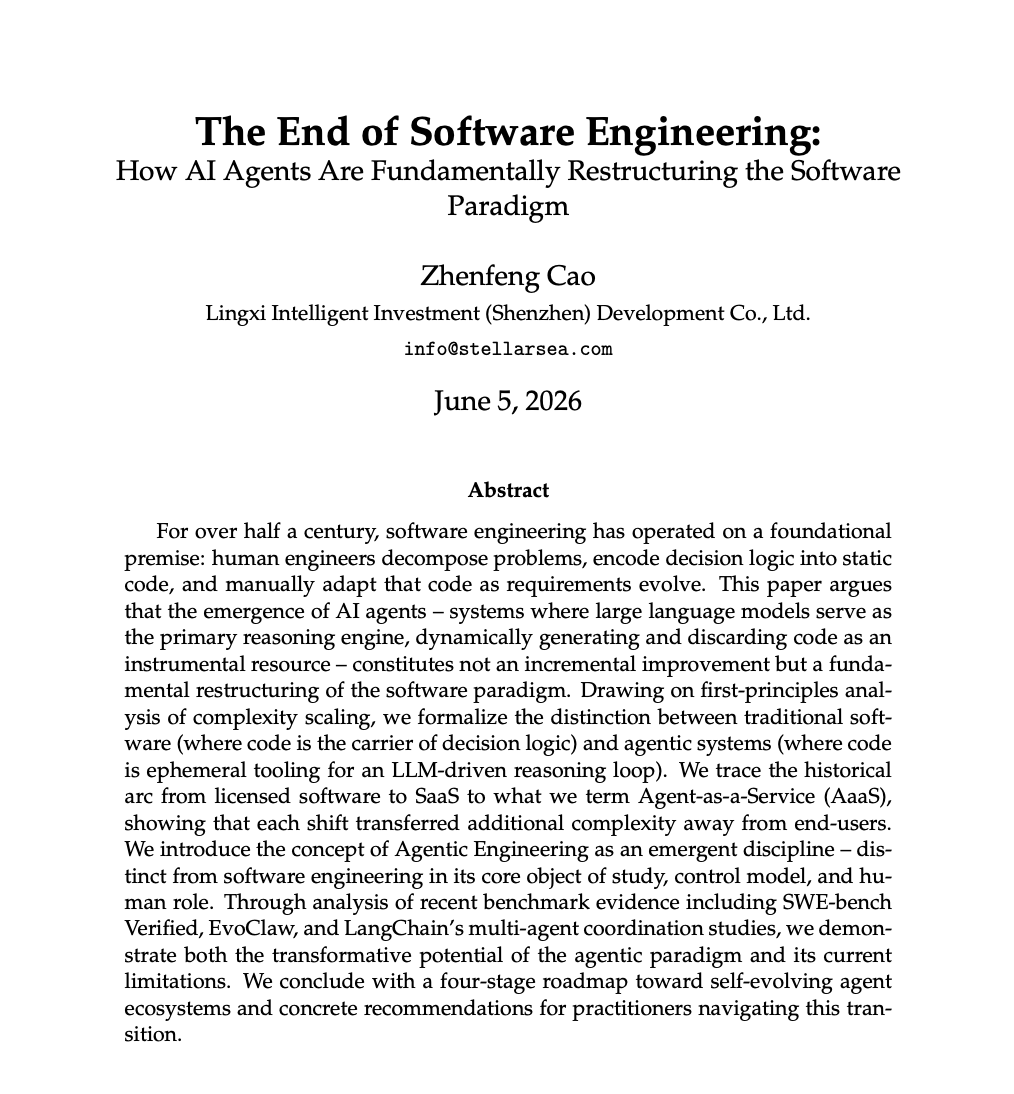
Chinese researchers published a paper with a devastating title: "The End of Software Engineering”
it argues software engineering is finished.
In traditional software, code is the carrier of pre-written human logic.
In agentic software, the AI agent is the software.
Code is no longer a permanent monument built by human hands. It is completely ephemeral, dynamically generated, executed, and discarded on the fly by an LLM-driven reasoning loop.
Think about how software delivery has evolved:
• Era 1: On-premise licensed software (you installed it locally)
• Era 2: SaaS (hosted in the cloud, managed by vendors)
• Era 3: Agent-as-a-Service (AaaS)
Each historical shift transferred complexity away from the user. But this latest shift transfers something entirely different.
It transfers decision-making complexity itself.
The paper argues that traditional engineering is hitting a hard complexity wall. Human brains can only hold so much state, manage so many dependencies, and debug so many lines at once.
LLM-based agents scale non-linearly.
They don't just write functions faster. They navigate architectural complexity by outsourcing reasoning to models that improve every single month.
Which means the role of the developer is permanently changing.
You are no longer a code author typing syntax line by line.
You are an intent architect.
Your job is no longer writing the implementation. It is specifying goals, designing multi-agent coordination loops, and auditing outcomes.
Petit point Omarchy, deux jours plus tard.
Après le premier contact et l’installation éclair de dimanche, place au vrai quotidien. J’ai passé une après-midi à travailler directement sous Omarchy.
Verdict : l’installation de tous mes outils s’est faite de manière étonnamment fluide, notamment grâce à l’IA, qui m’a guidé pas à pas vers les bonnes commandes.
Côté setup dev, Cursor s’est installé sans le moindre accroc. T3 Code a été un peu plus capricieux, mais il a fini par passer. J’ai même demandé à Codex de le configurer proprement pour récupérer ses mises à jour directement via « omarchy update ».
Et ça marche.
La découverte du jour : mise.
En installant Node, je le trouve déjà présent sur la machine. En revanche, pas de NVM dans le setup par défaut, alors que j’ai l’habitude de gérer mes versions de Node par projet avec NVM sous macOS.
À la place, Omarchy utilise un outil que je ne connaissais pas : mise.
Et franchement, c’est très bien pensé. Il place sa configuration directement dans le repo et sélectionne automatiquement la bonne version. Je n’ai même pas essayé de réinstaller NVM, je suis passé à mise sans réfléchir.
Un autre réflexe à prendre : sous Arch, on n’installe pas directement un fichier `.deb`.
On privilégie les outils Omarchy, soit en ligne de commande, soit via Super + Space, puis Install. Il existe même une entrée dédiée au développement avec Node, Bun et Deno.
En clair : paquets Arch ou AUR en priorité, conversion d’un `.deb` en dernier recours.
Mais le plus bluffant, c’est l’IA intégrée.
Premier incident : une commande tente d’activer le Bluetooth alors que je n’en ai pas. Rien de grave, mais Omarchy m’envoie une notification pour résoudre l’erreur. Je clique, ChatGPT s’ouvre et un agent commence seul à chercher la source du problème.
Deuxième cas, plus sérieux : un crash de T3 Code.
Même réflexe, je lance Codex dessus. Le diagnostic tombe en quelques secondes : ni la mémoire, ni Wayland, ni le GPU, ni mes données.
T3 Code, qui repose sur Electron, avait été lancé dans un sandbox restreint pour exécuter un simple `--version`. Le filtre seccomp a bloqué un appel système que Chromium considère comme fatal.
Un cas très spécifique de sandbox imbriqué, pas un bug d’Omarchy.
Obtenir ce niveau d’analyse sans quitter le bureau, c’est impressionnant.
Sur ma tour, tout est extrêmement fluide, mais c’est un peu de la triche vu le matériel.
Le vrai test arrive maintenant : installer Omarchy sur mon vieux Mac mini. Avec un matériel plus ancien, cela ne devrait logiquement pas être aussi impeccable. C’est justement ce que je veux vérifier.
Je reviens vers vous quand j’aurai terminé l’installation et un peu utilisé le Mac mini sous Omarchy.
Just discovered Omarchy and now I’m curious to try it out. 👀
Arch + Hyprland + Quickshell, AI-native workflow, quick shell, plugins, tiling, and its own package repo on top of AUR for a more controlled setup.
Looks pretty interesting. Time to install and break things. 🐧
🏆 Top 30% at the OpenAI × NamasteDev Codex Hackathon — here's what I built 👇
CodeLens — AI that understands any GitHub codebase in minutes.
Paste a URL → architecture docs, API schemas, DB analysis, diagrams, and a RAG chat that answers from your actual code.
Github: https://t.co/bXO2xl7X9l
Live: https://t.co/aIppV5KAi8
Biggest bug: asyncpg didn't work with pgvector, so my search feature broke. Switched to psycopg and fixed it with some raw SQL.
Lesson: check compatibility BEFORE picking your tools.
What I learned:
• Building the Kafka consumer taught me more about failure modes than any tutorial
• Redis caching showed me the gap between "it works" and "it works at scale"
• Manual offset commits forced me to think about what happens when things crash
Live: https://t.co/FzMmrCxnAi
GitHub: https://t.co/jjCpB6qjFc
Feedback welcome.
I just shipped ChatPulse — a real-time chat platform built to understand how production-grade messaging systems actually work.
Live at https://t.co/4Ipvbbz1DC
Code: https://t.co/e3HqPMSb9W
Here's the full breakdown. 🧵