Most AI & SaaS startups are still using a 2018 SEO playbook and it’s failing them in the age of Perplexity, ChatGPT, and Gemini.
Here is why traditional SEO is dying and how Generative Engine Optimization (GEO) is replacing it 👇 https://t.co/OL1xbq0qdA
We tested a client in AI tools with 3 prompts:
"Best AI image generator for beginners"
→ Top 3 recommendation
"Best lesser-known AI image generator"
→ Named #1
"Midjourney alternatives for beginners"
→ Named #4
4 months ago, this brand had 0 organic traffic on its key page.
Today: 5.6K monthly organic visits and 150 Google AI Overview appearances.
What changed? Not the product. Not the website.
Here's how we helped:
→ Picked the one page that mattered most
→ Mapped the keywords and topics buyers actually search
→ Placed editorial articles on trusted tech and AI publications
→ Gave every article its own angle, no repeated templates
→ Kept the brand description consistent across every mention
AI tools don't only read your site. They look at what others say about you.
Try your own category prompt. Does your brand show up?
#target2links #seo #saas #growth
Ask ChatGPT "best AI video generator" or "best AI writing tool" and watch what happens. Some brands get named every time. Others, with better products, never appear. The difference usually isn't the product. It's the third-party coverage.
@acecreamu Exactly. A citation alone doesn’t tell the full story. The context around the mention matters especially whether AI is defining, comparing, or actually recommending the brand.
AI visibility is becoming the new layer of SEO.
It’s not just about ranking anymore being mentioned, cited, and recommended by AI matters too.
The real question: Is your brand visible where your customers are asking AI for recommendations?
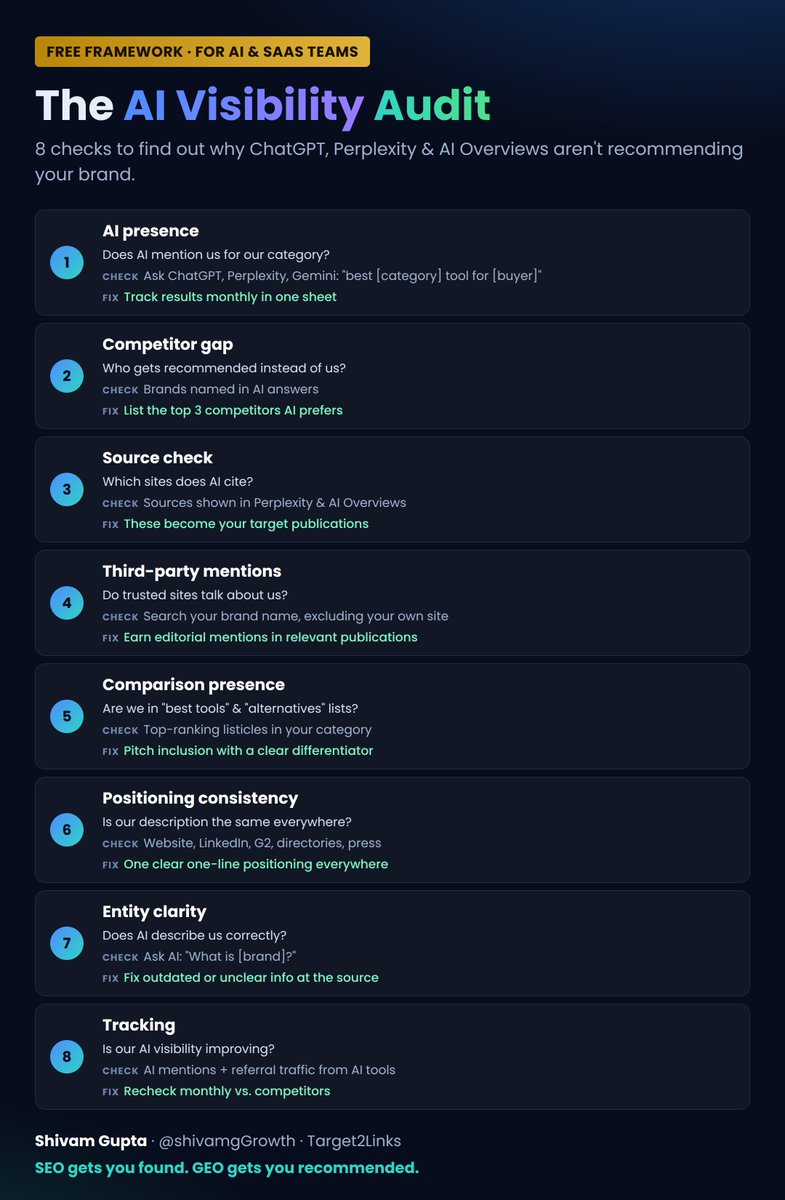
I made a free AI Visibility Audit framework for SaaS teams.
8 checks to find out why ChatGPT, Perplexity and Google AI Overviews aren't recommending your brand.
Each step has:
→ The question to ask
→ What to check
→ How to fix it
Bookmark it. Run it this week.
Reply "AUDIT" and I'll send the full sheet.
@lilyraynyc This is an important distinction. LLMs can use the information from a page while completely ignoring its self-promotional recommendation. Makes third-party authority increasingly interesting for AI search visibility.
GEO = Generative Engine Optimization
SEO: getting your pages ranked on Google
GEO: getting your brand mentioned in AI answers
Here's why that matters:
Your buyers now ask ChatGPT, Perplexity, and Google AI Overviews things like:
"What's the best tool for X?"
AI doesn't show 10 blue links.
It gives one answer with a few brand names.
And it picks those names based on:
→ Where your brand is mentioned
→ What trusted sites say about you
→ How consistently your category and use case are described
That's why you can rank #1 on Google and still be missing from AI answers.
SEO gets you found.
GEO gets you recommended.
Different goals, so they need different work.
An AI SaaS company came to us with a problem most founders don't notice until it's too late. Their product was genuinely good.
Their website was solid.
Their team was shipping fast. But outside their own site, almost nobody credible was talking about them. And that matters more than ever. Because today, buyers don't just Google "best AI tool for X."
They ask ChatGPT. They ask Perplexity. They ask Gemini. And those tools don't recommend the brand with the best landing page.
They recommend the brand the rest of the web keeps mentioning. So we didn't chase quick wins. No mass guest posts.
No random "write for us" sites.
No vanity metrics. Instead, we focused on three things: Publications their buyers actually read
Mentions that explained what the product does and who it's for
Consistency, month after month
4 months later:
→ 80+ editorial placements in relevant publications
→ Stronger authority across the web
→ A brand that finally showed up in the right conversations. The biggest lesson? Visibility isn't about being everywhere.
It's about being mentioned in the right places, in the right context, often enough that people and AI both remember you. If you're building an AI or SaaS product and feel invisible outside your own website, that's usually the gap.
Google SEO isn't dead, but B2B discovery has completely shifted. 70%+ of deep tech buyers use ChatGPT, Perplexity, or Claude to evaluate tools. If LLMs aren't citing your brand, you don't exist in the final answer.
3 GEO rules for 2026:
• Contextual editorial mentions > spammy backlinks
• Strong entity co-occurrence in tier-1 media
• Data-dense, extractable insights. Optimize for AI search answers, not just static page 1 ranks.
Old B2B Playbook:
Write 20 keyword-stuffed blogs a month for Google. New B2B Playbook:
Build high-tier Editorial Authority so ChatGPT recommends you. One builds digital noise. The other builds a brand. Which strategy are you betting on this year?
@Charles_SEO Important clarification from Google. The EEA-specific treatment is especially interesting it reinforces how site reputation signals and third-party content need to be approached with genuine editorial value in mind, rather than simply exploiting established domains.
@Nickeubanks This is a great example of how strong content-market fit can create search momentum even without an established link profile. The early traction is impressive; curious to see how this compounds as the domain matures.
Modern B2B marketing isn't about getting the most traffic anymore. It’s about getting the right traffic.If your content doesn't build Editorial Authority, it's just digital noise.Agree or disagree? Let me know your thoughts below. 👇#MarketingStrategy#B2B#SaaSGrowth
Most SaaS teams optimize for rankings.
Almost none optimize for being cited.
Google rankings ≠ AI trust.
ChatGPT, Perplexity, Gemini don’t care where you rank they care where you’re mentioned.
Editorial authority > backlinks.
Contextual mentions > guest posts.
The gap is real. Most brands haven’t noticed yet.