Networks Explorer; Fascinated by Data, Dynamical Systems & Neuroscience; AMATH & ECE assoc prof @UW; frmr Research scientist @Facebook; Happy Dad; tweets my own
Today at #neurips22 Trung Le is presenting STNDT work at J #638 stand. Definitely stop by to learn more@about spatio temporal transformers for neural data!
Today at #neurips22 Trung Le is presenting STNDT work at J #638 stand. Definitely stop by to learn more@about spatio temporal transformers for neural data!
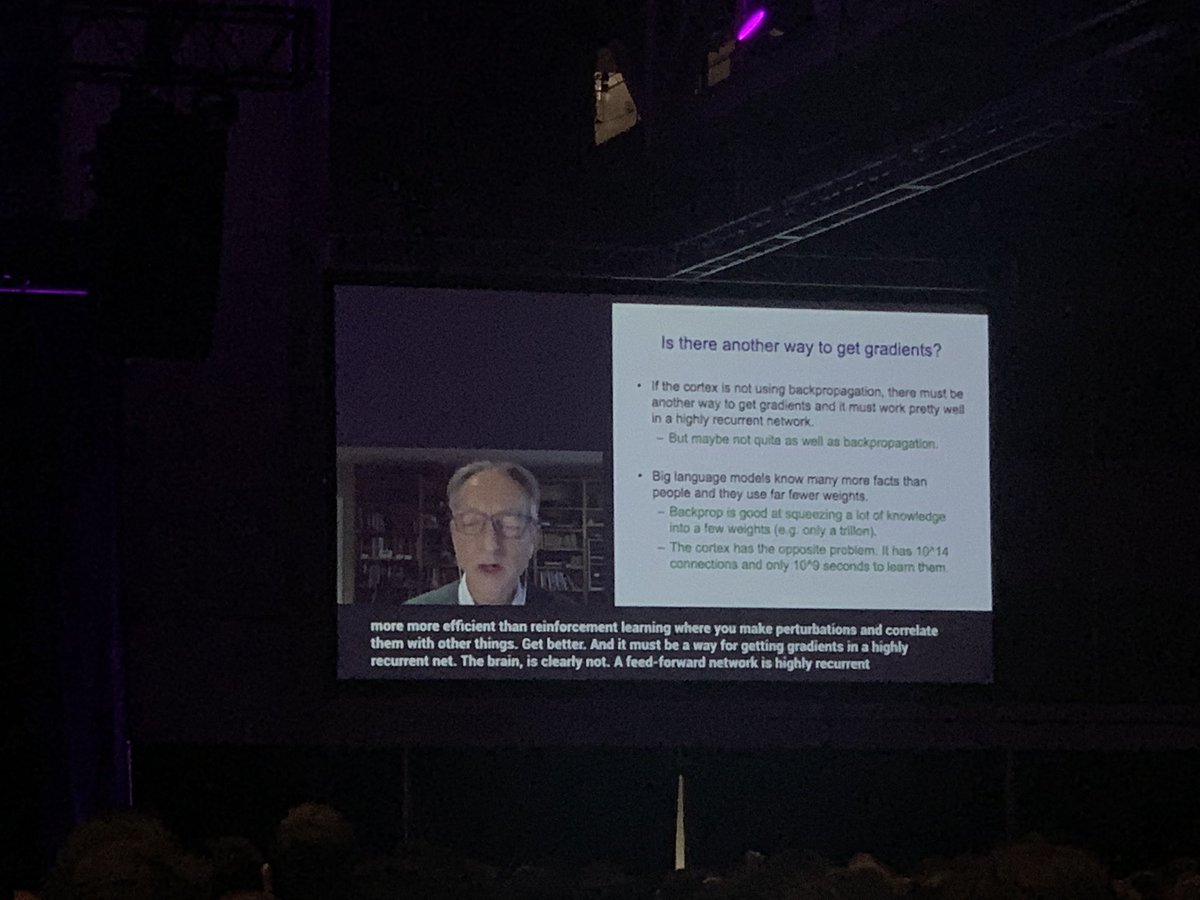
Geoff Hinton presents Forward forward networks at #NeurIPS22 plenary. An attempt to substitute back propagation with more biologically plausible learning.
Before we all start dissecting the neuralink show and tell tomorrow I wanted to share some of the other neurotech startups that I think are doing cool stuff (besides us at @motifneuro of course!)
It’s a great #neurotechrevolution community!! 🧵
The next @a3d3institute seminar on Monday, Oct 24 at 12 pm PT is on “Distributed coding of vision, action, and cognition in the mouse brain” by @SteinmetzNeuro. Join this event at https://t.co/GcKaQq0qR9
@kvnlxm @TrackingActions@shlizermangrp The clustering model that we use is not new but introduced in papers that I’ve mentioned. I believe they were published before VAME but from first read the latest BioRxiv version of VAME doesn’t include benchmarking against or citation. That’s why I’ve suggested to benchmark.
We’re excited to release an alpha ver of #OpenLabCluster(OLC)!👇
OLC is open-source project for classifying behaviors of animals in videos with unsupervised and active deep-learning to minimize the number of labels needed. You’re welcome to give it a try! https://t.co/jGj8IRtAmR
OpenLabCluster: Active Learning Based Clustering and Classification of Animal Behaviors in Videos Based on Automatically Extracted Kinematic Body Keypoints https://t.co/zkw6Kfu9y2 #bioRxiv
@kvnlxm @TrackingActions@shlizermangrp There is indeed more work to do to bring the preprint to a journal paper and code to a solid tool. We appreciate the feedback and working on these items!
@kvnlxm @TrackingActions@shlizermangrp I’m trying to explain on which model our work is based and conceptual differences. We didn’t try VAME yet since we weren’t aware of it (that’s the reason for no reference :) ). Of course we will be happy to cite it and also to benchmark it.
@kvnlxm @TrackingActions@shlizermangrp While clustering by itself is important it is equally important how the classifier interprets the clustering. We benchmarked several encoders- decoders on SOTA human skeleton keypoints and found the above to perform better than VAE or beta-VAE.
@kvnlxm @TrackingActions The clustering part is based on @shlizermangrp earlier work: predict & cluster, CVPR 20 https://t.co/3O0xPGqRMS and Encoder-Decoder interpretable analysis https://t.co/WIn6e35pYJ
@TrackingActions @kvnlxm Thanks! We are currently working on more baselines comparisons and discussion but wanted to release this alpha version of the project to the public to get feedback! DLC 2+ citation should’ve been there - this is being amended.
@kvnlxm Thanks for interest @kvnlxm! We are currently working on performing + publishing baselines comparisons but wanted to release this alpha version of the project to the public to get feedback! We’re also updating citations and discussion with latest.
The next @a3d3institute seminar on Monday, Oct 24 at 12 pm PT is on “Distributed coding of vision, action, and cognition in the mouse brain” by @SteinmetzNeuro. Join this event at https://t.co/GcKaQq0qR9
OpenLabCluster: Active Learning Based Clustering and Classification of Animal Behaviors in Videos Based on Automatically Extracted Kinematic Body Keypoints https://t.co/zkw6Kfu9y2 #bioRxiv