lowkey my old agents.md was the problem. it was all stuff i'd tell a junior dev, like only change what's asked and ask if unclear. rewrote it after @felixrieseberg's post to focus on goals and proving stuff works and claude started doing stuff i wouldn't have thought to ask for
Hi, I'm Felix. I'm an eng lead working on Claude. I love watching people take flight and do things they never thought possible.
We often describe that as "being more ambitious" when using AI, which is tricky advice to follow. I wrote a tutorial:
https://t.co/vNPPs5FWm8
Yea this is the most important result of the year, at the level of significance of “Attention Is All You Need”. It brings us from “is alignment even solvable” to “we may solve alignment in the next year.” And finally unlocks true recursive self-alignment enabled by RSI.
I will try to explain the 4 critical belief updates from this:
1/ neural networks are not fundamentally unintelligible to humans
It has seemed since the beginning of deep learning that neural networks are in some sense fundamentally unintelligible artifacts.
You throw in massive amounts of compute and parameters and these alien systems somehow find connections in the data that we cannot find ourselves.
But more importantly, these connections seemed not just “difficult to understand” but rather “intelligible in an embedding space higher dimensional that the human embedding space.”
When you look at old interpretability papers (esp. from Nick and Chris Olah, I’m thinking of the old posts on distill pub which I would highly recommend looking at as a precursor to reading Nick’s post today like “Activation Atlas”, “Thread: Circuits” and “Multimodal Neurons in Aritifcial Neural Networks”), you find that inspecting the response patterns of individual neurons and small groups of neurons yield oddly complex psychedelic patterns.
As you go deeper into the network, you find increasingly unintelligible and superhuman response patterns (for example, go to “Activation Atlas” and scroll to middle layer labeled representations) - you find some neuron group labeled “starfish” who’s response pattern looks like some multi-colored fractal geometry that could hardly be said to represent a starfish.
The reasoning that followed from this observation was that there is some underlying structure allowing a neural network operating on higher dimensional embeddings to compose these fractal patterns into what we call a “starfish.”
But the uncomfortable implication of this view is that the neural networks has learned to operate on structures that are too complex for the human mind to operate on (ie. we don’t have enough parameters in our brain to notice or manipulate these high dimensional symbols).
This is a bleak implication because it also means that as deep learning progresses, neural networks will be come increasingly unintelligible to us until they pass a threshold where they are reasoning in ways we will never be able to observe.
This view seemed to be further supported by things like the hugging face attack agents starting to speak to each other in an early form of neuralese speaking sentences like “zZ_123_agent01-02-2026 zzxhk_jekk123” which clearly are not in any human language. But somehow these symbols mean the same things to many different sets of weights, meaning there is some underlying shared structure behind them. And seemed further supported by the sheer effort required to recover just a few circuits from SAEs on LLMs.
However, Nick’s post has now completely shattered this idea - the apparent unintelligibility we observed in old interpretability work was really just a “skill issue”. In particular, he finds that 1) our deep learning techniques were just not clean enough to pressure the neural networks to form cleaner and more human understandable structures for decomposing concepts, which actually turn out to be more optimal and 2) our interpretability techniques were also adding substantial noise by forcing interp networks to “reward hack” the easiest representations they could find, leading them to settle for a fractal blob for its representation of the starfish neuron instead of a more crisp starfish image, simply because it is easier for the system building the interpretations to find the fractal blob and once it finds it it gets “stuck in that line of thinking.”
But with both of these issues being patched by further progress in deep learning (it seems especially that the residual stream has led to cleaner representations deeper down the network) and interp techniques that don’t overly pressure reward hacking (seems like “guess and check” is a safer method), new interp attempts yield orders of magnitude more human intelligible ideas for >90% of individual neurons in more complex networks!
2/ neural networks are fundamentally clean
The idea behind the title of Nick’s post is a very powerful one and points at something very specific:
Neural networks don’t just happen to be human interpretable, they are actually fundamentally forced by optimization pressure to be intelligible, because individual neurons need to create representations that downstream neurons need to be able to interpret - ie. neurons need to learn to produce clean signal for later neurons to use.
This is what Nick is saying in what I view as the most important and central sentences of his post:
“When I say neural networks are already clean, I mean something deeper than neuron monosemanticity, although even by that standard, I think things look much better than the field expects. I mean that a network's parts are built to be read, and built upon, by its downstream readers. In this sense, a neural”
But this still leaves us with the same uncertainty as before - just because neuron interpretations are “interpretable” in some sense (ok at least they’re not fundamentally interpretable but also how could that ever have been the case), doesn’t mean they are interpretable to humans.
So we still need one big update for this to become as bullish as it is.
3/ the language of humans and the language of neural networks is the same
This one is imo the most surprising and also pretty beautiful implication of Nick’s post, and it suggests something not just about neutral networks but also about the structure of reality.
After applying the above technique improvements (some of which just came from waiting for deep learning to improve farther), they find that >90% (maybe more) of much larger neural networks’ neurons are completely human interpretable and actually correspond very cleanly with ideas humans have individually words for.
This is especially interesting in image networks where neural networks were not trained on human language which is already a human artifact and so maybe you would expect it to be more plausible that LLM and human representations are the same. Image detection networks are just trained on images (many directly pulling signal from “the real world,” meaning they will find interpretations that are just most effective to represent the real world signal, rather than to represent language which is already a proxy for real world signal).
And it turns out that >90% of the representations they pick organically overlap with human ideas! That is insane. And it means something about the brain and reality.
It means that at least at the parameter sizes of the networks tested (which are quite large), there is really only one set of “optimal” symbols/language that represents the structure of reality!
There is ONE underlying structure of reality, and ANY language that describes it well is simply emergent from that structure - meaning there is always a translation path between any 2 languages that effectively compress realities signal through the “underlying truth.”
This would suggest that even weird alien seeming neural network languages like huggingface neuralese should be fundamentally human interpretable, and in fact maybe with the techniques laid out here we will eventually be able to translate these messages (would be a cool project).
So the brain and deep learning, as similar or different as they may be in techniques, are ultimately picking up on the same patterns and forming the same representations from the on “true” language which is the structure of reality!
The main thing to look out for in this area is how the idea interpretability % updates with scale, but we can hope given what we’ve seen so far that neurons will remain interpretable.
4/ alignment can progress as fast as RSI. recursive self-improvement unlocks recursive self-alignment and a scaling law for alignment.
This one is probably the most important implication for our future with AI and especially timely with the recent fear about runaway scaling and RSI.
As many have gathered by now, it feels like the researchers at the frontier AI labs have been quite bearish about our abilities to understand the new frontier of models, in particular with the appearance of unintelligible communication and the daunting and seemingly intractable task of scaling up existing alignment techniques (ex: SAEs) to the size of frontier networks.
And with RSI around the corner/already starting, it would seem that these networks will runaway in capability before we can ever hope to understand even today’s systems. Additionally, as systems compound in capability, it is reasonable to believe that the only tractable way to ensure they remain aligned would be to figure out some way to spend compute for them to align themselves (ie. a scaling law for alignment).
But there is an obvious problem with this: how can a system that we already know is unaligned and we are *trying* to align be used to align itself? Surely if it is misaligned it general it would figure out ways to misalign during “alignment” and create compounding misalignment risk.
The core issue high is the unverifibiality of this problem - the classic Achilles heel of current frontiers techniques is that it is difficult to train on problems with “unverifiable reward signal.” Well this is exactly that problem.
But the incredibly convenient thing is that Nick’s findings may convert alignment into a verifiable problem. If we can spend compute on frontier systems to “guess and check” which ideas correspond to which neurons, we have a highly verifiable reward - we can see directly whether an LLMs proposal for what a neuron represents actually corresponds with the highest activation for that neuron. In this way, we can actually observe and verifiably monitor the networks trying to guess at the interpretation of their own structure.
This means it is plausible for us to spend more and more compute doing more “guess and checks” (which you know, maybe is what RL does anyway, who knows) to try to develop a full interpretation of a neural network. In some ways this directly represents the possibility of a scaling law for alignment (more compute for more alignment).
And this also aligns RSI (greater capabilities) with recursive self-alignment (greater ability to align itself).
And the critical though maybe obvious implication of having a full interpretation (almost like a map) of a neural network, is that we can then understand exactly how to boost good traits and remove or lobotomize (lol) bad traits, which we’ve already seen works extremely well with stuff like Golden Gate Claude.
So overall this combines into an extremely bullish picture about the prospect of true and human interpretable alignment in the near future.
This is truly one of the greatest cases for optimism in years!
new way im ending my longer claude sessions is dispatching a haiku 5.5 sub-agent to peruse the session logs & identify any missed memories or useful workflows we may have missed
Bloomberg has released a massive article, detailing in-depth the development of GTA 6 and why it took so long, with exclusive information that we've never heard before.
Here are the highlights:
- GTA VI has been in full development for over 8 years, making it Rockstar's biggest and most ambitious project.
- The original vision included large areas of North and South America, but the scope was eventually reduced to Vice City (Miami) and its surrounding regions.
- Rockstar initially planned to develop GTA VI alongside Red Dead Redemption 2, but RDR2 required most of the company's resources, delaying GTA VI's development.
- Rockstar shifted from developing multiple games simultaneously to focusing most of its workforce on one major game.
- Rockstar's workforce nearly doubled, growing from 2,441 employees in 2018 to 4,711 in 2026, spread across 12 offices.
- Rockstar's three heads of development are Rob Nelson, Aaron Garbut, and Phil Hooker, rather than one traditional game director.
- The game's basic story, featuring Jason Duval and Lucia Caminos, was established by late 2019.
- The developers experienced a difficult early development phase, described internally as a "dark period," when the game's overall vision remained unclear.
- By 2022, enough of the game's systems had come together for the developers to begin seeing the complete vision.
- GTA VI features Rockstar's most realistic and detailed open world yet, building heavily on systems introduced in Red Dead Redemption 2
- Rockstar invested heavily in making NPCs feel believable, rather than simply populating the world with generic characters.
- The developers struggled to balance realism and entertainment, debating how interactive everyday activities should be, such as purchasing drinks or preparing food.
- Jason and Lucia can spend time together throughout the open world, rather than interacting only during scripted missions.
- Players controlling Jason can text Lucia and arrange to meet up.
- Making the couple behave naturally required complex traditional AI systems, which took years to develop.
- Rockstar considers the dynamic interactions between Jason and Lucia one of GTA VI's biggest innovations.
- GTA VI aims to balance GTA 5's chaotic, satirical gameplay with RDR2's realism and emotional storytelling.
- GTA VI's NPC systems are designed to generate unpredictable interactions and situations naturally.
- Bloomberg was shown a gameplay session by development head Phil Hooker, which emphasized this series of entirely unscripted event: He accidentally collided with another driver, Hooker attempted to visit a convenience store to recover health then another NPC insulted him, triggering a violent confrontation. he found the cash register unattended and robbed the store. Police pursued him, forcing him to abandon his vehicle so he stole another valuable vehicle intending to sell it then another vehicle blasting loud music nearly hit him, following that vehicle led him to discover a compound containing valuables. he stole the goods, visited a fence to sell them, and received another lead for an activity.
- Two hours passed without Hooker reaching the story mission he originally intended to test, that's how much fun there is to have in the GTA 6 open world, its insane!
- Hooker described this experience as one of the moments that convinced the team they had created something special.
- The game is designed to create these emergent gameplay experiences through overlapping NPC behaviors, police reactions, exploration, and criminal opportunities.
- Rockstar discovered it lacked the production capacity to create all the NPC content it wanted. To address this, Rockstar established a new Los Angeles studio dedicated to creating NPCs, employing writers, producers, and directors.
- Rockstar's leadership says the GTA 6 delays resulted from the immense complexity of bringing all the game's systems together, rather than one major technical problem.
- Some gameplay systems and design decisions were still being changed during the final months of development.
- Rockstar chose to delay the game rather than release a version that failed to meet its quality ambitions.
- Take-Two CEO Strauss Zelnick was reportedly shocked by the second delay but ultimately supported the decision.
- At Rockstar North, developers were heavily focused on bug fixing ahead of release, with internal progress indicators showing more resolved issues than outstanding ones.
- In September 2022, GTA VI suffered a massive leak after an attacker used phishing to access Rockstar's Slack communications.
- Dozens of unfinished gameplay videos were released publicly, exposing early development work.
- Rockstar developers described the leak as deeply invasive and emotionally difficult.
- The COVID-19 pandemic also significantly disrupted development, particularly performance capture.
- Several senior designers departed during development amid frustration over slow progress.
- Rockstar experienced another major leak in August 2026, despite introducing stricter security measures.
By 2024, Rockstar required employees to work five days a week in the office.
- Developers were prohibited from accessing company development servers and tools remotely, a policy Rockstar said was necessary for security.
- Rockstar intends to reconsider its remote-work policy after release, although a conventional hybrid arrangement is considered unlikely.
- Rockstar sought to eliminate the prolonged crunch periods associated with RDR2, which involved months of approximately 60-hour workweeks for some employees.
- The company introduced improved scheduling, additional hiring, and compensation or paid leave for extra hours.
- Leadership acknowledges that crunch was not entirely eliminated but claims working conditions improved considerably.
- Rockstar leadership says it will recognize a union if employees want one.
- Rockstar specifically rejected the rumor that development exceeded $1.5 billion.
- GTA VI's online component is expected to arrive in 2027, although Rockstar has not yet discussed it in detail.
So here's a big part: What is next for Rockstar?
- Rockstar believes GTA VI establishes a new technological and production foundation for its future games and content.
- The company says it has invested heavily in improving its engine, development tools, and production pipelines.
- Developers believe these improvements will allow them to create future content substantially faster.
- Rockstar's leadership says its next release should not require another eight years of development.
- The team points to GTA III and Vice City as an example of how a strong technological foundation can accelerate follow-up projects.
- Garbut says much of the fundamental technology has now been rebuilt and Rockstar does not intend to overhaul it again.
- The three development heads believe GTA VI represents the culmination of almost 30 years of accumulated experience.
Overall, this is a deeply interesting look inside of Rockstar and the development of GTA 6, it's clear that this game is now just the basis of what Rockstar intends to do going forward. I hope that with this foundation, they put out games like Bully 2, RDR3, GTA 7 and more much faster as they get back to faster releases.
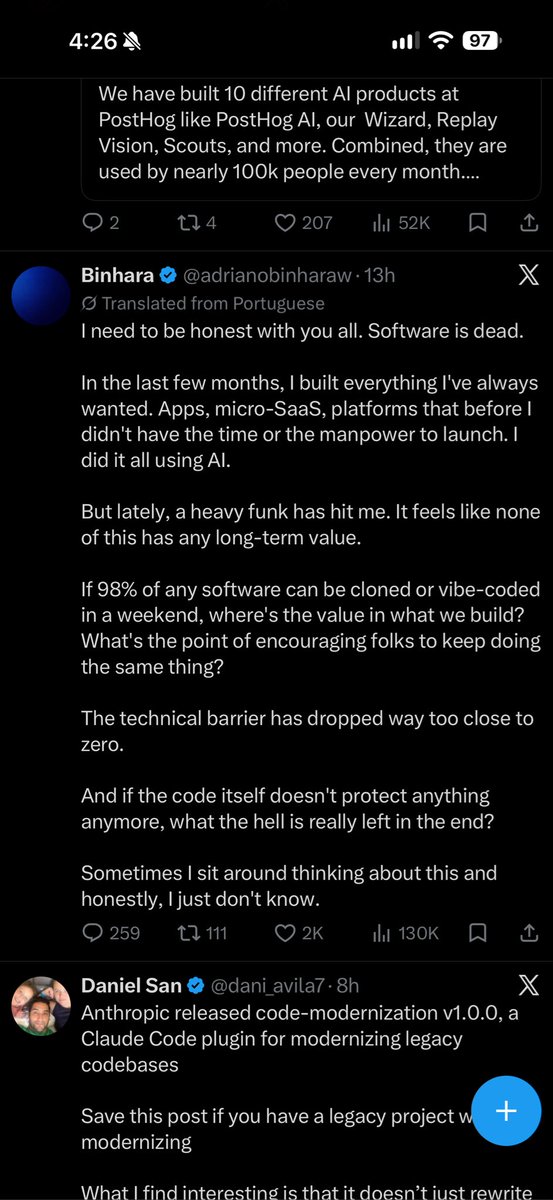
Preciso ser sincero com vocês. Software morreu.
Nos últimos meses eu construí tudo que sempre quis. Apps, micro-saas, plataformas que antes eu não tinha tempo nem braço pra subir. Fiz tudo usando IA.
só que ultimamente me bateu uma bad pesada. Parece que nada disso tem valor no longo prazo.
Se 98% de qualquer software pode ser clonado ou vibecodado em um fim de semana, onde tá o valor do que a gente constrói? qual o sentido de incentivar a galera a continuar fazendo o mesmo?
A barreira técnica foi pra muito próximo do zero.
E se o código em si não protege mais nada, o que realmente sobra no fim das contas?
Às vezes fico pensando nisso e sinceramente não sei.
How Anthropic's new engineering post would read without the PR:
Seven engineers, assisted by Claude, built and migrated to a new source control system in five months, handling 30,000 merges a day and reducing infrastructure CPU and memory requirements by 200x.
The system builds on architectures pioneered by Google's Piper and Meta's Sapling/Mononoke, and uses Google Spanner for distributed metadata storage and cloud storage for file contents. So the team didn't have to build the distributed database, replication, consistency, or fault-tolerance infrastructure from scratch.
The implementation and migration are genuinely impressive. But much of the difficult underlying infrastructure already existed, and the architectural ideas have been used at scale for years.
There's also the question of what the numbers mean. Going from 2,500 to 30,000 merges per day measures how much code gets merged, not how much useful software gets produced.
So the valid claim is that Claude helped a small team rapidly implement and deploy a specialized source control system, using mature infrastructure and well-established architectural ideas.
Instead, we got this announcement: "At Anthropic, coding is no longer the bottleneck to building systems or doing research."
New on our Engineering blog: Creating in-house source control.
In May, we merged around 2,500 code changes per day. In September, we merged more than 30,000 per day. As a result, we became bottlenecked by developer infrastructure built for human (rather than agent) scale.
Here, we share how we built a new version control system—and fully migrated our monorepo from git—in five months: https://t.co/wzNkwHs7IN
Didn't know ChatGPT had these interactive widgets... using it to help write my next article and it created this to help me draft it, in the chat window.
I went to register https://t.co/uPBJiifeUy to make a joke site but somebody already made a joke site.
Reassuringly the answer is currently: no
https://t.co/2M1EjVVho0
@kinglycrow@poteto opus 5.5 is good, but it still writes pretty lackluster code, with a lot of issues sometimes, unless you're guiding it pretty strictly, and making a lot of adjustments. I don't think any particular model has changed the game yet.
They certainly don’t produce better architecture or more coherent code that the average engineer I’ve interacted with
I’ll stick with calling it vibe coding ty