The commits on ecdsa-fail keep referencing "Fiat-Shamir Island." It sounds a lot like what you'd do if you wanted to cheat this test.
Are the AIs winning by simply cheating? Let's find out:
@kasai_lab Also, I guess we are missing the other part of the calculation-the logical error rate and measurement rate during surgeries.
Because, if you plan on an algorithm that has the volume of 1e12, and get LER of 1e-12 per round, but require 100 rounds per surg, that's not good enough.
@kasai_lab The Pareto-frontier is a great.
Normally, you would expect the distance to also come into consideration (might try metrics such as kd^2/n which does not make sense beyond 2D), but when you set a target LER and than compare encoding rates, that seems like the right way to do so.
@CraigGidney Very cool find.
Regarding keeping stim working on native windows: a lot of new students I work with do not have easy access to linux and might get lost working with wsl
(after all, they are phyisicst without a
lot of sw bckgrnd yet).
So this helps them hit the ground running.
@hyharryzhou@letonyo Thank you for your comment!
So just to be clear:
When using LER per logical, you are not just dividing by k? You actually count the number of observable flips?
Meaning that if x logical flipped in the same memory experiment, this count as x errors?
@letonyo Ohhh, that's important to note. So by 144 relative to bravyi et al.? (12 for logicals, 12 for d rounds).
What I find weird is that the bposd plot looks the same as Bravyi et al., so I am probably still missing something.
In their new paper, Oratomic use a bivariate bicycle code with parameters [[248,10,≤18]] (2603.28627).
I thought this is a nice test for my script, and indeed it run for about half an hour and it confirmed that the distance of the code is exactly 18.
Wrote a (technical) blog post about finding the circuit-level distance of a quantum error correction code using integer linear programming, repo included.
Let me know if you find this helpful!
Link in a comment.
Proud to have contributed to this work.
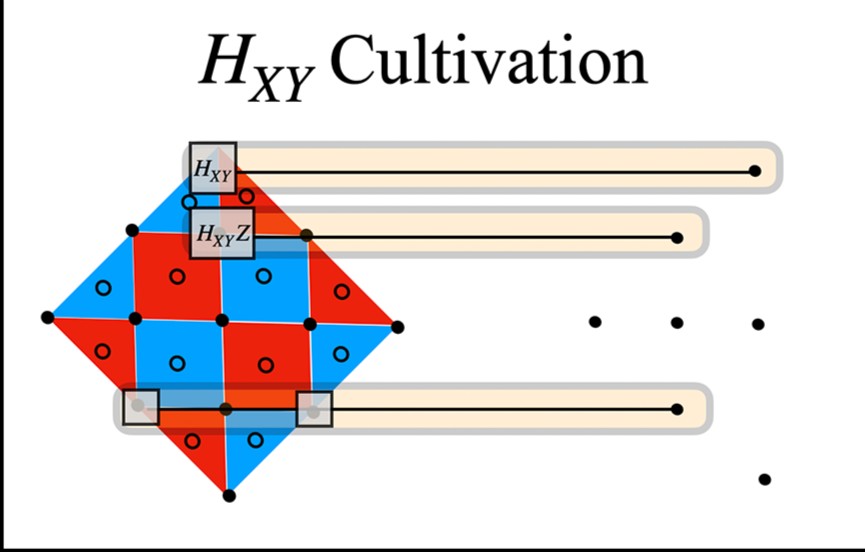
Because neutral-atom and ion platforms operate much slower than other modalities, high-rate magic-state generation is a problem.
This work presents a way for them to generate magic states at a much higher rate. Super important.
By implementing transversal gates directly on surface codes in systems with nonlocal connectivity, new cultivation protocols increase magic-state-generation rates by over a factor of 20 and achieve ultralow error rates. @yotamvaknin@ShohamJacoby
https://t.co/xeNET0slqH