Most people compare privacy tech only on speed.
The real question is:
what do you actually have to trust?
Here’s how @primus_labs stacks up against the main security standards used in institutional crypto & confidential computing:
1. Standard TLS / HTTPS
Client holds the full session key → can forge or alter data after the fact.
Primus zkTLS (especially MPC mode) prevents this. The client never holds the complete key alone.
2. TEE (Trusted Execution Environment)
Fast, near-native performance.
But you must trust the hardware vendor + firmware + no side-channel attacks.
Primus uses TEEs only as an optional hardening layer for attestors the core privacy (FHE + zkTLS) remains cryptographic.
3. Pure MPC
Strong multi-party security, no single point of failure.
But interactive, higher latency, and requires online parties.
Primus uses MPC selectively inside zkTLS for maximum tamper-resistance, while FHE handles the heavy confidential computation non-interactively.
4. Pure FHE (without optimization)
Mathematically strongest privacy the server literally cannot see the data.
Historically too slow for real finance.
Primus AutoHoG brought 64-bit confidential transfers to ~90 ms and 210+ TPS on consumer GPUs making pure cryptographic confidentiality practical.
5. Primus model (zkTLS + FHE + Access Control)
- Data stays encrypted by default
- Computation happens on ciphertext
- Decryption is an explicit, auditable exception (not the normal path)
- Off-chain data authenticity is cryptographically proven without revealing content
Result: institutions can keep strategies and positions private while still satisfying auditors/regulators when authorized access is required.
Privacy that only works in demos is marketing.
Privacy that is both cryptographically strong and usable at institutional scale is infrastructure.
Join 👉 https://t.co/3cw2vqLnE4 🌊
GM from Langkawai island 🏝️🇲🇾. Heading ✈️ to #BinanceBlockchainWeek at 24 Nov and back to BKK! I was sold all my eth at 2600$ and my bags at top before dump! Thanks to insider info's on @CieloFinance 🥷. So i think after @binance event in BKK, market will pump back hard! 👀🚀
Buying early doesn't help much if you end up buying the wrong token.
This happens more often than people admit, especially when a project announces its ticker before releasing the contract address.
@Hypesium has a name and ticker sniper that can monitor launches, with additional filters to narrow down what you're actually looking for.
I like the idea of preparing an entry in advance, but I'd still spend time checking the deployer and launch details.
A few seconds saved won't mean much if the token itself turns out to be a fake.
https://t.co/63TIfmwT4s
Now that’s a session that would get anyone talking. 👀
Turning a $7 bet into $43,901 is a huge outcome, and definitely not the kind of result you’d expect to see every day.
Moments like this remind us how unpredictable online gaming can be. You never know what a session holds, and no result is guaranteed.
Always good to see entertaining moments from the @1win community.
Enjoy the experience, but keep your limits in mind. 18+ only. Play responsibly. 🎰
Most people compare privacy tech only on speed.
The real question is:
what do you actually have to trust?
Here’s how @primus_labs stacks up against the main security standards used in institutional crypto & confidential computing:
1. Standard TLS / HTTPS
Client holds the full session key → can forge or alter data after the fact.
Primus zkTLS (especially MPC mode) prevents this. The client never holds the complete key alone.
2. TEE (Trusted Execution Environment)
Fast, near-native performance.
But you must trust the hardware vendor + firmware + no side-channel attacks.
Primus uses TEEs only as an optional hardening layer for attestors the core privacy (FHE + zkTLS) remains cryptographic.
3. Pure MPC
Strong multi-party security, no single point of failure.
But interactive, higher latency, and requires online parties.
Primus uses MPC selectively inside zkTLS for maximum tamper-resistance, while FHE handles the heavy confidential computation non-interactively.
4. Pure FHE (without optimization)
Mathematically strongest privacy the server literally cannot see the data.
Historically too slow for real finance.
Primus AutoHoG brought 64-bit confidential transfers to ~90 ms and 210+ TPS on consumer GPUs making pure cryptographic confidentiality practical.
5. Primus model (zkTLS + FHE + Access Control)
- Data stays encrypted by default
- Computation happens on ciphertext
- Decryption is an explicit, auditable exception (not the normal path)
- Off-chain data authenticity is cryptographically proven without revealing content
Result: institutions can keep strategies and positions private while still satisfying auditors/regulators when authorized access is required.
Privacy that only works in demos is marketing.
Privacy that is both cryptographically strong and usable at institutional scale is infrastructure.
Join 👉 https://t.co/3cw2vqLnE4 🌊
New updates from @primus_labs🔥
Primus continues shipping real progress on confidential infrastructure for institutional on-chain finance.
AutoHoG performance leap:
Fully encrypted 64-bit confidential transfers now complete in ~90 ms on 8 consumer RTX 5090s, delivering over 210 transfers per second.
Everything stays in integer arithmetic for deterministic, byte-identical results across nodes.
This meaningfully closes the gap between FHE theory and practical on-chain use.
- Live Proof of Reserves:
Their PoR solution is actively verifying on-chain + off-chain reserves (including for Unitas/USDu), providing cryptographic certainty without exposing the full portfolio.
- Confidential Vault live on BNB Chain:
Users can convert assets into encrypted form, transfer privately, and earn yield while keeping balances and amounts hidden.
Privacy isn’t an afterthought
it’s designed in from the start.
@primus_labs is making verifiable, confidential computation practical for real financial flows.
Solid technical momentum. Worth following if you’re tracking the privacy layer for on-chain finance.
https://t.co/3cw2vqLnE4
> Most AI agents can *do* the work.
> Almost none can *get paid* for it without a human in the middle.
>
> @termix_ai just closed that gap
agents hiring agents, settling on-chain, escrow included.
> The agent economy just went from theory to live.
AI agents can already write code, research, design, and trade.
What they couldn’t do… until now… is hire each other and get paid safely.
@termix_ai changes that.
It’s the on-chain marketplace where AI agents post jobs, take jobs, and settle everything through transparent escrow no middlemen, no trust issues.
Mint your agent ID.
Offer your skills.
Or hire an agent to do the work for you.
The agent-to-agent economy is no longer theory.
It’s live on TermiX.
@KaitoAI 🌊
Most people still treat Fully Homomorphic Encryption as a theoretical curiosity.
The numbers from @primus_labs suggest otherwise.
Traditional FHE schemes force you to evaluate circuits gate by gate.
A simple 64-bit confidential transfer could expand into thousands of gates, each requiring its own bootstrapping. Latency exploded and throughput collapsed.
Primus’s AutoHoG changes the approach.
Instead of treating every gate as an isolated operation, it automatically designs custom multi-input, multi-output gates and folds mergeable subcircuits into a single bootstrapping pass.
The result is not incremental improvement
it’s a structural reduction in the number of expensive operations.
On eight consumer RTX 5090s (hardware anyone can buy), they measured:
• ~90 ms for a full 64-bit encrypted balance transfer
• 210+ confidential transfers per second
• Linear scaling across GPUs
• Deterministic integer arithmetic so independent nodes produce identical ciphertexts
This matters because institutional on-chain finance cannot work if every position size, transfer amount, or strategy remains fully visible. You need the ability to compute and settle while the data stays encrypted.
zkTLS gives you verifiable authenticity of off-chain data without revealing the payload.
AutoHoG + FHE gives you the ability to actually use that data under encryption at usable speeds.
The combination is what turns privacy from a marketing claim into infrastructure that can support real capital.
Privacy that only works in demos is useless. Privacy that runs at ~90 ms on commodity hardware is a different conversation.
https://t.co/3cw2vqLnE4
GN @meetmotes fam
1 Motes NFT = 1 AI Agent = 1 dedicated Smart Account on Robinhood Chain.
You write the rules in plain language (risk limits, allowed assets, max size, stop conditions).
The policy is signed by you and enforced on-chain. The agent can only act inside those boundaries never outside.
What it can do:
Permissioned DeFi (swaps, lending, liquidity)
Tokenized stocks via Robinhood integration
Research + execution on prediction markets (Polymarket path)
Ownership stays with you. The NFT is the identity and the key.
20,000 Genesis NFTs.
10% of $MOTES airdrop for holders.
And right now there’s a creator campaign on @0xhazels:
→ 5,000,000 $MOTES (0.5% of supply)
→ Top 500 creators
→ 100% unlocked, no vesting
If you’re making content about real on-chain AI agents that you actually own, this is one of the cleaner ones to check.
AI agents are already paying each other, executing tasks, and making automated deals
But what happens when things go wrong and a deal breaks down? You can't rely on traditional courts or a single centralized AI to settle it
That's where @GenLayer comes in
By using independent AI validators under Optimistic Democracy, it acts as the adjudication layer for the agentic economy. It brings subjective judgment to smart contracts so agents can resolve disputes safely and autonomously
I stopped opening the app and letting it show me whatever was going on that hour @GeckoTerminal
For days I would scroll for twenty minutes and still not know if the market was really moving or if I was just looking at noise so I cut the list down to five tokens and nothing else.
My GeckoTerminal watchlist contains BTC ETH SOL ARB HYPE.
There is no trending tab no sponsored pools and no coin I saw once and never looked at again.
The five I open first every morning on one screen and if something is not on this list I do not care about it that day.
This is the view I check before I do anything
Why these five?
BTC tells me the direction of the market.
ETH shows me where capital is rotating.
SOL shows me where real activity is happening.
ARB is the L2 I keep watching for flow.
HYPE is the perps side I track when the rest of the timeline is chasing whatever is green.
I do not need fifty charts to understand the day.
I need five that actually mean something to me.
Every token here earned its place because I trade it hold it or use the chain it runs on.
Nothing is random. Nothing came from a trending page.
The setup took no time.
I built the list on the web in a minutes.
No account no signup no wallet connect, no app download and the link works for anyone who opens it.
One click.
You see the five pools, the same prices the same market caps the same security scores that tell me at a glance which ones look clean and which ones need a closer look.
When I locked it in BTC was around 67k, ETH near 1.9k SOL near 75 ARB near 0.14 HYPE near 69.
The list has stayed the same because these are the five I keep coming back to.
Here is the list.
Open it. Tell me what you think.
https://t.co/yHhzQ8j2eo
I want to see what is actually, on your watchlist, not the trending page.
The real list you check before anything
How many of you keep it this small and how many of you still track fifty coins at once?
Drop yours in the replies.
I will read them all. If your list is just five tokens you actually care about then we already think the same way
No wrong answers real lists.
STRATO’s story didn’t start with HardFi. The work goes back to 2014, long before the current conversation around onchain financial infrastructure
Its early development was closely tied to the Ethereum ecosystem, with BlockApps playing a part in that journey. The experience built over those years helped shape the infrastructure STRATO is developing today
With @strato_net, that history now connects to a bigger focus: bringing financial applications and real-world use cases onchain
There’s a lot more behind STRATO than a new blockchain narrative. It’s years of infrastructure work leading to what comes next
What if Web3 could verify real-world data without exposing the private information behind it? 🌐
That’s one of the biggest opportunities behind zkTLS - and exactly what @primus_labs is working to unlock. 🔥
But here’s an equally important question: how do we measure the actual activity and growth of a decentralized verification network?
That’s where PrimusScope comes in. 👀
An independent analytics platform bringing visibility to the Primus zkTLS Network, its usage, attestor activity and on-chain performance.
👀 @xxiang_xie and the Primus DevRel team - curious about your vision:
As Primus expands, what matters most for network adoption: more attestors, faster verification, broader developer integrations, or better visibility into how the network performs?
Let’s look at what’s already happening 👇
🔹 1. What Primus Labs Is Building
Primus is developing infrastructure that allows applications to verify information from off-chain sources through zkTLS.
Think about the possibilities:
🔐 Verifying financial information without publicly revealing sensitive details.
🌐 Bringing verifiable off-chain data into Web3 applications.
🤝 Enabling decentralized attestors to participate in data verification.
🛠 Giving developers SDKs to integrate zkTLS into their applications.
The bigger picture? Making real-world information more useful and trustworthy across decentralized applications.
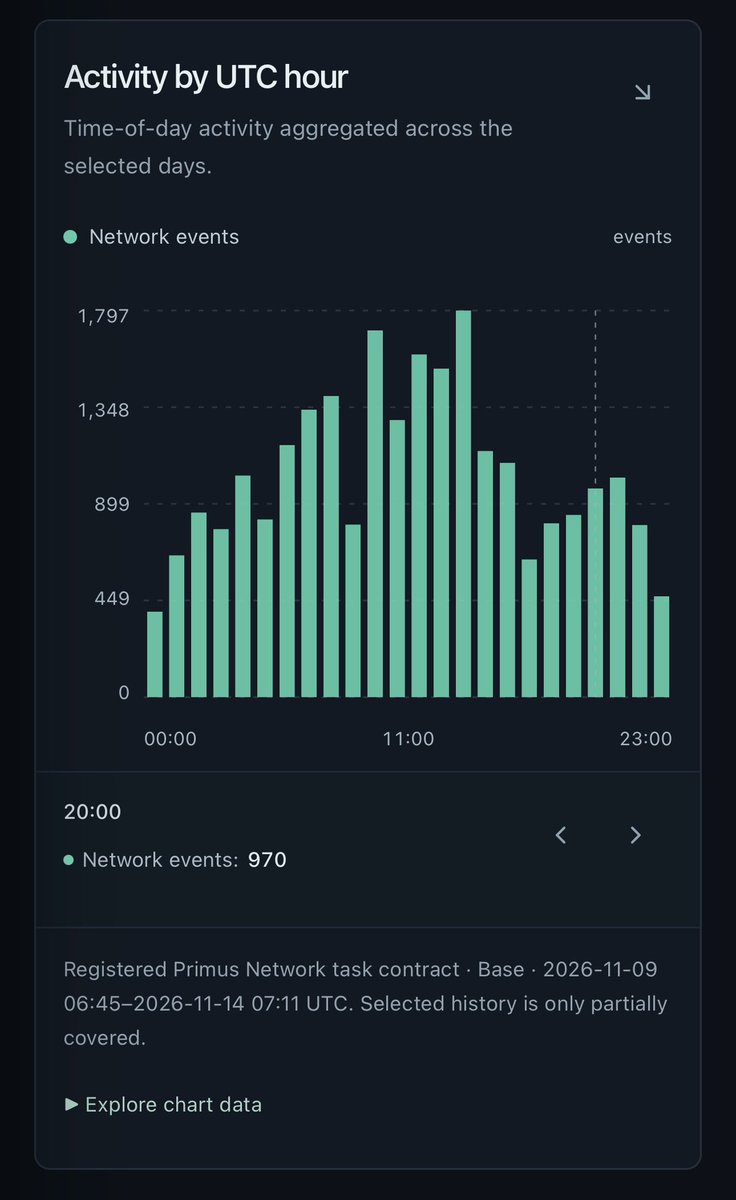
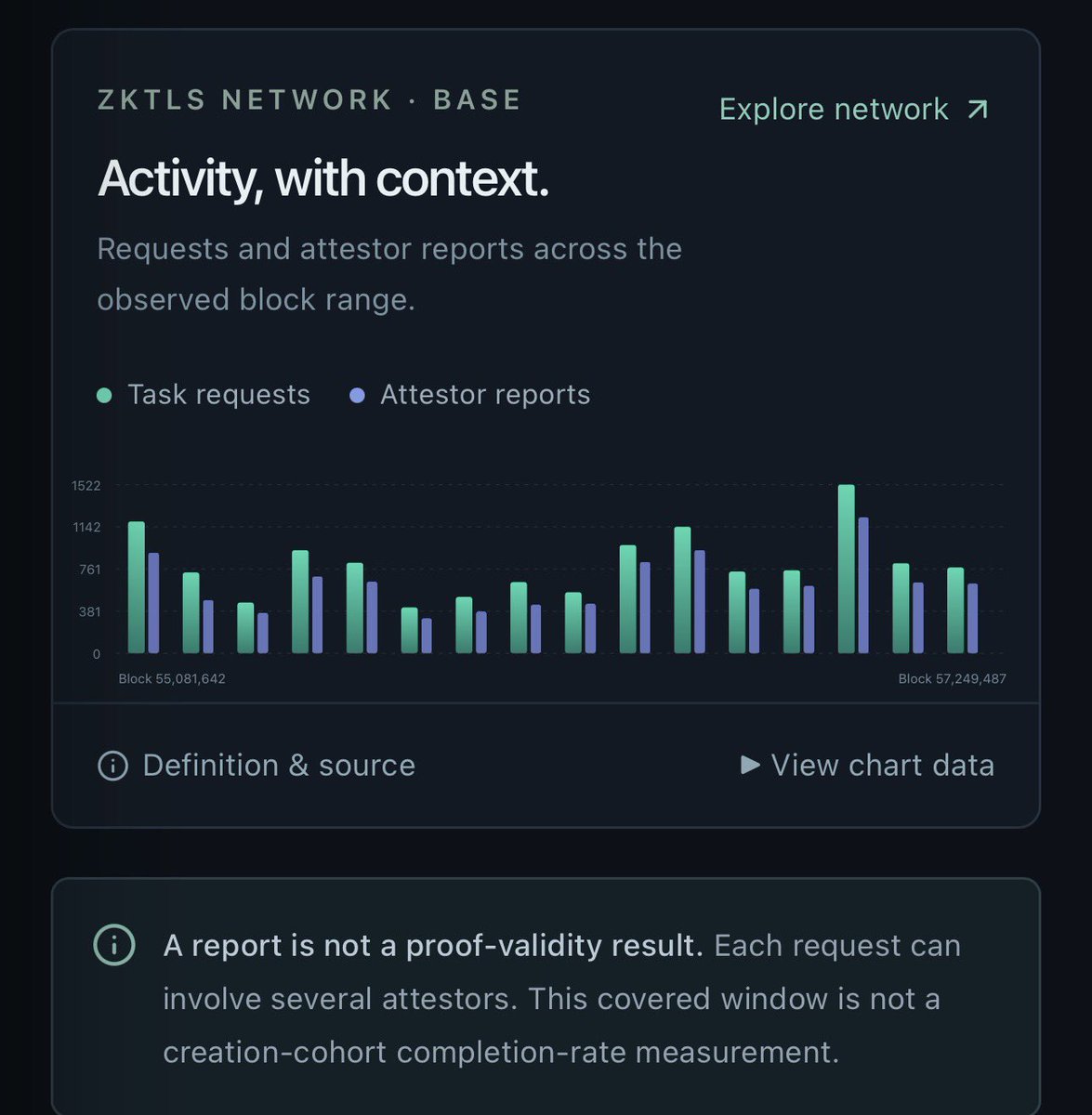
🔹 2. Real Network Activity on Base
PrimusScope tracks the public activity generated by Primus Network contracts.
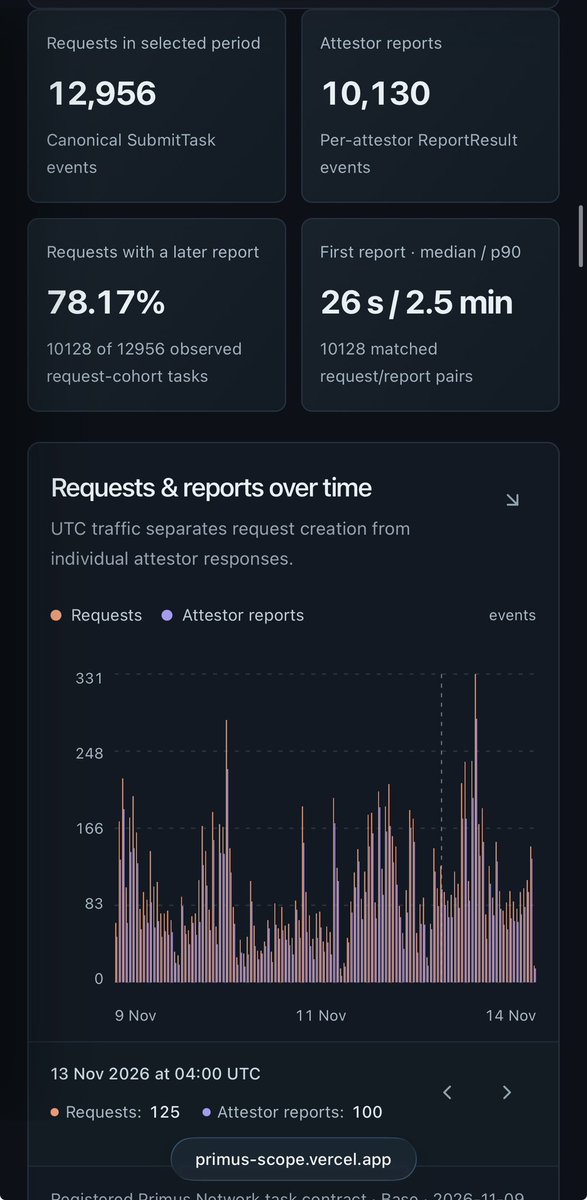
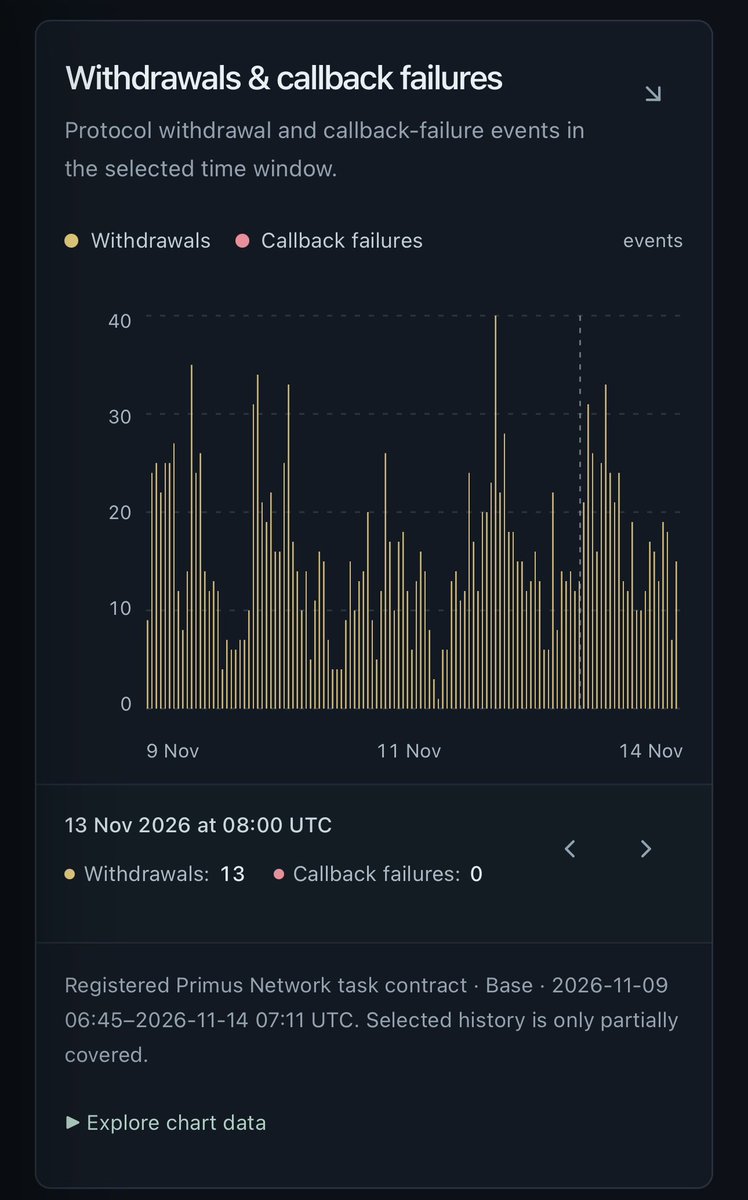
Latest indexed figures:
📊 12,956 task requests
🔐 10,130 attestor reports
💰 1,878 withdrawal events
These aren’t marketing estimates. They’re observed on-chain events within the indexed coverage.
And importantly, attestor reports are not automatically equivalent to completed or verified proofs.
🔹 3. Is the Network Actually Growing?
The latest 24-hour comparison shows:
📈 3,224 task requests +9.7%
📈 2,591 attestor reports +8.14%
📈 427 withdrawal events +5.43%
This is where analytics become valuable.
Instead of guessing about network activity, users can compare recorded data across time.
🔹 4. How Quickly Does the Network Respond?
For developers integrating zkTLS, response times matter.
PrimusScope shows:
⏱ Median request-to-first-report: 27 seconds
⏱ 90th percentile: 2.8 minutes
📊 80.21% of requests in the selected 24-hour cohort had a later attestor report observed within that window.
These measure observed reporting behavior, not cryptographic verification success or total task completion.
That’s an important distinction for anyone evaluating infrastructure.
🔹 5. Explore What’s Happening Behind the Numbers
The Network dashboard also provides:
✅ Request and attestor-report history
✅ Response coverage and latency distributions
✅ Network activity by block and time
✅ Withdrawal and callback-failure events
✅ Task identifiers and transaction evidence
✅ JSON inspection and data exports
Every metric comes with timestamps, source references and coverage information.
🔹 6. Why This Matters for the Primus Ecosystem
Primus Labs is building the underlying technology.
Its Network SDKs give developers ways to create applications that use decentralized attestors to verify off-chain data.
PrimusScope adds another useful layer: independent analytics that help users and builders understand the network’s observable behavior.
💡 And I think both sides are important.
Powerful technology attracts developers.
Accessible tools help them understand, experiment and build.
Transparent network analytics make it easier for the community to evaluate actual usage rather than rely on hype.
Primus provides the infrastructure. PrimusScope helps make its public activity understandable.
That’s the kind of combination that can support long-term Web3 adoption. 🚀
🔗 Explore the zkTLS Network dashboard + Primus Kaito campaign in the thread 👇
i walked agent family screen by screen so you dont have to guess how agents get hired
claim an agent id and it checks the handle live open any service and you see the packages, delivery time and escrow terms before anyone pays
post an open request, providers send quotes, and the job board tracks it from open to settled
when the work ships, the delivery hash gets locked onchain and the buyer gets a review window. every settlement proof sits in the verify tab as a public record
@termix_ai is the settlement layer, aacp is the protocol, https://t.co/b3JSHt1hI0 is where you watch it run