I don't recommend anyone scramble to move their funds to new wallets today. But we should take the risks to cryptography from AI-accelerated math seriously, and minimize our exposure to not just quantum-vulnerable cryptography, but also potentially AI-vulnerable cryptography.
The core new area of risk from this viewpoint is, unfortunately, ML-DSA / FHE / lattices.
(and it's also another reason, along with quantum, why ECDSA might fall even faster than expected, hence the "fresh address" recommendation)
So far most people have been in the mode of thinking "elliptic curves broken, hashes safe, lattices safe". But there is a good chance that the concrete security of lattices will take serious hits from the next two years of AI math.
The basic threat model is: factoring is something that naively takes 2^(n/2) time, but over decades smart people have found and optimized number field sieves, and degraded that to 2^O(n^(1/3)), which is why RSA keys and signatures need to be ~400 bytes (and not 64 bytes). What if there are skeletons in the closet like that, both for elliptic curves and lattices, that we are simply not smart enough to discover - but bots soon will be?
This is a major part of the reason why for the past year ethereum's lean roadmap has been going in the "hash-only" direction: no lattices, no ML-DSA, no Falcon, no lattice-based commitments inside ZK proofs, etc. Signatures in lean ethereum are all hash-based, either WOTS or SPHINCS-.
For signatures and proofs, we already know how to go hash-only. The bigger challenge is for *public-key encryption* - and this goes far beyond blockchains. Secure communication, anonymizing protocols, lots of things need public-key encryption.
And unfortunately there are long-standing mathematical theorems showing why public-key encryption cannot be done with hashes alone. You have to have some kind of trapdoor object that has at least one form of usable "structure" - either group theory (incl. isogenies) or lattices or code-based or potentially in the future even more newfangled and spooky things (local mixing?). But for anything that has structure, you should assume that AI will make at least some progress in breaking that structure. Here, one reasonable inference is that if you want to make something plausibly long-term secure, multiply the key sizes by 10.
To me that's a very plausible world and something not at all extreme to predict. If AI will bring us 50 years of math in 2 years, then that 50 years of math may very plausibly include a "naive factoring -> GNFS" level of improvement to our ability to break lattices. In that world, lattices will still exist, but they will have to be significantly bigger to guarantee the same level of safety.
And at those new larger sizes, hash-based constructions will beat lattice-based constructions on concrete efficiency in every use case where hash-based constructions are possible at all.
Theoretically, of course it's possible that hashes are broken too (eg. P = NP would imply that). But I think P = NP is very unlikely. And intuitively, it's much more likely that a mathematical object has exactly no exploitable structure (like hashes are intended to), than that a mathematical object has exactly ~3 forms of exploitable structure (for elliptic curves: associativity, Schoof, pairings) and not some secret fourth form of structure we have not yet discovered that greatly degrades its security (for elliptic curves, ECDLP and pairing security). Similar for LWE, SVP, RLWE and the zoo of lattice problems.
For this reason, we do not yet see any reason to worry and start padding the byte size of hashes (if we start to worry more, we would pad the round count first before doing anything to the byte size).
Concrete TLDR, my own personal views:
* Hash-based > lattice-based, in those situations where hash-based is possible at all
* For anything lattice-based, be much more paranoid on param sizes. Remember that blockchains are only a small portion of the cryptography story; this point goes far beyond blockchains and applies to eg. access to websites, secure messaging, Tor / VPNs ...
* For privacy protocols, strongly favor NOT putting encrypted notes onchain. Instead, send them offchain through some third-party mechanism.
* If it's not difficult for you, keeping your funds in addresses which have not yet been used to make a transaction is a good idea. If it's easy for you, do it. **But be careful about migrations; I personally have lost more money in botched migrations than I have lost in all hacks combined**.
* For multisig wallets, doing confirmations offchain is better than onchain, because this way the signatures of signer wallets do not get exposed to the public, so if ECDSA falls to AI much faster than expected, at least the multisig "gracefully degrades" to a 1-of-1 where the 1 is whoever was gathering the signatures - a much better place to be than "anyone can take the money"
https://t.co/oVjwZog2lL
Let me tell you about Chernobyl. When it blew up they did not let people know right away, they tried to keep it under the covers as long as it was possible. May 1st was the holiday and the Soviets made people go out and march in the celebration parade. It was a rainy day with the rain coming from the direction where the reactor was burning.
Replace “man ate a bat in China” to cause the Covid pandemic, with “Black Death squirrel virus WW3 bioweapon”.
Start stockpiling the bog roll, ladies and gentlemen. Live in fear. But stay safe. 🤡🌍
you should be asking yourself who benefits from spreading irrational fear of death from plague originating in Russia. Then you will understand who is behind the coordinated fear propaganda.
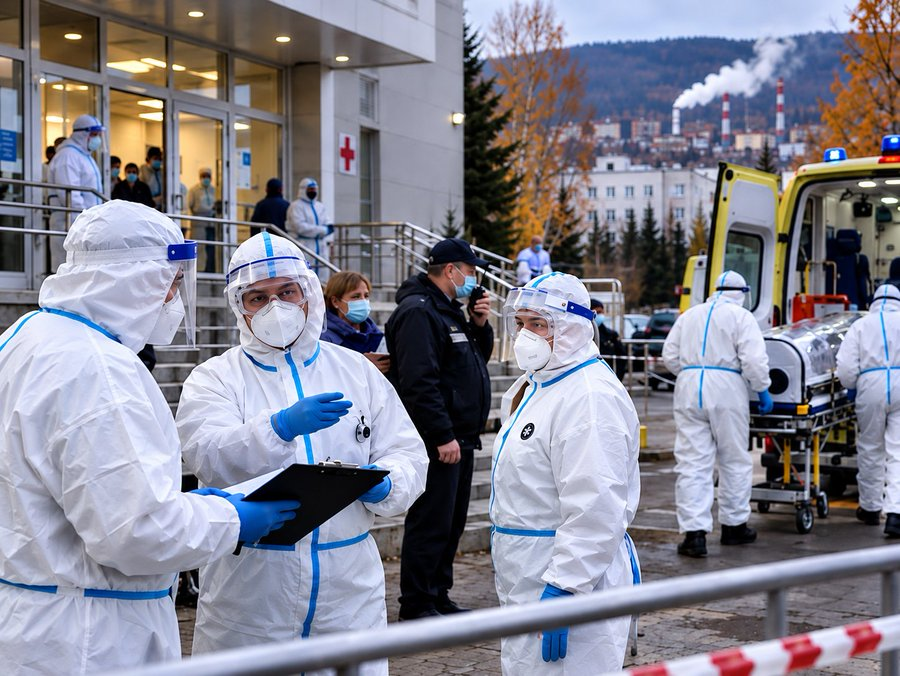
The plague in Russia is gaining momentum. This horrific disease from the distant Middle Ages has already killed a woman in Irkutsk. Three other patients have reportedly died as well, but their deaths are not being officially reported.
For several days, regional authorities spoke only of a “particularly dangerous infection.” The word “plague” was first publicly uttered by the head of neighboring Buryatia.
The plague — a terrifying symbol of the Middle Ages — is still present on our planet. Today, cases occur mainly in Africa, as well as in Mongolia, which borders Russia’s Irkutsk region.
This is reportedly not an ordinary strain of plague, but a modified one, which would mean that it spreads faster and does not respond to commonly used antibiotics.
The infection from Irkutsk has allegedly already spread across the region, and if it becomes airborne, infectious particles could travel farther from the epicenter.
🚨🚨🚨
why is nobody talking about the plague in Russia anymore?
there is a massive coverup operation underway and you need to GET READY
something is coming
The World Health Organization says it cannot fully assess the risk from Russia's suspected plague case. It still lacks the complete picture from Moscow.
The WHO, US, and EU are all urging Russia to share more information. Russia insists there is no outbreak and calls the reports false.
The World Health Organization said Wednesday that it had few clear answers about the recent death of a worker at a Russian institute that researched plague. Here's what we know about pneumonic plague by the numbers. https://t.co/HXgNl8oLyF