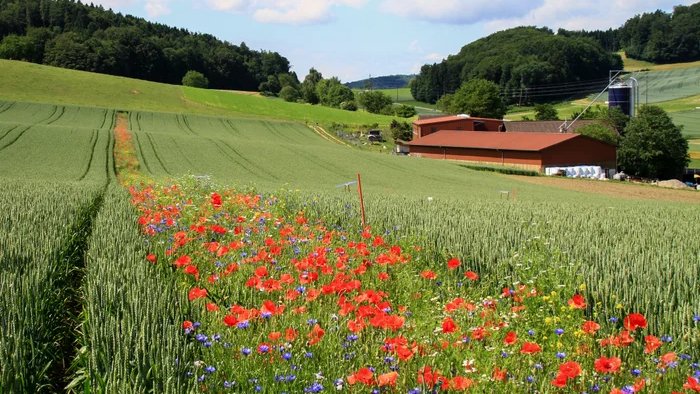
Farmers have figured out that the cheapest pesticide is a strip of flowers.
When you plant wildflowers through a crop field, not just around the edge but in strips running through the middle, you get ladybugs, lacewings, hoverflies, and parasitic wasps living in the field instead of visiting it.
They eat the aphids, the caterpillars, and the mites for free, all summer long.
In controlled trials, fields with tailored flower strips had leaf-beetle numbers 40 to 50% lower and crop damage cut by around 60%, enough to drop below the threshold where spraying was even considered worth it.
The flowers attract a standing army to our fields.
We spent decades engineering chemicals to kill the insects eating the crop, when the insects that eat those insects would have worked for the price of seed.
They did not take cursive from the schools because children no longer needed it. They took it because of what it was quietly building in them.
Consider what the exercise actually is. A child, six years old, is handed a pen and asked to draw a single unbroken line that becomes a word. The wrist must float. The fingers must hold a living pressure, never quite the same twice, always correcting. The eye must follow the ink forward and trust the hand to finish what it has begun. There is no lifting, no stopping, no starting over mid-word. The loop must close. The ascender must rise and return. The sentence must travel from one margin to the other as a single continuous gesture, and at the end of it the hand must still be steady.
Twelve years of this. Every day. Ten thousand small acts of sustained, self-correcting attention, carried out below the level of conscious thought, until the motion belongs to the body and the body belongs to the motion.
This is not penmanship. It is the slow construction of an interior form.
The hand that has learned to carry a line without breaking it is the hand of a mind that has learned to carry a thought without breaking it. The two are not metaphors for one another. They are the same faculty, trained in the same child, by the same daily discipline. Continuity of the stroke becomes continuity of the reasoning. The patience of the loop becomes the patience of the argument. The commitment to finish a word one has started becomes the commitment to finish a sentence, a paragraph, a life's idea, without reaching for the nearest distraction halfway through.
Print is a different creature entirely. Print lifts. Print stops. Print assembles a word out of separate, stamped, interchangeable pieces, each one beginning and ending in isolation. A mind raised only on print learns to think the way print is made, in discrete tokens, in replaceable units, in fragments that can be recombined by any outside hand without the owner noticing the substitution. It is precisely the shape of thought a language model produces. It is precisely the shape of thought a language model can steer.
Cursive is kata. This is the whole of it. A form repeated daily, for years, not for the sake of the form but for what the repetition lays down in the practitioner beneath the form. The swordsman does not train kata so that one day he may fight in kata. He trains it so that when the moment comes and there is no time to think, the movement is already inside him, older and deeper than thought, and it rises on its own. Cursive was the kata of the literate mind, the daily quiet drilling of continuity, of patience, of a line held steady under the long pressure of its own length. And the signature it produced at the end, that small flourished mark unique to a single human being on earth, was only the outward proof of an inward form no machine and no other hand could ever reproduce.
Take the kata away and the practitioner is left with vocabulary in place of faculty. He can recognise a whole thought when he encounters one. He cannot carry one himself. He can admire a finished argument. He cannot sustain one long enough to close its loop. He begins books he does not finish, sentences he does not end, ideas he abandons the moment the screen in his palm offers him a brighter one. And when the machine begins feeding him tokens in the exact shape his schooling taught him to receive, he meets it with no interior resistance at all, because no interior form was ever built in him to push back with.
They removed it quietly, across a generation, and they removed it in the last years before the machines arrived. Twelve years of daily practice in unbroken, embodied, self-authored thought, gone from the curriculum of almost every child in the Western world, just as the instruments designed to complete their sentences for them came online.
The hand forgets. The mind, having never been taught the kata, forgets a thing it never knew it had.
That is what cursive was. That is what was taken. And that is why the thought of anyone who still writes by hand, in long unlifted lines, remains, quietly, stubbornly, and without their ever needing to announce it, their own.
Now the question stands open. What else has been banned, phased out, quietly retired from the curriculum and from common life over these same decades, under the same soft excuses? Mental arithmetic. Memorisation of poetry. Latin. Logic as a formal subject. Map reading. Knot work. The keeping of a commonplace book. The reading aloud of long passages in class. Singing in parts.
What was each of those actually building in the child, beneath the surface of the lesson, and whose interest was served by its disappearance?
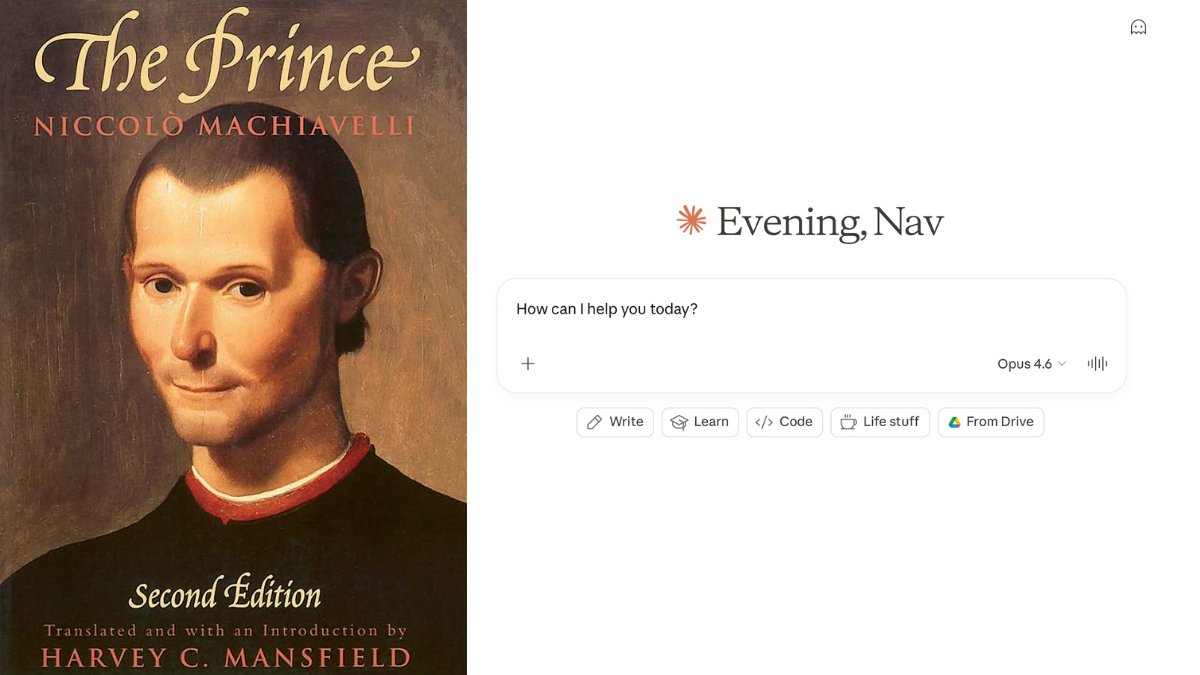
🚨 In 1513, a man was thrown in prison, tortured, and exiled. So he wrote a book about power.
The Catholic Church banned it. Napoleon was caught with a copy in his carriage after his final defeat. Stalin kept it on his bedside table and wrote notes in the margins. Mussolini read it. Kissinger and Nixon used it as bedtime reading.
The book is The Prince by Niccolò Machiavelli. It's 500 years old. It invented the word "Machiavellian." And it's still the most dangerous book on power ever written.
I turned Machiavelli's core strategies into 12 Claude prompts.
You describe any power struggle (office politics, negotiations, competition, leadership) and it gives you the exact Machiavellian counter-move.
Here are all 12:
I think I know why everything sucks...
...and it's because everything is fake
We are getting fake college degrees that cost 4 years and six figures that teach you fake education and get you fake jobs.
We are eating fake food, with fake ingredients, funded by fake research.
We are scrolling through fake lives, with fake relationships, who take fake, curated vacations to promote brands that make fake products.
We are voting for fake candidates, who run on fake promises, inside a fake system that was never designed to fix anything.
We are raising kids in fake schools that teach fake history, fake science, which quietly produce fake adults who can't think for themselves.
We are watching fake news, about fake crises, produced by fake journalists, for fake outrage.
We are borrowing fake money that was printed from nothing, to fund a fake economy that would collapse in an afternoon if people stopped pretending it was real.
We are buying fake organic food that's just a paid label, and drinking fake juice with two percent juice in it, and putting fake cheese on cheeseburgers that's just "cheese product" on fake burger meat.
We are donating to fake nonprofits where the moeny never makes it to the people and then funding fake foreign aid that buys real weapons to prop up fake governments.
We are going to fake therapy that teaches fake coping skills instead of telling you hard truths.
We are buying fake furniture made of fake wood that's actually compressed sawdust and glue that looks like wood, ships in fourteen boxes with instructions written in a fake language that isn't quite any language, requires tools it doesn't include, takes 4 hours to build, wobbles on day 1, and is totally destroyed in 6 months.
We are downloading fake "free" apps that charge a subscription after three days for AI features that don't work, hidden behind a paywall we didn't see, protected by a privacy policy we didn't read, buried inside Terms of Service written by lawyers specifically so we wouldn't read them, that we agreed to by tapping a button the size of a thumbnail, that gave a company we've never heard of the right to sell our data to companies we'll never hear of, to build a profile on us we'll never see, to influence decisions we'll never know were made.
IT. IS. ALL. FAKE.
And we all yearn for what was once real.
Don't you remember? Did you forget?
There was a time with a simple handshake between men was a contract.
When bread went stale because... well, that's what real bread does!
When kids played outside all day until it was dark, and nobody tracked them.
When a family could live off a single income.
When music was made by people who LIVED something real and you could feel it.
When schools was HARD... and that was the point!
When doctors knew your name and your family, they even came to your house,
When you bought something once... and it was yours forever.
When the chair your grandmother bought once lasted 70 years and she passed it onto your dad.
And now nothing is real, and that's why everything sucks.
King Gregory messed with the calendar. He changed it from the Julian calendar to the Gregorian calendar.
The Julian calendar was 13 months 28 days a piece with one day left over.
Julius Caesar felt that he should have one extra day in his month and that's why you have 31 month days in the month of July.
Augustus Caesar felt that he should have an extra day in his month.
That's why August has 31 days.
The reason why they call it April fool's Day is because there was a lot of people that refused to follow the calendar King Gregory put forward. So they were called April fools because that was the one day that was left over was April 1st which is New Year's by the way. The real New years this actually April 1st.
The turtle has 13 squares on the inside and 28 little squares on the outside of those.
Sept means 7 so why is the 9th month September?
Oct=8 so why is the 10th month October?
Nov=9 so why is November the 11th month?
Dec=10 so why is December the 10th month?
Them messing with our calendar has messed with our bodies rhythm.
Micki Lynn Larson-Olson
AKA QPATRIOT
21 years United States Air Force
Iraq War Veteran
Navy Mom
PARDONED
January 6th inmate 376303
True knowledge begins when you stop naming and start observing.
Richard Feynman’s father taught him this lesson with one simple bird:
A brown-throated thrush lands.
His dad asks: “Do you know what that bird is?”
“It’s a brown-throated thrush,” young Richard answers.
Then his father lists the names in Portuguese, Italian, Chinese, Japanese…
“Now you know every name in every language.
But you still know absolutely nothing about the bird.”
All those words are just human labels.
They tell you what people in different places call it — nothing about its flight, its song, its feathers, its life.
“You only know about humans and what they call things,” his father said.
True understanding starts when you stop reciting names and start really looking — watching what the bird actually does.
Feynman learned this very early — and it shaped how he saw the entire world.
In an age obsessed with labels, credentials, and quick definitions, this 45-second story is a quiet revolution.
What’s something you’ve stopped truly observing because you already “know the name”?
An Iranian man left this comment on my YouTube channel. This is without a doubt the single best explanation of the reality facing Iranian people today👇
"As an Iranian, I can tell you the situation is no longer just political—it's existential. We are trapped between two collapsing structures: one internal, one external. On one hand, we face a deeply dysfunctional government, led by the Supreme Leader and the Islamic Republic’s unelected institutions.
Decades of economic mismanagement, suppression of dissent, and brutal ideological control have alienated multiple generations. No one believes in reform anymore—because every attempt has either been co-opted or crushed. But here's the paradox: We are also terrified of regime collapse—because we've watched the aftermath of Western intervention in countries like Iraq, Libya, Syria, and Afghanistan. Each was promised freedom; each descended into chaos, civil war, or foreign occupation.
So no, we don't trust the U.S. or Israel. Not because we support our regime—but because we know how imperial powers treat ‘liberated’ nations in the Middle East.
Freedom, in their language, often means vacuum, fire, and permanent instability. Right now, many Iranians live with three truths at once: The Islamic Republic is morally and politically bankrupt. The alternatives offered by foreign actors are not liberation—they’re collapse.
A bad government is survivable. No government is not. We are not silent because we agree. We are cautious because we’ve learned—too well—what happens when superpowers decide to "help." In a sentence: Iran is a nation held hostage by its own regime, but haunted by the fate of its neighbors. We are stuck in a house we hate, surrounded by fires we fear more."
Jim Carrey describes a profound, sudden awakening: One day, after studying Eckhart Tolle, he "woke up" and realized thought is illusory—an illusion largely responsible for suffering.
In that instant, he stepped back: "Who is aware that I'm thinking?"
This shifted perspective into vast freedom—expansive, no longer trapped in a separate self, body, or problems.
"I was bigger than what I do. I was bigger than my body. I was everything and everyone. I was no longer a fragment of the universe. I was the universe."
The state comes and goes like riding a wave—sometimes on, sometimes off—but the knowing remains: this is the direction, and he wants to bring as many people along as possible because "the feeling is amazing."
A raw glimpse into non-dual realization from one of Hollywood's most iconic figures.
Have you ever had a moment where the illusion of the separate self cracked—even briefly—and what stayed with you?
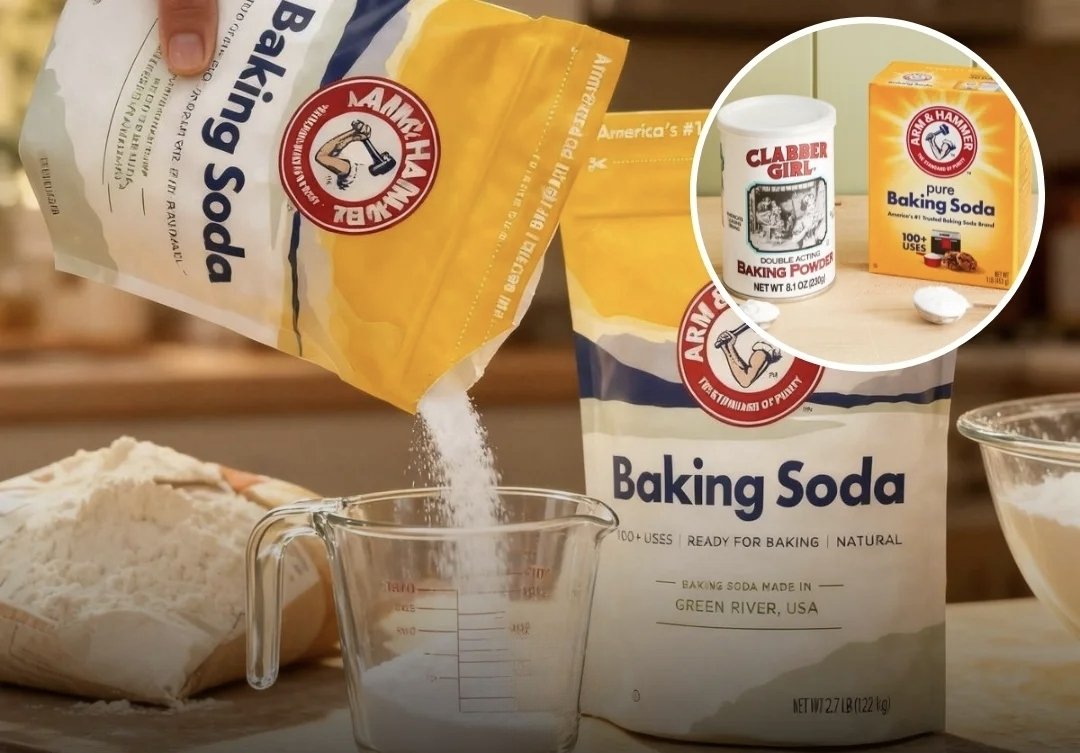
Baking soda isn't a health hack.
It's a forgotten medicine.
In 1924, doctors used it to fight the flu.
Today, research shows it fights cancer cells, kills inflammation & much more.
Here are 7 ways to use it: 🧵