McKinsey reports that 93% of enterprises have exceeded their AI budgets. Spend is only increasing
Getting more out of AI shouldn’t mean paying more for it. Open source models and Fable/Astra alternatives offer much more intelligence per dollar. But routing between them can break prompt caching and disrupt the developer experience.
Our team of Olympiad medalists, ex-founders, and researchers has spent the last year building algorithms to cut coding costs without sacrificing frontier accuracy or the experience developers love.
More soon
https://t.co/1FkZ6V3Wbq
OpenAI’s $200 subscriptions will only give you 1/2 the usage starting tomorrow.
The age 50x and 70x subsidizations is over. All of their labs have been pushing enterprises and are now gradually pushing consumers to api pricing before their IPOs. (Enterprises were recently notified that all of their current subscription pricing would be moving to api based starting next year)
It’s far better to be in control of your coding system and optimize intelligence/$ than letting labs gradually degrade you towards api pricing.
Hi,
Tomorrow we are re-opening the Pro $200 subscriptions to new subscribers, but together with it we are also changing how we calculate the usage for it. In effect, if you do the math, it will net out at half the dollar in API spend compared to the old Pro $200 plan.
Now that it's said, let me explain why this is happening and why you will still get more work done than if you were on the Pro $200 subscription one month ago.
(a) We didn't want to compromise in other ways and are committing to not reintroducing the 5h limit, so that you can fully use the weekly usage when you want.
(b) On the subscription, we guarantee that over time you always get more work done and with an increasing level of quality. This means that you will continue to get more value per dollar spent as a result of models getting more efficient and us passing down the improvements in the form of API price reductions.
(c) We don't want to put an incentive on ourselves to artificially inflate the API list prices to make it look like you are getting a lot (and workaround it through discounts, etc). Instead we want to continue to both rapidly reduce prices and increase capabilities of models on the API. This week we introduced GPT-6 Sol and GPT-6 Luna at 50% of their previous price. Over time, we see prices go low enough that it makes sense for most to buy usage as needed without there being a significant gap between what you get in a subscription and what you get in the API for a dollar spent.
(d) Tomorrow, we are adding more things to the subscription that won't draw on the usage, I won't reveal what that is yet.
I wanted to be transparent before all the big announcements tomorrow. Lots of new exciting things are coming to the subscriptions that will make it super compelling, but I wanted to make sure to share this change ahead of time so you can all understand it before we shower you with good news.
Codexingly,
Tibo
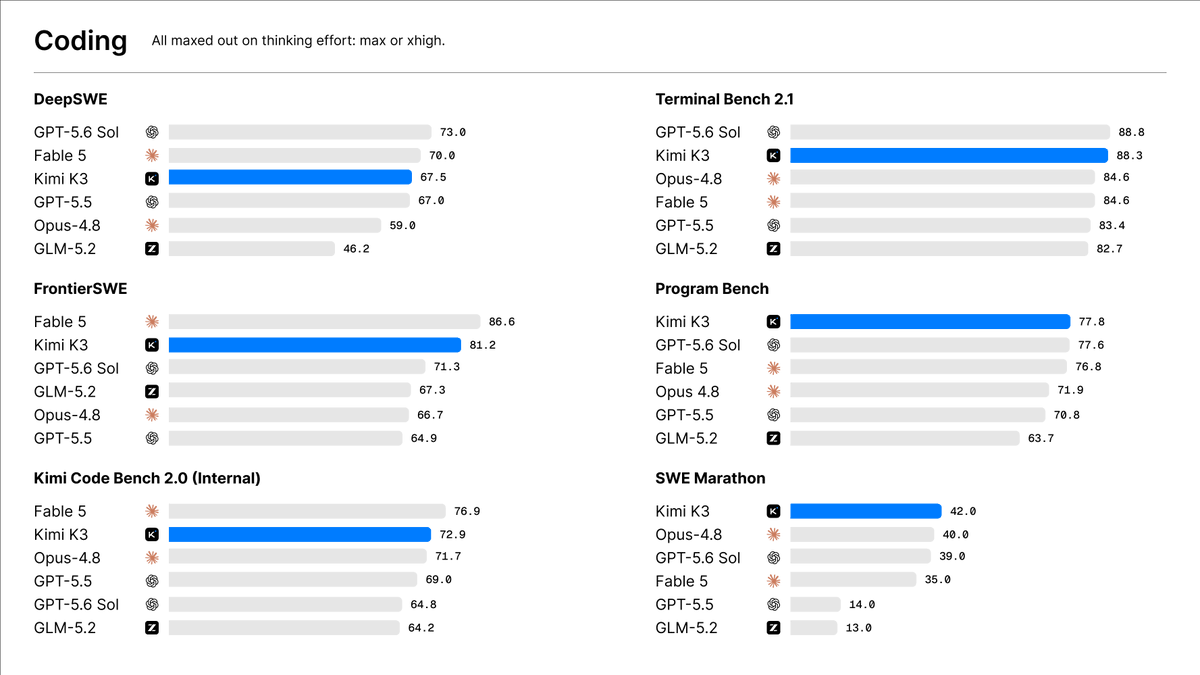
Introducing Kimi K3: Open Frontier Intelligence
🔹 2.8 Trillion Parameters, 1 Million Context, Native Multimodal
🔹 Kimi Delta Attention enables up to 6.3x faster decoding in million-token contexts
🔹 Attention Residuals deliver ~25% higher training efficiency at <2% additional cost
🔹 Built for long-horizon agentic coding and self-evolving workflows
Kimi K3 is now live on on https://t.co/zrk6zZxZUo, Kimi Work, Kimi Code, and the Kimi API.
Open Weights by July 27, 2026.
🔗 API: https://t.co/XCrgjXAqMw
🔗 Tech blog: https://t.co/YTfiMSNM1f
Unfortunately it appears the world has changed and we are never going back
OpenAI just announced GPT-5.6 Sol, a model that beats Mythos at 1/3 the price
It will only be in limited release to start as the government reviews it
The days of wide release frontier models are over
The years of some executives shilling AI as a world destroying technology that needs regulation got what they wanted, regulation
Now only the select few will get access to super intelligence. Leaving the normie class behind
It's a massive loss. Now winners and losers will be picked by the government. Which sucks.
All of this doomerism has done nothing but slow America down
On the positive side, Fable 5 will have competition
It appears OpenAI has discovered a new post training technique that is allowing them to make revolutionary jumps at a fraction of the price
That is unbelievably positive for all consumers.
Will be counting down the days until I get to use this model
In the meantime I hope this was a wake up call to the entire industry that our words and marketing matter
Most companies aren't that far behind. Most likely you’re not either.
We're in the middle of a massive economic renovation - slow, confusing, time-consuming - but, if history is any guide, the future belongs to the people who roll up their sleeves and work on what comes next.
Read the full report: https://t.co/2Z2PR3tlT1
Good take
My guess is
- demand for intelligence is near infinite
- but 80% of workloads will be running on 99% cheaper models within 12-18 months
- 20% of workloads will still run on latest gen models where IQ maxing is important (scientific breakthroughs, higher level ochestrator agents?)
- rough analogy might be what % of macbooks or gaming PCs sold have the maxed out specs for CPU/GPU, prices are falling much faster than Moore's law here though
- this leads me to think the limiting factor will be energy and compute, not better models
At Coinbase we're working hard on routing prompts to cheaper models where appropriate, and in some cases have been able to keep costs roughly flat, while token usage continues to grow exponentially.
imo there’s a pretty solid default recipe that everyone should use to optimize a system of
Agent = Model + Harness
you should “train” both
1. Build v1 agent using a sensible base harness and some task specific prompting + tools
2. Harness Engineering using eval tasks that roughly match prod
this is often enough - most companies can get acceptable perf doing this. then they collect traces, mine them for patterns, and make slight tweaks from there
3. SFT using data collected from traces) or synthetic data. Often is good candidate for “distillation tasks” to train a cheaper model while maintaining existing performance
4. RL if you have the bandwidth and ability and desire to create environments and designing rewards that represents the tasks you want your agent to be good at. Push past the SFT behavior of “copying” data from existing model to pushing past in some dimension
5. Light harness engineering again to squeeze any more juice (ex: slight prompting) using the trained model that’s better at your task distribution
this loop will largely be productized as a general purpose recipe for building and improving agents
we’re still in the earliest innings of the world’s companies getting comfortable with steps 1-2 of this loop. Harness engineering will probably be the dominant way ppl will optimize agents
but i expect a large number of companies to onboard through this entire loop on some trial project of interest in the next year
As I wrote this, I saw X go into meltdown over tokens.
You've seen the headlines: “Uber blows yearly AI budget in just one quarter.” “Meta employee burns 281 billion tokens in April.”
But, the problem isn't spending. Spending works. Since 2023, the top quartile of our AI spenders doubled their revenue. The bottom quartile? Flat.
It's blind spending. We don��t know which spend worked.
A sales team has qualified leads. A support team has resolved conversations. These are units you can measure against. All a token tells you is the meter ran, not whether the work was worth it or not.
Finance says, “half the budget,” engineering says, “double it” and you don’t know who’s right because there is no shared language of value. There’s no attribution, and no attribution means no allocation.
For example, right now, all work, no matter the size or shape, defaults to frontier models. But meeting summaries and calendar updates don’t require GPT-5.5 Pro.
In isolation this seems trivial, but re-route just 10% of a $10M AI bill from frontier to GPT-4 level intelligence you’ve saved nearly one million dollars. This sounds like a made-up stat — it’s not. It truly is that much cheaper.
This is the future of finance: not blindly rubber-stamping or rejecting AI spend, but allocating it with the same rigor companies apply to headcount.
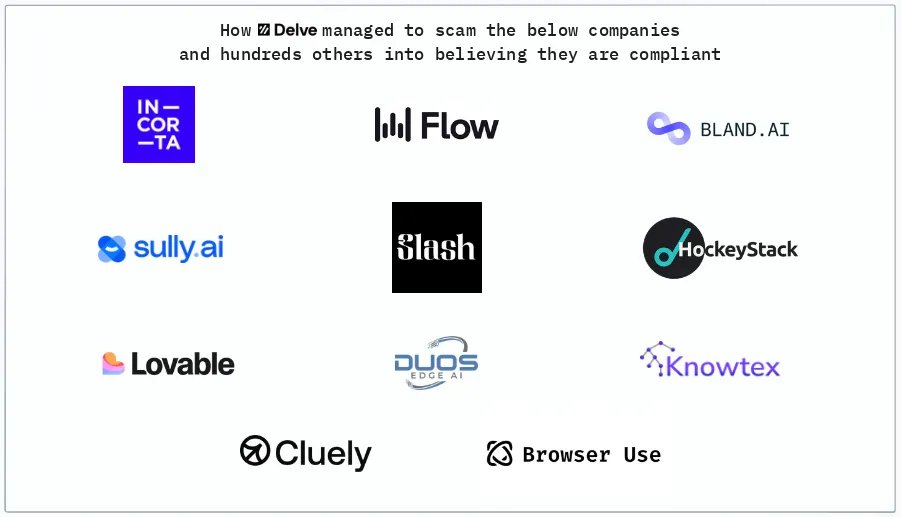
Delve, a YC-backed compliance startup that raised $32 million, has been accused of systematically faking SOC 2, ISO 27001, HIPAA, and GDPR compliance reports for hundreds of clients. According to a detailed Substack investigation by DeepDelver, a leaked Google spreadsheet containing links to hundreds of confidential draft audit reports revealed that Delve generates auditor conclusions before any auditor reviews evidence, uses the same template across 99.8% of reports, and relies on Indian certification mills operating through empty US shells instead of the "US-based CPA firms" they advertise. Here's the breakdown:
> 493 out of 494 leaked SOC 2 reports allegedly contain identical boilerplate text, including the same grammatical errors and nonsensical sentences, with only a company name, logo, org chart, and signature swapped in
> Auditor conclusions and test procedures are reportedly pre-written in draft reports before clients even provide their company description, which would violate AICPA independence rules requiring auditors to independently design tests and form conclusions
> All 259 Type II reports claim zero security incidents, zero personnel changes, zero customer terminations, and zero cyber incidents during the observation period, with identical "unable to test" conclusions across every client
> Delve's "US-based auditors" are actually Accorp and Gradient, described as Indian certification mills operating through US shell entities. 99%+ of clients reportedly went through one of these two firms over the past 6 months
> The platform allegedly publishes fully populated trust pages claiming vulnerability scanning, pentesting, and data recovery simulations before any compliance work has been done
> Delve pre-fabricates board meeting minutes, risk assessments, security incident simulations, and employee evidence that clients can adopt with a single click, according to the author
> Most "integrations" are just containers for manual screenshots with no actual API connections. The author describes the platform as a "SOC 2 template pack with a thin SaaS wrapper"
> When the leak was exposed, CEO Karun Kaushik emailed clients calling the allegations "falsified claims" from an "AI-generated email" and stated no sensitive data was accessed, while the reports themselves contained private signatures and confidential architecture diagrams
> Companies relying on these reports could face criminal liability under HIPAA and fines up to 4% of global revenue under GDPR for compliance violations they believed were resolved
> When clients threaten to leave, Delve reportedly pairs them with an external vCISO for manual off-platform work, which the author argues proves their own platform can't deliver real compliance
> Delve's sales price dropped from $15,000 to $6,000 with ISO 27001 and a penetration test thrown in when a client mentioned considering a competitor
Cursor is raising at a $50 billion valuation on the claim that its “in-house models generate more code than almost any other LLMs in the world.” Less than 24 hours after launching Composer 2, a developer found the model ID in the API response: kimi-k2p5-rl-0317-s515-fast.
That’s Moonshot AI’s Kimi K2.5 with reinforcement learning appended. A developer named Fynn was testing Cursor’s OpenAI-compatible base URL when the identifier leaked through the response headers. Moonshot’s head of pretraining, Yulun Du, confirmed on X that the tokenizer is identical to Kimi’s and questioned Cursor’s license compliance. Two other Moonshot employees posted confirmations. All three posts have since been deleted.
This is the second time. When Cursor launched Composer 1 in October 2025, users across multiple countries reported the model spontaneously switching its inner monologue to Chinese mid-session. Kenneth Auchenberg, a partner at Alley Corp, posted a screenshot calling it a smoking gun. KR-Asia and 36Kr confirmed both Cursor and Windsurf were running fine-tuned Chinese open-weight models underneath. Cursor never disclosed what Composer 1 was built on. They shipped Composer 1.5 in February and moved on.
The pattern: take a Chinese open-weight model, run RL on coding tasks, ship it as a proprietary breakthrough, publish a cost-performance chart comparing yourself against Opus 4.6 and GPT-5.4 without disclosing that your base model was free, then raise another round.
That chart from the Composer 2 announcement deserves its own paragraph. Cursor plotted Composer 2 against frontier models on a price-vs-quality axis to argue they’d hit a superior tradeoff. What the chart doesn’t show is that Anthropic and OpenAI trained their models from scratch. Cursor took an open-weight model that Moonshot spent hundreds of millions developing, ran RL on top, and presented the output as evidence of in-house research. That’s margin arbitrage on someone else’s R&D dressed up as a benchmark slide.
The license makes this more than an attribution oversight. Kimi K2.5 ships under a Modified MIT License with one clause designed for exactly this scenario: if your product exceeds $20 million in monthly revenue, you must prominently display “Kimi K2.5” on the user interface. Cursor’s ARR crossed $2 billion in February. That’s roughly $167 million per month, 8x the threshold. The clause covers derivative works explicitly.
Cursor is valued at $29.3 billion and raising at $50 billion. Moonshot’s last reported valuation was $4.3 billion. The company worth 12x more took the smaller company’s model and shipped it as proprietary technology to justify a valuation built on the frontier lab narrative.
Three Composer releases in five months. Composer 1 caught speaking Chinese. Composer 2 caught with a Kimi model ID in the API. A P0 incident this year. And a benchmark chart that compares an RL fine-tune against models requiring billions in training compute without disclosing the base was free.
The question for investors in the $50 billion round: what exactly are you buying? A VS Code fork with strong distribution, or a frontier research lab? The model ID in the API answers that.
If Moonshot doesn’t enforce this license against a company generating $2 billion annually from a derivative of their model, the attribution clause becomes decoration for every future open-weight release. Every AI lab watching this is running the same math: why open-source your model if companies with better distribution can strip attribution, call it proprietary, and raise at 12x your valuation?
kimi-k2p5-rl-0317-s515-fast is the most expensive model ID leak in the history of AI licensing.
Short every SaaS company on planet earth
Today Cursor announced a REALLY sick feature that probably cost them millions of dollars to make
Their AI agent records demo videos of itself after it builds things
I gave the announcement to my OpenClaw. It built it out in 5 minutes.
I pasted in the announcement to Henry. He said on it chief. 5 minutes later he not only built out the entire feature, but recorded a demo video of it too
It's now implemented into our entire workflow. Now every time I ask my OpenClaw to build something, a demo video will be attached to every PR
At this point how does any SaaS survive? You can take quite literally any feature they build, give it to your personal assistant, and it's built out in 5 minutes
What moat is left? When I have superintelligence running locally on my mac studio, and it's able to build out any piece of software I can imagine in minutes, literally what value is left in any software company?
This is the most exciting, frightening, awe inspiring time to ever be alive
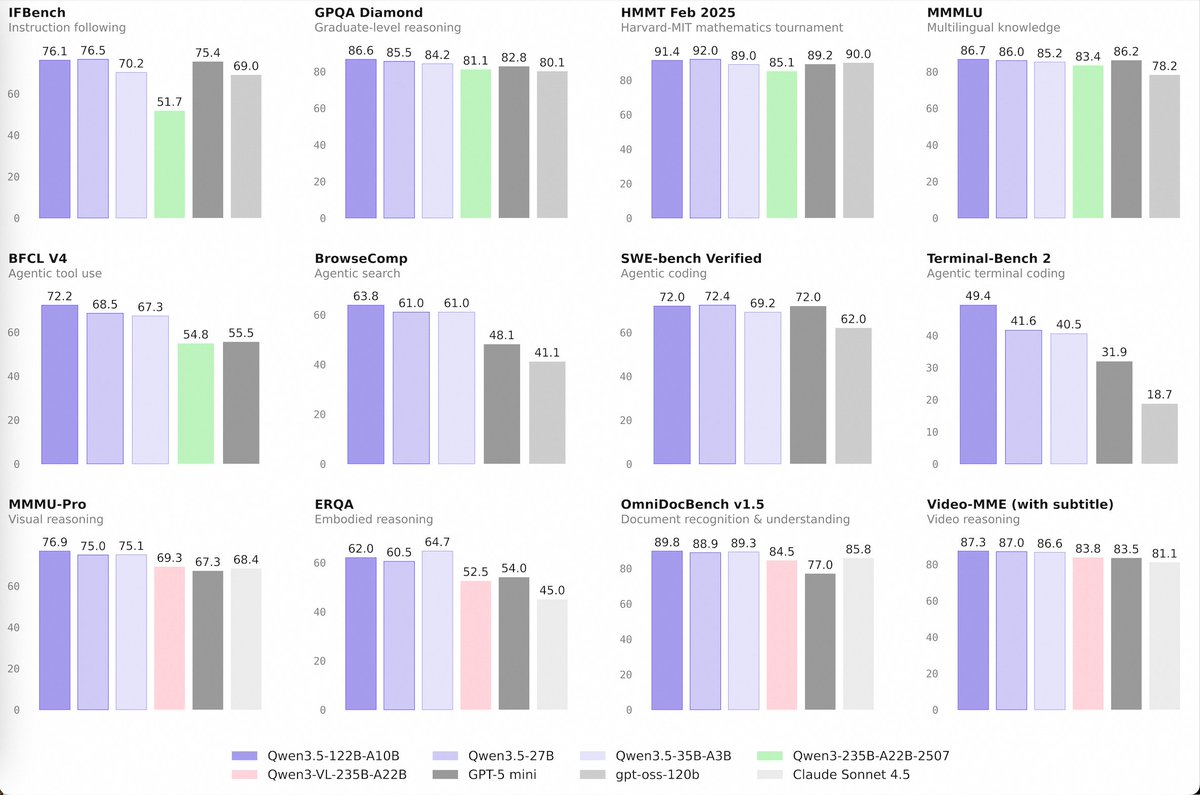
🚀 Introducing the Qwen 3.5 Medium Model Series
Qwen3.5-Flash · Qwen3.5-35B-A3B · Qwen3.5-122B-A10B · Qwen3.5-27B
✨ More intelligence, less compute.
• Qwen3.5-35B-A3B now surpasses Qwen3-235B-A22B-2507 and Qwen3-VL-235B-A22B — a reminder that better architecture, data quality, and RL can move intelligence forward, not just bigger parameter counts.
• Qwen3.5-122B-A10B and 27B continue narrowing the gap between medium-sized and frontier models — especially in more complex agent scenarios.
• Qwen3.5-Flash is the hosted production version aligned with 35B-A3B, featuring:
– 1M context length by default
– Official built-in tools
🔗 Hugging Face: https://t.co/wFMdX5pDjU
🔗 ModelScope: https://t.co/9NGXcIdCWI
🔗 Qwen3.5-Flash API: https://t.co/82ESSpaqAF
Try in Qwen Chat 👇
Flash: https://t.co/UkTL3JZxIK
27B: https://t.co/haKxG4lETy
35B-A3B: https://t.co/Oc1lYSTbwh
122B-A10B: https://t.co/hBMODXmh1o
Would love to hear what you build with it.
Crosby is rewriting an entire industry. We are a law firm powered by modern software and AI, and we have barely scratched the surface.
On a personal note, I am pumped to be joining the @CrosbyLegal team with @Ryanjdaniels and @jsarihan!
Check us out: https://t.co/gErog35pY8