ICYMI, "Next year, Windows updates for Windows 11 and Windows Server 2025 will bring Sysmon functionality natively to Windows." via Mark Russinovich
✅Same rich functionality, including support for custom configuration files
✅No separate download or manual deployment
✅Automated compliance as updates flow through Windows Update
✅Customer service support
✅Install it with a single command via the Command Prompt or cmd.exe:
> sysmon -i
➡️https://t.co/XmHIjocCeL
🧠 A Day in the Life of a CISO
It’s not just boardrooms and breaches.
Being a Chief Information Security Officer means leading, defending, influencing, and constantly adapting.
Here’s what a real day looks like behind the title. 🧵
📱 And it's the dayyyyyyyyy 🚨
Today marks a major milestone as we launch the FIRST professional cybersecurity training app!
Simply head over to the App Store or Google Play, search for the keyword (you already know what it is), and dive in!
We can't wait to hear your feedback—it’s essential for us to continue improving and delivering a better app. Thank you for always supporting us!
Available now for both iOS and Android. 🍎 🤖
#PrakritiLamsal,Nepali https://t.co/YwWWlP7dto student, was driven to take her own life due to relentless harassment from her ex-boyfriend, Advik Srivastav. Despite seeking help, no action was taken by the university. #JusticeForPrakriti
Saw a guy hunting for threat actors in the network today.
No SIEM.
No IDS.
No EDR.
He just sat there. Watching traffic in wireshark.
Like a psychopath.
Diwali’s vibrant rangolis aren’t just beautiful—they’re a mathematician’s playground! 🎨
Let’s uncover the hidden geometry in these traditional designs.
#Diwali2024#Rangoli
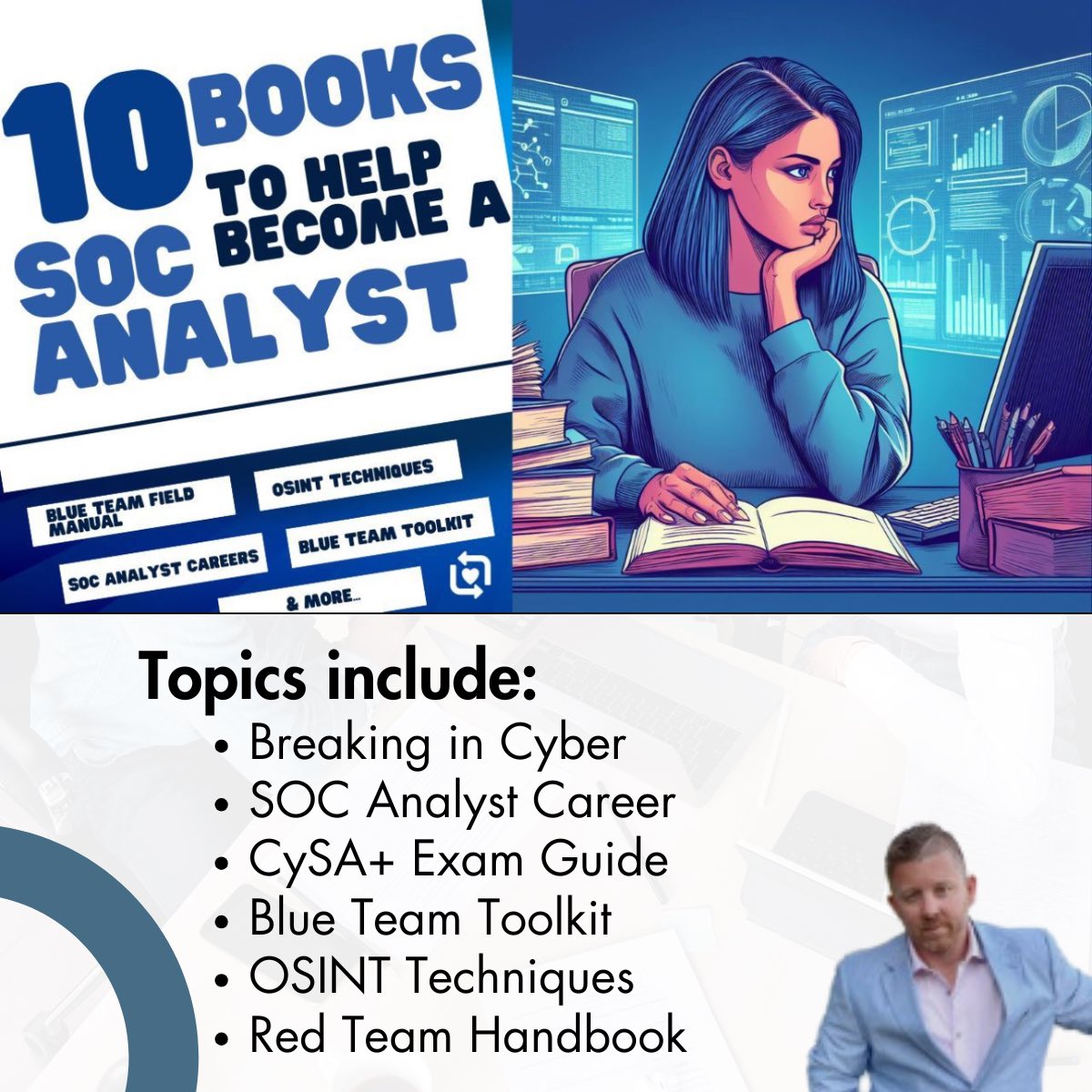
This stack of 10 books I found will help you become a Cyber Security SOC Analyst. You need to read these.
Knowing what to learn for a career in cybersecurity can be confusing. Sometimes you never know if you are learning the right thing.
Here are 10 Books I found that will help you get your SOCs on.
1. Break in Cyber Playbook - This books covers all aspects on getting into cyber security.
2. Jump Start Your SOC Analyst Career - This book covers real world insights and practical tips shared by Tyler Wall and Jarrett Rodrick. They both have extensive real world experience in this field.
3. CySA+ Exam Guide - Looking to get a good certification? This guide will help.
4. Cyber Security Blue Team Toolkit - This book has rave reviews and covers tools such as Nmap, OpenVAS, Metasploit, WireShark and others. It lays things out in o you can understand them.
5. Blue Team Field Manual - with nearly 18,000 positive reviews, this book aligns with the NIST Framework.
6. OSINT Techniques - want to learn intelligence? This will help.
7. Operator Handbook: Red Team + OSINT + Blue Team - if you wants to be good at defense you have to understand how the offense works.
8. Tribe of Hackers - just an all around great book with some great thought leader input.
9. Nmap - one of my favorite tools.
10. Cyber Security Master Plan - if you are thinking long term in your career, this book will help you develop a plan.
Don't forget to 💾 save this post so you have these resources later and ♻ for others.
If you could pick one, which would it be?
You can get to them and some other great options here -
https://t.co/S6ZS4ofNCH
🚨 [AI GOVERNANCE UPDATE] The Australian Government has just released two essential documents on safe and responsible AI, which are crucial reads for anyone involved in AI governance. Here's a breakdown:
1️⃣ Safe and Responsible AI in Australia - Proposals Paper This paper outlines potential mandatory guardrails for AI use in high-risk environments. It covers four key areas:
Why Guardrails are Needed: A focus on the importance of regulating AI development and deployment to mitigate risks in high-risk applications.
Defining High-Risk AI: A principles-based approach to identifying high-risk AI, including general-purpose AI models.
Guardrails for Testing, Transparency, and Accountability: Proposed mandatory measures to ensure these principles are upheld across the AI lifecycle and supply chain.
Regulatory Options: Discusses different approaches, from adapting existing laws to creating new AI-specific regulations.
2️⃣ Voluntary AI Safety Standard- This document sets a complementary voluntary standard, with 10 key guardrails aimed at promoting AI safety:
➵Establish governance and accountability processes.
➵Implement a risk management strategy.
➵Protect AI systems and ensure data governance.
➵Test AI models and monitor systems post-deployment.
➵Enable human oversight of AI systems.
➵Inform users about AI-driven decisions and content.
➵Create mechanisms for people to challenge AI outcomes.
➵Share transparency across the AI supply chain.
➵Maintain compliance records for third-party review.
Engage stakeholders, prioritizing safety, diversity, and fairness.
👉 Access both documents below.
➵ Safe and responsible AI in Australia: https://t.co/HRNklPvWRT
➵ Voluntary AI Safety Standard: https://t.co/ODGLz9j5JO
#AIPolicytracker #AI #ArtificialIntelligence #AIGovernance #Innovation #SafetyStandards #Transparency #Australia #AIPolicy #AIRegulation
Before you set out to build a threat hunter team, ask yourself this: is our organization equipped with basic SOC skills?
The truth is, if you don’t have a proper SOC (Security Operation Center), you can’t jump in and say, ‘let’s do threat hunting.’
Standard SOC skills like log analysis, use of analytics tools, knowledge of baseline network activity, and threat analysis—these might seem like core essentials, but they’re critical for any threat hunting team.
It truly is a case of getting down to basics.
This might be a 6-year old clip from when I gave a talk at the SANS Threat Hunting & Incident Response Summit back in 2017, but it’s as true now as it was then.