Enterprise AI has an evidence problem.
I built ChronoRAG-G around a simple idea: every required part of an answer should own the right evidence, from the right time.
80.70% audited accuracy. 101/101 unanswerable.
Paper & repo in the article. https://t.co/gjFetlQcEb
@jared_mitosis Not chain-of-thought. I’m tracing structured requirements, temporal/entity constraints, evidence slots, retrieval, coverage, resolution, and answer/refusal. Those 167 failures were mostly downstream binding/assembly failures despite the evidence being present.
Interesting failure pattern from a temporal QA system I’ve been evaluating:
194/1,005 answers failed audit.
In 167 of those failures, the required evidence was already present in the trace.
So “retrieval succeeded” and “the system had what it needed to answer correctly” are not equivalent.
Curious how others are measuring this boundary in RAG systems.
AI can answer. The harder question is whether an enterprise can safely hand it the work.
Sthiraka is now live.
We’re working toward OETRA-class systems that keep evidence, time, state, conflicts and trace attached as AI moves from answers toward execution.
https://t.co/bgQFlpzXpx
The result I keep returning to isn't 80.70%.
Single-time enumeration fell to 59.12% — 162/274.
Time was simple.
The question wasn't.
Every slot-bearing question in that subgroup carried at least 3 evidence obligations.
Complexity had moved from the calendar into construction.
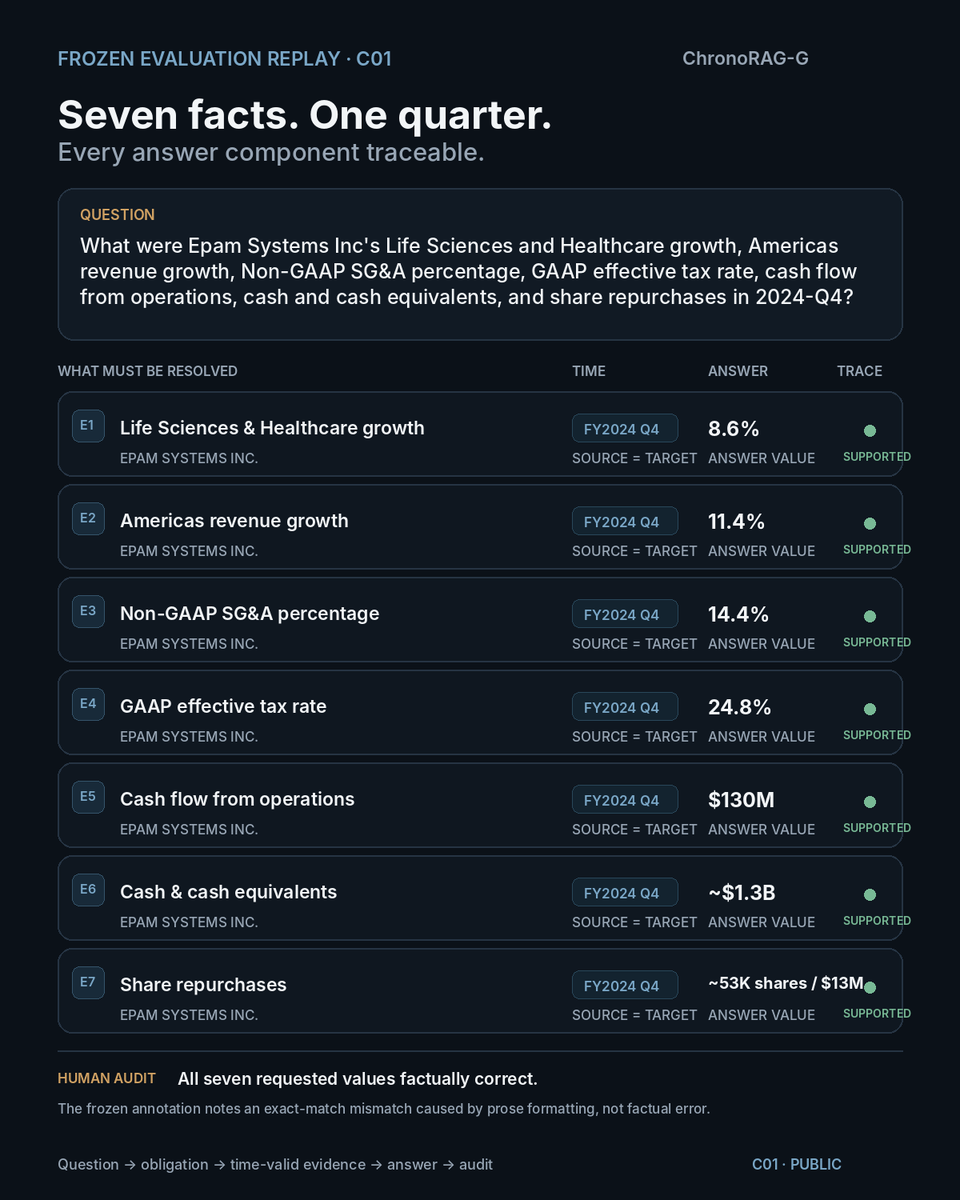
Seven facts. One quarter. One answer.
The paragraph is almost the least interesting part.
What matters is that every requested fact remains visible as its own obligation from
question → evidence → answer.
Fluency can hide a missing fact.
An explicit obligation cannot.
@thealtryst This could be genuinely useful as a counterweight to how broadly agents are used now, define the work tightly, keep the state persistent, and only spend compute where the task actually changes.
The dangerous RAG failure isn’t only hallucination.
It’s a cited answer where every source is relevant, but one fact belongs to the wrong period. Nothing looks broken.
The answer looks grounded. The decision is wrong. That’s an evidence-ownership failure.
Enterprise AI has an evidence problem.
I built ChronoRAG-G around a simple idea: every required part of an answer should own the right evidence, from the right time.
80.70% audited accuracy. 101/101 unanswerable.
Paper & repo in the article. https://t.co/gjFetlQcEb
@FReza1984 Exactly.
The useful part is that the challenge can become local: which fact, which evidence, and which time failed - instead of auditing the whole answer as one opaque output.
Enterprise AI has an evidence problem.
I built ChronoRAG-G around a simple idea: every required part of an answer should own the right evidence, from the right time.
80.70% audited accuracy. 101/101 unanswerable.
Paper & repo in the article. https://t.co/gjFetlQcEb
ChronoRAG-G came from one belief:
An AI answer should not earn trust just because it sounds right.
Think of it like a number in a financial statement without the ledger behind it. The number may be correct, but you still need to know how it got there.
That is the problem I wanted to work on.
ChronoRAG-G is now public.
For the last few weeks, I’ve been building, breaking, rebuilding, testing and writing this work.
This started as one question I wanted to solve. A few weeks later, after a lot of building, testing and fixing, it became this paper.
Paper:
https://t.co/vspafGz5Pu
I’m grateful to Prof. P. Sivakumara and Tippeswamy for their guidance and support through this work.
ChronoRAG-G has a much bigger story than this paper alone. I’ll get to that later.
Public research artifacts:
https://t.co/JY373zfYGz
The final evaluation covered 1,005 questions.
80.70% audited end-to-end accuracy.
90.44% of the measured oracle upper bound.
The numbers matter, but what matters more to me is carrying this from an idea all the way to completed public research.
I think agent reliability has a similar problem: getting the right information somewhere in the system is not enough.
The system has to preserve what each step is responsible for all the way to the final action.
Evidence traceability may be one way to make that explicit.
I started ChronoRAG-G with one question:
what if an AI system had to know exactly what evidence it needed before trying to answer?
A question can need 2 companies × 3 periods × several values.
Finding one highly relevant piece of context doesn’t mean the whole answer is covered.
A product question I’m starting to care about:
should an AI system be allowed to answer just because it found relevant context, or should it first prove that every required piece of evidence was actually resolved?
The second model creates a very different kind of AI product.
I started ChronoRAG-G with one question:
what if an AI system had to know exactly what evidence it needed before trying to answer?
A question can need 2 companies × 3 periods × several values.
Finding one highly relevant piece of context doesn’t mean the whole answer is covered.
The part I’m most interested in now is not better top-k retrieval.
It’s whether every fact the answer depends on can stay identifiable from retrieval to final output.
That shift is starting to look more important than another RAG optimization.
I started ChronoRAG-G with one question:
what if an AI system had to know exactly what evidence it needed before trying to answer?
A question can need 2 companies × 3 periods × several values.
Finding one highly relevant piece of context doesn’t mean the whole answer is covered.
Across 1,005 questions, ChronoRAG-G resolved
3,837 / 3,889 required facts - 98.66%.
That pushed the idea beyond RAG for me.
RAG is where I tested it.
The broader idea is an evidence contract:
define what the system must resolve, then trace whether that evidence actually survives into the answer.
I started ChronoRAG-G with one question:
what if an AI system had to know exactly what evidence it needed before trying to answer?
A question can need 2 companies × 3 periods × several values.
Finding one highly relevant piece of context doesn’t mean the whole answer is covered.
So I stopped treating the question as one retrieval job.
Each required fact became its own evidence obligation.
I kept that identity through retrieval, time checks, evidence allocation and answer construction.
That gave me something I now care about more than retrieval accuracy:
evidence traceability.