Colonial observation on Jodhpur royal family and state at large :-
The members of royal family were portrayed as of low character: Indulgent and pleasure-seeking, uneducated and Undisciplined Privileged and above law and punishment, Arrogant and lawless, conflicting female interests and improper quarrels.
The royal family's character is marked by luxury, sensuality, indiscipline, factionalism, privilege, and impunity. More fundamentally, it represents a bottom of aristocratic self-discipline: the very family that should embody authority has allegedly become one of the forces undermining it.
Along with this there is a powerful body of Thakurs, a faction of intriguing officials, and a large and unruly family, all of whom are practically beyond control and may themselves commit any oppression, or connive at the misconduct of others, without fear of any consequences from the Court.
In such a state of affairs, and in a country afflicted by famine and anarchy, it is hardly surprising that highway robbery was very prevalent throughout the country.
Particularly those in the neighbourhood of Jodhpur, are unsafe for travellers by day or by night.
One of the strangest misconceptions about Indian history that is propagated is that Rajputana was ruined by the Marathas. It is portrayed as if Rajputana was a paradise before the arrival of the Marathas and later fell victim to their atrocities.
Rajput youth present the Maratha invasions as the sole and most important cause of the destruction of Rajputana. This misconception is vigorously propagated by the youth of the Rajput community. But this is only half the truth.
There is no doubt that the Maratha attacks caused damage to Rajputana, but the Maratha invasions were not the only cause of Rajputana's decline, nor were they the most important one.
An important factor that Rajput youth ignore as part of an agenda is the weakness of the Rajput rulers, their corrupt administration, and the widespread anarchy that arose from it.
Let us take Udaipur as an example. Administrative disorder had become so deeply rooted there that necessity was imposed upon Colonel Tod, the first officer appointed as British Agent, for the responsibility of conducting the entire administration.
The reforms initiated by him proved so beneficial that within three years the revenue had nearly doubled while considerably improving the condition of the local people. Having thus practically demonstrated how a system of government could be administered, Colonel Tod, in accordance with the instructions of his government, handed over authority to the local officials of Udaipur. The experiment was not satisfactory.
During the next two years, heavy debts were incurred, revenue declined, and the tribute payable to the British Government was left unpaid. Once again, the administration was entrusted to state officials and good governance was restored.
In 1826, the administration was again handed over to the local authorities. Unfortunately, it once more ended in failure. Within a few months, disorder had reached its height, and the revenue had fallen almost to the low level from which it had been raised by the decisive measures adopted in 1818. Within a few months, extravagance and oppression had once again reached their former extremes, and the roads had become almost impassable for solitary travellers.
Bhim Singh died in 1828 and was succeeded by his son Jawan Singh. Unfortunately, the new ruler was a man of no character, addicted to vicious habits and base pursuits. It can readily be imagined that under such a ruler the affairs of the state could not prosper. Within a few years of his accession, tribute again fell heavily into arrears, the state became overwhelmed with debt, and an annual deficit of two lakh rupees accrued.
Misgovernment had reached such an extent that the Rana had to be warned that if he proved unable to fulfil his obligations to the British Government, security in the form of territory or some other adequate guarantee would be demanded.
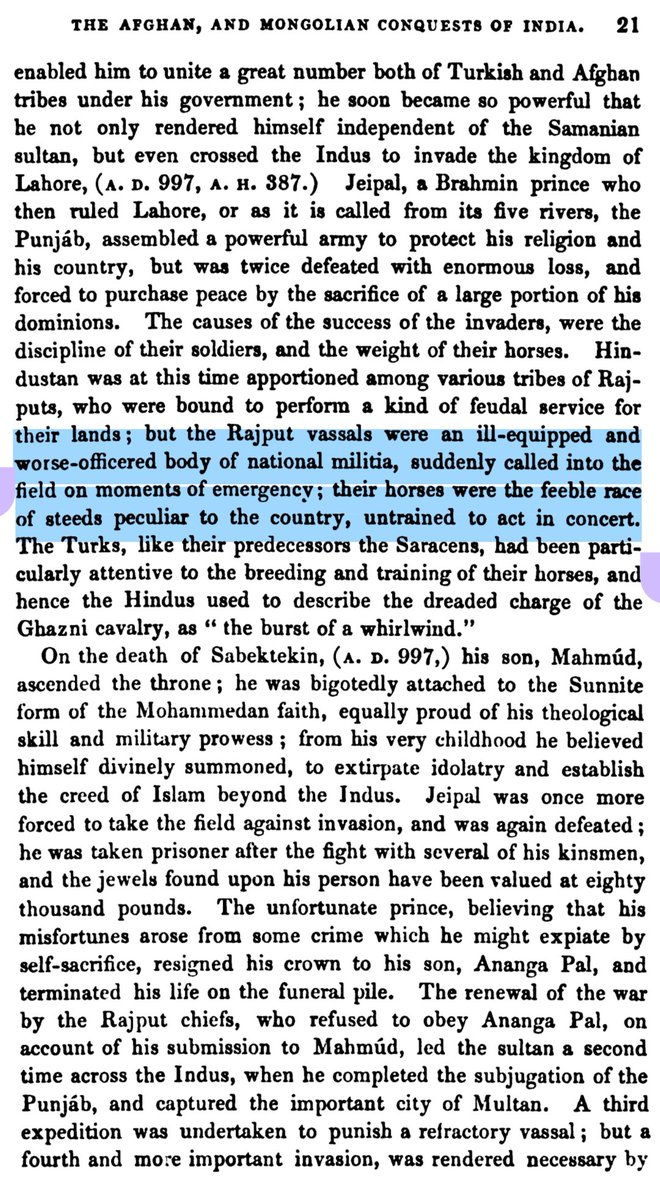
All of this was taking place after 1818, by which time the Maratha Empire had already fallen.
Sogdian Magis Màjüsi priest...
Ibn al-Faqih indicates that the guardians of the idols (sadana) tried to warn Qutayba against the consequences of his profanation. The fact that Qutayba did not directly attack the clergy stands in contrast with his behaviour some months before in Khwärezm, the northern neighbour of Sogdiana, as recorded later on by Birüni Chronology: After Qutayba Muslim had exterminated their scribes and executed their priests, and had burnt their books and rolls (the Khwärezmians) remained ignorant and had to rely upon their memory for their history.
Here we have a clear mention of priests (ha-rabidha), from Persian (herbed), but Birüni does not give any such information about Sogdiana; on the contrary, he mentions that priestly writ-ings from this country were still in circulation in his own time, a point to which I shall come back. The relatively detailed accounts we have of the conquest of Sogdiana ignore any role of priests in the resistance and, consequently, any mass persecution. The only priest mentioned in this context is a certain Khushtyär, qualified as 'alim al-majūs, thus presumably a scholar-priest: according to the Kitab al-Qand, a catalogue of the muhaddith of Samarkand, he polemicized with Qutayba when the latter captured Bukhara, and eventually became a Muslim scholar. Re-ports from Arab travelers from the tenth century show the Zoroastrian community still flourish-ing in Samarkand, where they were in charge of the maintenance of the water supply. Today a bridge on the main canal branch still carries the name Pul-e ab-e moghan, The Bridge of the River of the Magians, but Magians (moghan, majūs is a general name for Zoroastrians, not a specific designation of the priestly class. Under the reign of the Abbasid caliph al-Ma'mün (813-833), the Zoroastrians of Samarkand addressed the hudēnan pëšōbāy, the acknowledged leader of the Zoroastrians in Färs and Kerman, to seek advice on the reconstruction of a stone dakhma a building for the exposure of bodies.
The earliest mention is in the Ancient Letter 1, writ-ten in 314 C.E. by a Sogdian merchant's wife who lived in Dunhuang. The priest is designated as vaghnpat (βynpt), literally master of a temple, a term unknown in Sasanian Iran (except in the Manichaean polemical text with the meaning "idol-priest"), but whose cognates exist in Armenian (bagnapet, borrowed from Parthian) and Middle Indian (bakanapati or vakanapati, borrowed from Bactrian). It is always applied to a priest serving a temple containing images. In the Dunhuang letter the vaghnpat is not named, which might indicate that he is the only holder of this office in the community; he provides the author of the letter, who has been abandoned by her husband and by everyone in his clan, with material support and promises to give her a camel and a bodyguard if she decides to go and join her husband. Thus the Zoroastrian clergy appears in the same institutional role of protector of the poor as in Sasanian Iran.
Rajputs want to elevate their character by Genealogies. But genealogies couldn't hide their moral bankruptcy and wretchedness.
Colonial observers considered castes like Bheels far morally superior to Rajputs, despite their reputation as thieves and savages.
Their word was considered more trustworthy. They were regarded as franker and more cheerful. Their women were treated considerably better and had greater influence.
Although Bhils could kill without hesitation during blood feuds or raids, they were not generally vindictive or inhospitable.
British officers could travel into Bhil territory for hunting and fishing without military protection, relying on Bhils themselves as guides and companions.
ārşeyāņi nāmadheyāni, rşīnām nāmadheyāni
Those who do not even know the distinction between gotra and pravara are not worth wasting time explaining it to. There are several systems for understanding gotra and pravara. Gotras are of two types Ārṣa and Laukika for example, asamāna-pravarair vivāhah marriage is with persons who have different pravaras; asamāna-rşi-gotra-jātām (udvahet)3-a man must not marry a woman born in the same rși-gotra, that is, gotra as determined by the rși-names of the pravaras. The Vişnu-Smrti prohibits a woman of the same 'pravara of rșis' (asamānārşa-pravarā) as well as one of the same gotra (asagotrā). Manu apparently felt that the prohibition of gotra was sufficient by itself; but Yājñavalkya more explicitly says asamānārşa-gotra-jām, i.e. a woman of a different ārşa-gotra. The Mitākṣarā interprets this last expression as a Dvandva compound, 'of a different ārsa, i.e. pravara, and of a different gotra'. This is doubtful, and is certainly misleading, since it suggests to the reader that two separate prohibitions are intended. It has indeed even in modern times been stated that Brahmans avoid in marriage both gotra and pravara. The passage noted above from the Vişnu-Smrti is open to the same interpretation, although in this case the term asagotrā may have been intended simply to explain asamānārşa-pravarā. But in Yājñavalkya's phrase it is difficult to see any reason for preferring the Mitākşara's rendering. The word ārşa is primarily an adjective 'concerned with rșis' and could only have the sub-stantival meaning of pravara as the result of an ellipsis. It seems preferable to translate it as an adjective here; and this translation is further upheld by the Vişnu-Smrti (which could hardly intend ārşa-pravara to mean 'pravara and pravara'), and by the unmodified form of the Vaikhānasa Sūtra-rși-gotra.
Thus, Yājñavalkya here is quite clearly defining the kind of gotra that a man is to avoid: it is not gotra in the everyday sense of 'family', that is, not the laukika-gotra, but the arsa-gotra, that is, the gotra connected with the rșis. In brief, ārşa-gotra means, not 'pravara and gotra', but 'gotra as determined by the rși-names in one's pravara'. In the use of the pravaras, therefore, we are to see simply a mechanism whereby the exogamous group is defined, and the system preserved from the dissolution which the inexact usages of the word gotra might have brought about. The phrase ārşeyān ṛṣīn would naturally mean 'rșis who are also descendants of rșis', and in this sense, indeed, it occurs frequently enough in the later Vedic hymns, where the authors pride themselves on their hymn-composing ancestry. But in the case of the pravaras it is difficult to see the reason for the double requirement.
In fact, normally one rși in the pravara is not a 'descendant of a rși', but is himself the original rşi (mūlabhūta rșih) who is, so to say, the founder of the family. In the case of ārşeyān pūrvajān, 'ancestors who are descendants of rșis', the same objection holds. In the election of the priests prior to a sacrifice, the Sūtra injunction is normally that one should choose a Brahman who is ārşeya; and indeed in this connection the Yajur-veda uses the phrase rșir ārşeyah. This, however, is in order to guarantee the priest as a member of one of the authentic Brahman clans, as being the descendant of one of the gotra-rșis. It is clearly a distinct usage from that seen in the pravara-prescription though of course allied to it.
The neuter form, ārşeyāny apatyāni, would mean 'descendants who are descendants of rșis. abhí no arşa divya vásūny abhí viśvā parthivā pūyámānah:
अंग्रेज लिखते हैं कि राजपूताना पहले इस्लामी आक्रमणों से बर्बाद हुआ, और जो कुछ कसर बाकी रह गई थी, उसे यहाँ के निकम्मे शासकों ने पूरी कर दी। उन्होंने अपने कुशासन और गलत नीतियों के माध्यम से इस भूमि को पूर्णतः ��िनाश की स्थिति तक पहुँचा दिया। @prthwii
@Samantimarxist @Kaladin_04
वेलेंटाइन कैमरन प्रिंसिप राजपूतों के बारे में लिखते है कि राजपूतों में अफीम खा के सठीया जाना कोई नई चीज़ नहीं थी। अफ़ीम ��ी ऐसी भारी खुराक रहती थी कि दर्द का सिस्टम ऑफ़ हो जाता था, और लेखक तंज़ कसते हुए कहता है कि कई बार अक़्ल का स्विच भी।
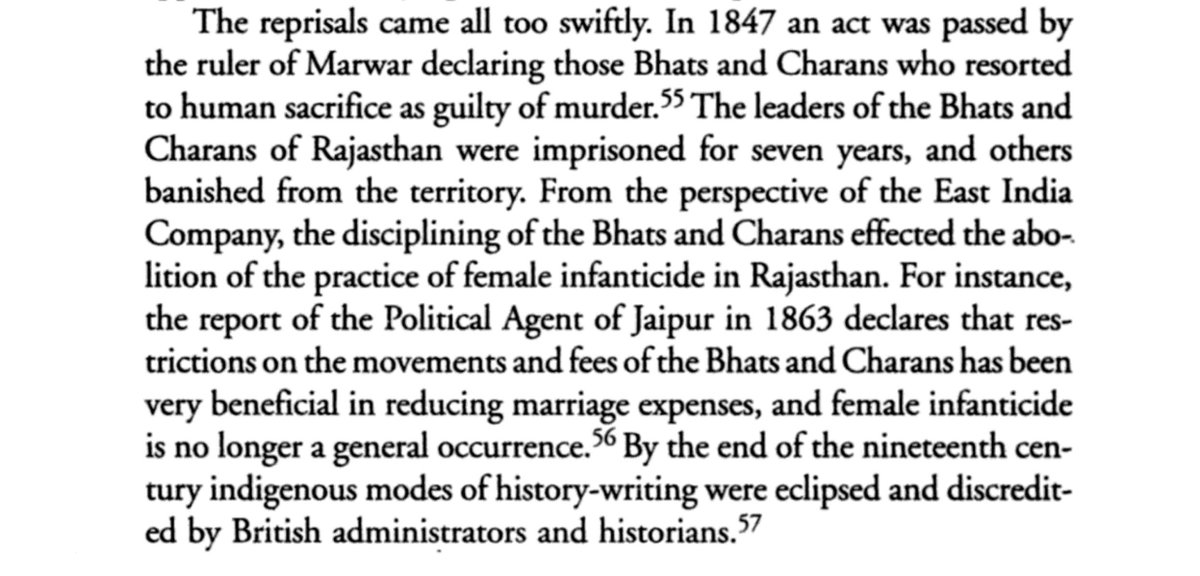
In Rajasthan, there is a caste known as the Charans. They are professional flatterers who praise the Rajputs and receive large sums of money from them. They succeeded by convincing people that they were sacred, and that anyone who shed their blood would incur God's wrath.
Under the cover of this claimed sanctity, they engaged in various crimes, one of which was human sacrifice. To force others to comply with their demands, they would have elderly women from their own families killed. In 1847, the British government banned this practice of human sacrifice and expelled them from several regions.
They were also responsible for encouraging female infanticide among the Rajputs. Today, members of this caste preach morality on the internet. @Deviputra21
दलपत विलास में लिखा है कि दलपत सिंह राठौड़ का एक भाई था जिसका नाम मदन सिंह राठौड़ था, दलपत विलास का लेखक लिखता है कि जब मदन सिंह राठौड़ ने अकबर को देखा तो बन्ना की "गांडि फाटी अर लिपरका करणै ��ागी"।
अर्थात बन्ना की गांड फट गई और लिपरका करने लगी। @prthwii @Samantimarxist
बन्ना महाराणा प्रताप की जयंती पे कुछ इस तरह झूम उठे। पर ये जरूरी नहीं कि ऐसे वीडियो प्र���ाप बन्ना कि ��यंती पर ही बनाए जाए। आप बन्ना लोग @USujaan @Samantimarxist @prthwii हमें रोज ऐसे वीडियो dm कर सकते है। दिखाइये बन्ना अपना टैलेंट, बाईसा देख रही है आपको।
Why not send the Kachwaha princess, with mehndi-adorned hands and a silver-like body, to the Government of India’s harem, and reclaim the State of Jaipur?