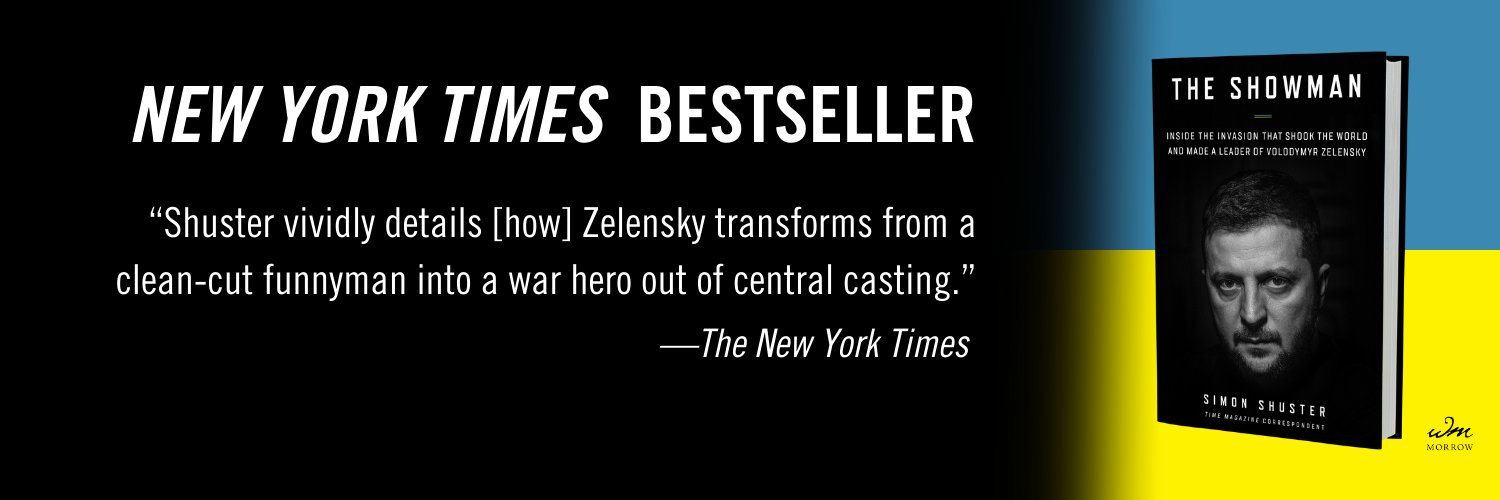
Sooner or later, books fly the nest to live their own lives, outside the authors' control. Mine has now reached that point. If you see it, please grab it, read it, and judge it for yourself.
https://t.co/2lXaEFQ3Hy
'She made her position a platform for promoting distortions and undermining public confidence in the very institutions she’d sworn an oath to lead"
From @shaneharris, on Tulsi Gabbard
https://t.co/MRRiCzWGxH
Strategic ambiguity, long the U.S. approach toward defending Taiwan, is no longer reserved for the Indo-Pacific. Under Trump, it also defines Washington’s approach to Europe.
Our latest @TheAtlantic with the great @nancyayoussef and @isaacstanbecker
https://t.co/Bks8bqtiZu
"I am in the business of writing long and complicated stories full of nuance. Yet I am at the mercy of platforms that want to turn my words into cortisol and endorphins, often for people who will never click the link to read what I wrote. Regardless of my intentions, my work can fuel the false division I despise."
@michaelscherer captures a core frustration of the modern journalist: https://t.co/gDbgSG01Tp
Why did so many titans of Silicon Valley turn against Ukraine after the Russian invasion? George Packer finds an answer in this brilliant profile of @DavidSacks.
"If you neutralize any sentiment of right and wrong, Ukraine just looks like a risky bet."
https://t.co/hiFZl2DTQe
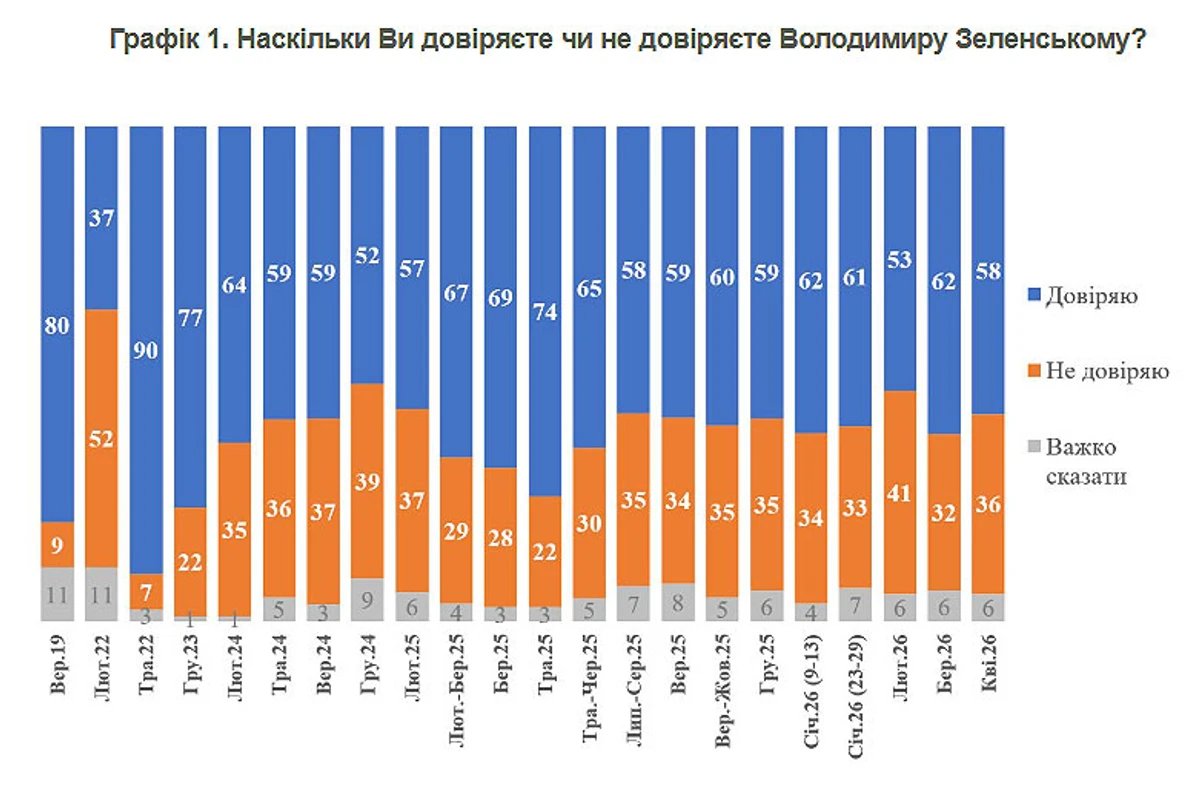
On the political benefits of having a backbone: Trust in Zelensky peaked right after the invasion (90%) and in the weeks after his clash with Trump/Vance in Oval office.
Now at 58%.
After 4+ years of all-out war, still a level many presidents can only dream of.
28% of Ukrainians want to see Volodymyr Zelenskyy remain president after the war (up from 25% in early October 2025), while another 16% believe he should stay in politics as party leader or MP, acc. to a new KIIS poll conducted April 20-27.
30% think he should leave politics entirely to focus on charity, promoting Ukraine abroad, or personal matters (down from 36% in October), and 15% say he should face criminal prosecution. Trust in the President stands at 58% (down 4 points since March), with 36% saying they do not trust him, giving a trust balance of +22%. Among those who trust him, 25% trust him fully and 33% rather trust him. If were true, this still would be much higher than just before large-scale war when 37% said they trusted Zelenskyy and 52% did not.
"Volodymyr Zelensky is taking the next step, one that would have been unthinkable even as recently as 2024. By word and deed, he’s showing Europe and the world how the post-American free world can preserve its liberty and independence."
https://t.co/7LtxcnG7XG
If the United States truly thinks about withdrawing from NATO, then European security will be based solely on the European Union. But not in its current form. I think that the EU is in a situation where it needs more countries.
The UK, Ukraine, Türkiye, and Norway. These are four strong countries, which are part of Europe. Together, the UK, Ukraine, and Türkiye have armies that are stronger than Russia's army. Without Ukraine and Türkiye, Europe can’t match Russia. With the four countries on board you can wrest control of the seas, have secure skies and the largest land forces.
It’s not about offense, because when Russia makes the decision to have an army of 2.5 million people by 2030, Europe has to think about security and how to preserve its independence. The UK once was a member of the EU. There are concerns about agriculture when it comes to Türkiye. But you can manage all of this if you have a really great economy. But security comes first, economy second. Not vice versa.
From an interview on The Rest Is Politics podcast (5/5).
🚨 BREAKING: Zelensky proposes a defensive military alliance that includes the EU + Ukraine, Turkey, Norway, and the UK.
This will enable control of the seas, skies, and land of all Europe as the United States withdraws from NATO.
The alliance will be stronger than Russia.
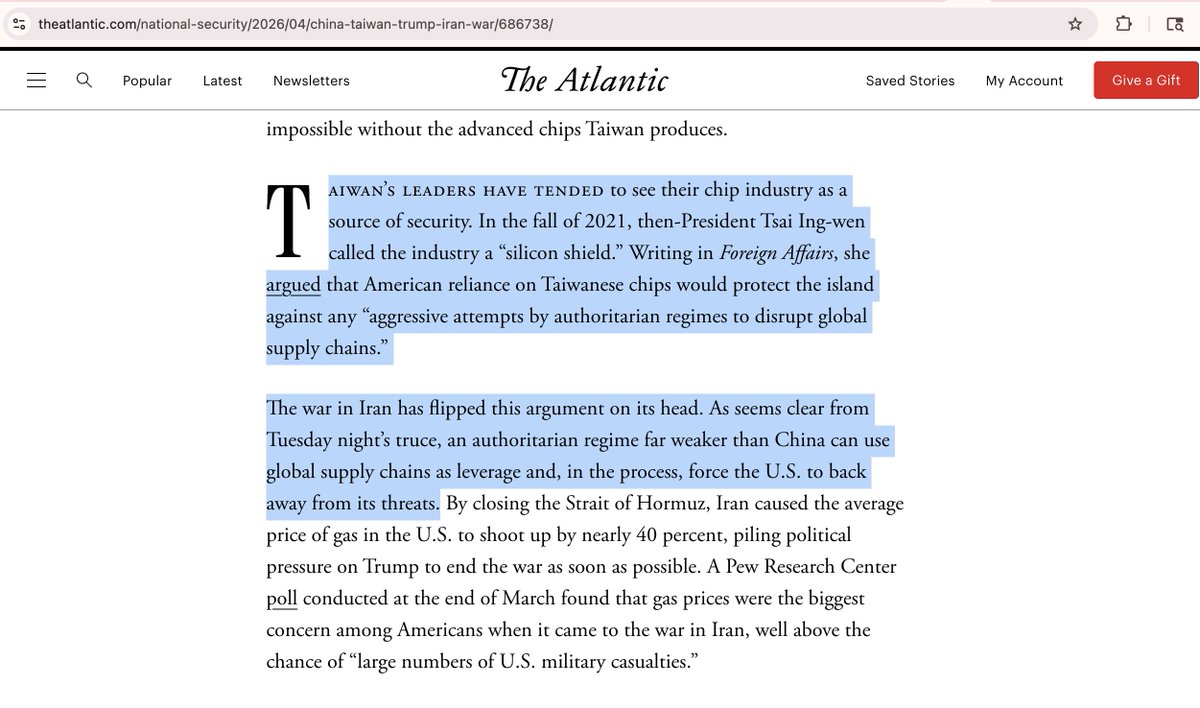
Iran’s control of the Strait of Hormuz may have given China a model to follow—but the resulting shock of a partial blockade of Taiwan to the global economy would be far worse, @shustry argues: https://t.co/3l5CPzXceu
The Times says a strategy of publishing “fewer, better stories” has led to three consecutive months of record-breaking global audience growth - including Google traffic increases
The Times has gone from publishing more than 200 stories a day to about 150 – a 25% cut
Beijing has paid close attention to Trump's pain threshold in Iran. For the Chinese leadership, yesterday's ceasefire shows how a global supply-chain crisis (like, say, a blockade of Taiwan, or the Strait of Hormuz) can make the Americans back down
Gift link below @TheAtlantic
It's true, the author of this book had extensive access to the people who blew up the Nord Stream pipelines. One big question is how much President Zelensky knew about it, and when. Very curious to read it @bopanc
https://t.co/7fq8LG7zhP
With a cameo by Zelensky: In an interview with Simon Shuster published last week, the CEO of Germany’s biggest arms manufacturer “dismissed the work of Ukrainian drone makers as child’s play.” Shuster reports on the backlash that followed: https://t.co/ylWH00aJWP
This is not the first time the Americans try to pull Europe into a brawl. The last time, in a standoff with China, the US found one particularly eager ally in Lithuania. It did not go well for them, and the Europeans remember.
Russia’s Education and Science Minister Valery Falkov informed the rectors of the country’s largest universities earlier this year that at least 2% of their total student body must enlist to serve in Ukraine. ⤵️
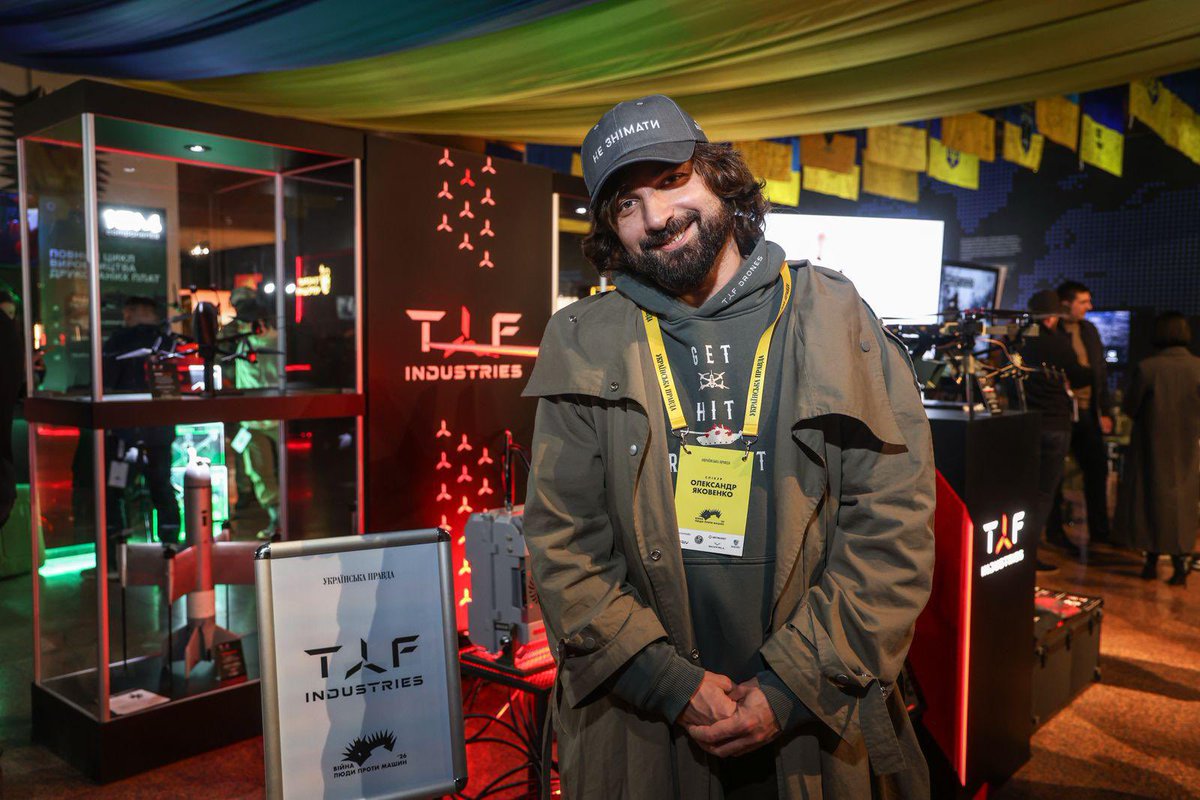
Dear Mr. Armin Papperger, CEO of Rheinmetall,
When you referred to Ukrainian drone manufacturers as “Ukrainian housewives with 3D printers” you revealed just how deeply the European defense establishment still fails to understand the nature of modern warfare.
This is not about emotion. It is about battlefield reality. Here are the facts your industry refuses to acknowledge:
In 2025 alone, Ukrainian drones carried out 819,737 confirmed strikes. They caused 90 percent of all Russian combat losses, more than all other weapons systems combined.
TAF alone produces up to 100к FPV drones monthly. In any given 90-day period, my company’s products alone achieve more confirmed strikes than your entire fleet of equipment has across its full combat history in every conflict. And most importantly, I built this company and achieved these results in two years, not fifty. Think about that.
Our drones generate more kinetic effect in three months than your flagship platforms have in half a century.
Why? Because the battlefield has changed, and your business model has not.
•Russian electronic warfare has made GPS-guided Western munitions such as Excalibur and GMLRS nearly ineffective.
•Expensive and complex systems designed for wars with air superiority and traditional peer-to-peer combat have become easy prey for drones costing $500, attacking them from above.
•The cost-to-effect ratio has been turned upside down: one 120 mm Rheinmetall shell or one anti-tank missile costs more than a dozen of our drones, and yet our drones still win.
This is not a “Lego game.” It is industrial Darwinism in real time. We iterate every week. We print parts in basements and ship 100к strike systems per month, while your engineers still require three to five years and hundreds of millions of euros in certification costs for even a minor upgrade.
The war in Ukraine is not a temporary anomaly. It is the first true drone-industrial war. And it has already proven that outdated European platforms, no matter how expensive or “serious” they may seem, are becoming less and less relevant unless they integrate the very technologies you mock.
So when you say, “this is not innovation,” I hear something else: “We do not want to admit that the future is being written in Ukrainian workshops, not in Düsseldorf boardrooms.”
#MadeByHousewives is trending for a reason. Because these “housewives” destroy more enemy equipment every month than entire European armies do in full campaigns. And they do it while your industry continues to sell 20th-century solutions at 21st prices.
The invitation remains open, Mr. Papperger. Stop laughing at the kitchen table. Come and learn how tomorrow’s war is actually being fought. Because the next time someone asks, “Who needs tanks in the age of drones?”, the answer may be simpler than you think: Whoever still believes in 1979 will lose to whoever is building in 2026.
With respect, but with facts,
Oleksandr Yakovenko “Ukrainian housewives”
Founder TAF
Wer sprengte #NordStream? Woher kam der Befehl? Was wurde vertuscht?
Das neue Buch rekonstruiert erstmals die gesamte Operation – basierend auf jahrelangen Recherchen und Gesprächen mit Beteiligten.
Jetzt via @amazon bestellen:
https://t.co/LbwVcvBQCz