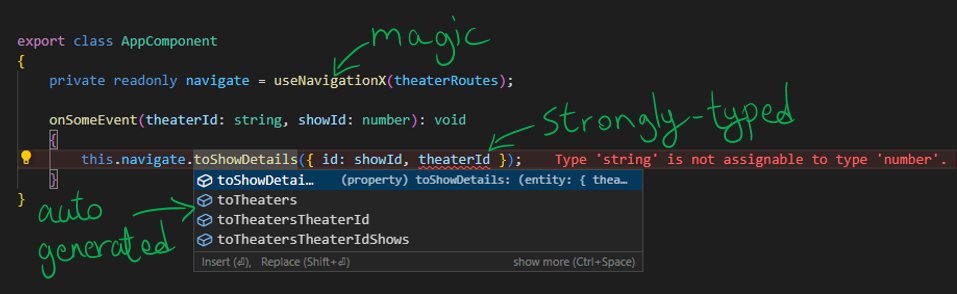
A lot of @typescript magic is coming your way... 🚀
It's time to release my strongly typed navigation system for @angular, and IT! IS! WICKED! ✨
I would love hearing your feedback. 👍👎
@steveruizok Mind blowing...
Is there any specific use-case that brought you to try this? or is it pure creative playing?
I'd love to hear about the application.
@juristr ...In other words, problems.
As far as tooling, I would love to see 2 things:
1. Tooling to facilitating refactors when trouble comes.
2. Tooling to facilitate standards on predefined scheme, meaning generation+enforcement on a level deeper than linting module bounderies.
@juristr Coordination & alignment. It takes time to train everybody on new standards/architecture/organization.
Large codebases many times mean large heterogeneous team(s). Lack of alignment means problematic code getting pushed frequently and regularly, creating rolling snowballs.
Nx and monorepos require a paradigm shift for many developers. Meanwhile, it's impossible to hold production and code gets pushed.
A few steps into the future, you try to move things around, you get circular dependencies, libs referencing apps, large non-domain specific libs...
@mgechev Also, I've always considered the multi flag to be related with the token itself, not the provider. This makes more sense to me:
const TOKEN = new InjectionToken<...>('TOKEN', { ..., multi: true });
Which will also allow enforcement at the framework level.
@mgechev Could you give an example? How would they simplify multiproviders?
Say I have a BusyService which injects multi provider with boolean observables corresponding with different heavy mechanisms in the system to later output a single boolean.
How would that work?
@mgechev Yes, I understand that.
It just feels like we're going back to the days we used server syntax (e.g. Razor) to dynamically render static pages on the server.
I always found the syntax visually disruptive.
@mgechev ... and honestly, that is something I always dislike about the the other frameworks: The hard-to-read mixture.
If we are going to invent new syntax, let's make it look more like html...
@mgechev Am I the only one upset by this RFC?
Functionality-wise, the benefits are obvious.
However, templates should be templates. That was the *one* thing that caught my attention in Angular initially. The clear separation between template and JS code.