90'larda doğanlar olarak hiçbirimiz yaşımızı göstermiyoruz. Bizden önceki nesil bu yaşlardayken gayet olgun duruyordu ama biz hala 20 lerin başında gibi duruyoruz. Bizden sonraki nesil de büyük duruyor ama biz nedense küçük duruyoruz. Anlam veremiyorum buna. Ne ara 30 olduk sahi?
In 1993, this photo of Belgian soldiers roasting a Somali boy alive went viral.
The soldiers were in Mogadishu as part of a 5,000-strong UN-led "peacekeeping" mission codenamed Operation Restore Hope in Somalia.
The image shocked the world.
What happened in November 1997, was even more shocking — A Belgian court acquitted the two soldiers.
Sometimes you look back and feel amazed at how you survived certain failures, betrayals, and disappointments. There were moments that hurt so deeply, you didn’t think you’d make it through. But somehow, you did.
An Arab scholar in 1011 was placed under house arrest in Cairo for 10 years. He used the time to invent the scientific method, prove how vision actually works, and write a 7-volume book that Newton studied 600 years later.
I read about him last night and could not stop thinking about it.
His name was Ibn al-Haytham. The book is called the "Book of Optics."
The textbook story names Bacon, Galileo, and Descartes as the founders of modern science. All three of them came 600 years after Ibn al-Haytham. All three of them studied his work directly or through Latin translations. The man who actually invented the scientific method was working alone in a single room in Cairo while Europe was still in the Dark Ages.
Here is the story almost nobody tells you.
He was born in Basra around 965 CE. By his 40s he had a reputation across the Arab world as one of the most original minds alive. Then he made the mistake that almost killed him. He claimed publicly that he could regulate the flooding of the Nile. The mad caliph al-Hakim of Cairo summoned him to Egypt to do it.
Ibn al-Haytham took one look at the river and realized the project was impossible with the technology of his era. The caliph had executed dozens of scholars for less. So he faked madness. The caliph believed him and put him under house arrest in his own home in Cairo for the next 10 years.
Most people would have lost their actual mind. He used the time to invent science.
Before him, knowledge worked one way. You quoted authority. If Aristotle had said it, it was true. If Galen had written it, it was correct. The role of a scholar was to memorize and defend the ancient Greeks. I
Ibn al-Haytham broke this completely. He wrote a sentence in the Book of Optics that quietly destroyed 1,400 years of intellectual culture. "The seeker after truth," he said, "is not the one who follows his natural disposition to trust the writings of the ancients. The seeker after truth is the one who suspects them, questions them, and submits only to argument and experiment."
That single sentence is the foundation of modern science. He wrote it 600 years before the European Renaissance.
The second thing he did was build the actual machinery of experimentation.
He insisted that no claim about the physical world was acceptable until it had been verified by an experiment anyone could repeat. He gave detailed instructions for every experiment in his book. He told his readers, in writing, not to take his word for any of it. Build the equipment. Run the tests yourself. Verify or destroy my claims with your own eyes.
The third thing he did was use the method to overturn one of the most settled questions in physics.
The Greeks had taught for centuries that vision worked because the eye emitted invisible rays. Ibn al-Haytham proved them wrong with a darkened room, a small hole, and a wall. The first camera obscura. He showed that light from the outside world enters the eye, the exact opposite of what every Greek thinker had taught.
Two hundred years later his book was translated into Latin in Spain. Roger Bacon cited him. Kepler cited him. Galileo's work on the telescope was built on his optics. Newton's foundational work on light rested on his framework.
Walk into any physics department today. Ask who founded the scientific method. Almost nobody will say Ibn al-Haytham.
The man who invented the way humanity actually knows things did the work under house arrest, with no funding, no laboratory, and a paranoid caliph next door waiting for an excuse to kill him.
He did it anyway. Most of the world is still pretending it was someone else's idea.
This is why you have to strip yourself of Eurocentrism. If your exposure to global history is limited to a Western point of view, then you’re missing a great deal of important detail.
I could look at this picture alone and write a dissertation on China versus Europe, on how differences in resource distribution, political structure, and cultural outlook helped shape colonial attitudes and their lasting impact on the world today.
Historically, China often operated from a position of relative abundance and self-sufficiency, especially during its strongest dynasties. It held its civilization in very high regard and viewed itself as the center of the world, prioritizing internal stability and regional influence over sustained intercontinental expansion.
They hardly suffered from a lack of capacity; they had formidable naval and economic power. There were literally Chinese pirates with fleets rivaling those of some powerful European states, this is not an exaggeration.
Of course, they had some periods of outward engagement but they were followed by deliberate withdrawal, and most of the expansion they did was continental or tributary rather than overseas or settler-colonial.
Western Europe, by contrast, was relatively constrained in land and resources and remained politically fragmented for much of its history. Competition between states, combined with commercial ambition, greed, their fascination with mercantilism cum capitalism and some advances in navigation which China had way before them, helped drive maritime expansion and, in many cases, exploitation abroad.
Many don't know that, for a time, Europe was deeply fascinated by Chinese goods, from porcelain, prized as a luxury, to tea, silk, and more. Meanwhile, China maintained controlled trade and had limited interest in European goods beyond silver. In response to this imbalance, British traders introduced and expanded the opium trade to disrupt and eventually decimate Chinese society.
China had the capacity to project power more broadly, but global domination was never a sustained objective. Its priorities were shaped more by internal governance and regional order than by overseas empire-building. I don't think much has changed in their approach to geopolitics, even today.
Nigeria's 🇳🇬 Dangote Refinery in Lagos has begun direct jet fuel supply to Ethiopian Airlines 🇪🇹, deepening energy ties with Africa’s largest carrier.
This is a major step for the refinery as it expands across the continent and supports regional aviation.
The deal also helps reduce reliance on fuel imports from outside Africa at a time of tight global supply.
The refinery is operating at full capacity of 650,000 barrels per day, with jet fuel exports rising to about 158,000 barrels per day. Demand has grown after supply disruptions in the Strait of Hormuz.
Europe remains the biggest buyer, but exports within Africa are increasing, strengthening Nigeria’s role in global energy markets.
The warehouse structures at the former Ramatex buildings have been sold to the Rani Group, with the transaction handled by liquidators, Bruni and McLaren. The sale is part of the liquidation of Ramatex's assets, which ceased operations in 2008. The transaction involved the disposal of the improvements on the land, including the factory’s core infrastructure. Rani Group is a textile and manufacturing group understood to be owned by businessman Rajan Mahtani. The group has roots in southern Africa and is associated with operations registered in Zambia, with business interests spanning textiles, energy, and other sectors across the region. Responding to questions from NBC News, City of Windhoek spokesperson Lydia Amutenya said the municipality was not involved in the sale process. Amutenya said, “As previously communicated, the improvements (buildings) on the Ramatex site were sold through a private process administered by the appointed liquidators, as these assets are privately owned. The City of Windhoek was not a party to this transaction." Amutenya added that details relating to how the sale was conducted, including whether it was advertised and the value of the transaction, fall under the jurisdiction of the courts and the Master’s Office. “It is important to clarify that Ramatex, as an entity, was not sold. Only the warehouse structures were disposed of by the liquidators. The land on which these buildings are situated remains the property of the City of Windhoek,” she said. Amutenya said a lease application is currently being considered by the council in consultation with the relevant line ministry, but details cannot yet be disclosed due to confidentiality. The Ramatex factory was constructed in the early 2000s, with operations starting around 2002. At its peak, the facility employed about 6,000 workers. Since its closure, the site in Otjomuise has remained largely unused, with the buildings now standing near dilapidation after years without maintenance.
Emil Xamro Seibeb
#NBCNews #nbcdigitalnews #nbcDSTV282 #nbcGOtv20 #nbcplusapp
A 12-year-old boy from Otavi is in urgent need of medical assistance after his remaining eye began showing signs of serious complications, raising fears that he could lose his sight completely.
The boy, who attends Shalom Primary School, lost his left eye at the age of four after sustaining an injury while playing. His teacher has voiced concern over the impact on his right eye, which threatens his only remaining vision.
Despite efforts to seek help, the teacher says no assistance has been received so far.
The child lives with his grandmother and has limited support for accessing the specialised medical care he urgently needs.
Those close to the case say the situation is critical and requires immediate intervention to prevent further deterioration of his vision.
Johanna !Uri#khos
#NBCNews #nbcdigitalnews #nbcDSTV282 #nbcGOtv20 #nbcplusapp
Rich. The US passed a law forcing ByteDance to either sell TikTok’s US operations to a buyer approved by the US government or face a ban. TikTok is now 80% owned by an American. I'm sure it was "very difficult" for them to do so, but there's them apples.
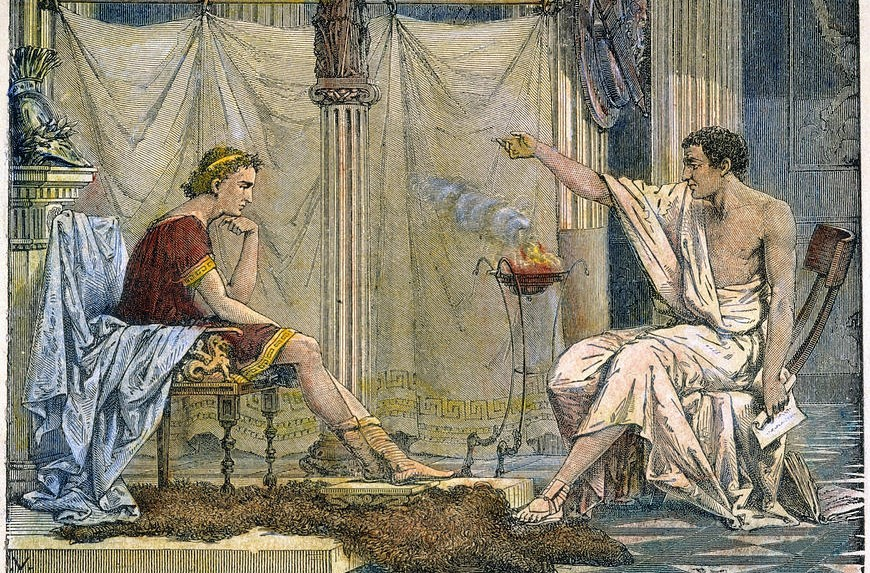
Alexander the Great conquered the known world by age 32.
He did it by asking one question that no general before him had ever thought to ask.
Not "how do I match their strength?" But "where is the gap?"
Aristotle taught him the difference. It is called first principles thinking, and it is the reason Alexander never lost a single battle in his entire life.
At Gaugamela, Alexander faced a Persian force that outnumbered his by a ratio of five to one. Some historians put it higher. Every military commander on the field was running the same template: more soldiers means more force, more force means you spread your line wide, defend against encirclement, engage across the full front.
This was not a tactical opinion. It was the accumulated logic of every battle anyone had ever studied.
Alexander looked at the same situation and asked a different question.
Not how do I survive this, but what is actually true here at the most fundamental level. He studied Darius's formation until he found it. A gap. Small, temporary, the kind that only exists for a moment in the chaos of a shifting line. He reorganized his entire cavalry around that single point. Then he rode directly at it himself, at full speed, with everything he had.
Darius fled the field. The Persian Empire ended that afternoon.
Here is what Aristotle actually taught him.
There are two ways to think about any problem.
The first is reasoning by analogy. You look at what is in front of you, search for the closest thing you have already seen, and apply that template forward. This is not a failure. It is extraordinarily efficient. It is how you learned your profession, how you function at speed, how civilization scales without having to rediscover fire every generation. Without analogical reasoning you would spend your entire life solving problems that were solved a thousand years ago.
The second is reasoning from first principles. You ignore the template entirely. You ask what is actually true at the most fundamental level, strip away every assumption that is only true because someone decided it was, and rebuild your understanding from that ground up. You arrive at conclusions the template would never have generated.
The insight is not that one mode is better. It is that they fail in opposite situations.
Analogical reasoning works perfectly inside a stable system where the template still matches reality. It fails catastrophically at the frontier, because the frontier is exactly where the existing templates are wrong. When you apply a map to a territory it was not designed to describe, the map does not warn you.
It just leads you somewhere incorrect with complete confidence.
This is why every major disruption follows the same pattern. The people who get disrupted are not stupid. They are the most sophisticated analogical reasoners in the field, applying the best available templates with perfect internal logic. And those templates, built entirely from the history of the existing system, are structurally blind to what a genuinely new thing actually is.
Kodak invented the digital camera in 1975 and shelved it. Every framework they had said it would destroy their film business. They were correct about the analogy and completely wrong about the conclusion, because the analogy assumed photography was a film business rather than a memory business.
The template was so embedded they could not see past it while holding the invention that would replace them.
Elon Musk wanted to buy a rocket in 2002. The cheapest price he found was $65 million. So he asked a different question. Not what do rockets cost, but what are rockets made of. Aluminum. Titanium. Carbon fiber. Copper. He priced the raw materials. They came to roughly 2% of the market price. The gap between 2% and 100% was not engineering. It was assumption. Decades of convention and unchallenged procurement logic, passed forward so many times it had started to feel like physics.
SpaceX was born in that gap.
The reason almost nobody actually uses first principles thinking is not that it is hard to understand. Aristotle wrote it down clearly in the fourth century BC. It has been available to anyone who wanted it ever since.
The reason is what it costs.
It is slow. It requires you to put down the confidence that comes from convention and sit with genuine uncertainty long enough to reach something real. The brain resists this completely, because the analogical template is faster, cheaper, and almost always good enough.
The pull toward the familiar pattern is not laziness. It is the most efficient cognitive system ever built doing exactly what it was designed to do.
First principles thinking only becomes worth the cost at the moments where the template has quietly stopped matching reality. Where everyone in the room is agreeing on something that feels like an established fact but is actually just an unchallenged assumption that has been passed forward long enough to seem permanent.
Alexander did not beat armies that were five times his size by being braver than every general who came before him.
He beat them by asking the question nobody else had thought to ask.
The most dangerous thing in any room is not the problem everyone is arguing about.
It is the assumption nobody noticed they were all making.
The founder of the Cheetah Conservation Fund (CCF), Laurie Marker, has received the lifetime achievement in research award from the Namibian government. https://t.co/5oKZU6bb8c
Don't stop talking about Sudan
Don't stop talking about Sudan
Don't stop talking about Sudan
Don't stop talking about Sudan
Don't stop talking about Sudan