We need Christians in the secular world: politicians, doctors, farmers, factory workers etc., but we also need ministers of the Gospel planting churches here and abroad.
Keep the plight of the lost before their eyes. Point your kids to Christ and His mission continually.
You cannot call your kid to ministry but you can aim them as in that direction.
Too many Christian parents put worldly success in front of their children’s eyes instead of pointing them to Christ and His mission.
@Danjo5string@realnaholmes The same guy who told me the “translated” idea said every translation gives “advanced revelation” So even though he was KJVO he was proponent of translating Scripture, but believed that God gives “advanced revelation” to that translation or as he called it “extra light” 😑
@Danjo5string Oh my goodness! I’ve heard this one. The guy I hear it from even brought out “we have been translated from the kingdom of darkness to light” So every time the word translated is used in Scripture it’s going to something better 🙄
Watched 9/11 footage with the family today. My heart still hurts from that day.
We’ve been praying every day for our country this week in family worship leading up to today. Lord, send an awakening! Revive thy people that they might rejoice in thee!
Religious people love a law they can keep, and especially one they can watch everyone else break.
Why? Because we are a law-bent people.
And to be clear, I do not mean that we just like rules.
I mean there is something in fallen man that desperately wants a standard he can measure, something he can point to and say, “There. I did that.”
My point is, we grab to the rules, because we like to measure.
The issue with this type of thinking is that before long we reduce the Christian life to a series of comparisons by which we can convince ourselves that we are doing a little better than the person sitting three pews over.
The point is, we don't want the law; really, we want something to do that we can measure. One that asks questions like:
How often were you at church?
How long did you stay?
How much did you give?
How many chapters did you read?
How did you rearrange your schedule for the things of God?
How excited were you about church compared to the concert, the ballgame, the vacation, or whatever else filled your calendar this week?
These are things we can measure, things we can do, and, most importantly, things we can compare.
But the fact of the matter is that the law of God isn't nearly this manageable.
God does not just say, “Attend.”
He says, “Love the Lord thy God with all thy heart, and with all thy soul, and with all thy mind.”
He does not just say, “Give.”
He demands a heart so free from the love of this present world that every possession is held beneath his lordship.
He does not merely ask whether you read your Bible.
His Word searches the thoughts and intents of the heart.
He does not merely ask whether you spent two hours in a church building.
He demands that every hour, every affection, every desire, every thought, every word, and every deed be rendered unto him in perfect holiness.
Now try and keep score...
That is what the law does when we allow it to speak in its full strength. It does not give man a ruler with which to measure.
It takes the ruler out of his hand, and shuts his mouth (Rom. 3:19)
The man on the front row has nothing to boast over the man on the back row. The person who gives twenty dollars has nothing to boast over the person who gives nothing. The man who reads ten chapters before breakfast cannot bring those chapters before the judgment seat of God and say, “Here is my righteousness.”
Because the law doesn't demand these things, it questions:
Have you loved God perfectly?
Have you loved your neighbor as yourself?
Have your motives been pure?
Have your affections been holy?
Have you rendered to God, from your first breath until this present moment, everything that he is worthy to receive?
And when it is done, the whole world stands guilty before God.
And right there, when the law has stripped us of every little righteousness we have constructed for ourselves, the gospel speaks
Christ.
Christ has obeyed where you have not obeyed.
Christ has loved God with the perfect love you have never rendered.
Christ has fulfilled the righteousness the law demands.
Christ has borne the curse pronounced upon lawbreakers.
And the gospel does not point you back into yourself to discover whether you have finally done enough.
It points you outside yourself and cries, “Behold the Lamb of God.”
We are law-bent people.
We will turn almost anything into a standard by which to justify ourselves if given the opportunity.
So let the law be the law.
Let it demand everything of you, let it expose everything in you, let it shut your mouth.
And then let the gospel give you everything the law could never produce in you: a whole Christ for guilty sinners.
I want to talk about the danger of evangelism and community. I know it sounds crazy, maybe even sacrilegious, to call them dangerous. But they can actually destroy spiritual vitality in the life of a Christian and a local church.
Let me explain.
There are some substances that are not dangerous to men but are made up of a variety of substances which, when isolated by themselves, are quite toxic or poisonous. There are also some tools that are quite helpful but, when you remove a component from them, become too dangerous to be helpful. Such is the case with the old circular saw in my garage that doesn’t have a guard on it any longer. This is the sort of idea I’m getting at with evangelism and community. They are part of a whole. And when they’re removed from that whole, they become dangerous. They actually become something they’re not.
Take evangelism. Over the last 150 years or so, it’s really been reduced down to getting individuals to verbalize a profession, often without any definite future view toward discipleship. They go to some sort of rally, walk up front, pray the sinner’s prayer, and then maybe are told to go find a church the next Sunday. Someone preaches the gospel to them on a street corner, prays with them, and does the same thing. They go to some sort of college ministry. Once again, there’s a sinner’s prayer, and maybe they plug into a Bible study, but there’s no emphasis on the centrality of the local church in discipleship.
So, in a weird way, evangelism becomes about a momentary profession instead of a life of being discipled in the whole counsel of God’s Word. This can also happen in churches where every Sunday is an evangelism Sunday, or where the content is kept thin and crafted to appeal to so-called seekers or new believers. Everything becomes about mere numbers and not the overall quality of discipleship. So while these people do actually attend a local church, the church has built everything around what it thinks is conversion, and it is all excused and called praiseworthy in the name of evangelism.
But evangelism was designed by God to lead into a life of discipleship with other believers in a local church. And when it doesn’t, it leads people to think they can simply float to and fro as disconnected individuals who never develop any real depth. In this way, evangelism, which, of course, is not biblical evangelism because it has been removed from the whole, becomes dangerous.
A similar thing happens with community. I was adjacent to the emerging church movement in the late ’90s and early 2000s, and I also have lots of friends and a lot of interaction with the house church movement. Both talk about community incessantly. And they often use the words community and fellowship interchangeably. But if you listen carefully, what they really mean by community or fellowship is hanging out together and talking about your life.
Now, of course, there’s nothing wrong with that. But Christian community is organized around the public worship of God and the living out of His truth in service to Him in all if life. So fellowship is not just about hanging out. The idea of fellowship in Scripture is more like a business partnership. It is mission-focused. Fellowship isn’t merely about sitting across from each other, talking about your doubts and feelings, and opening up about your childhood. It’s about the pursuit of God. It’s about repenting of sin and growing in Christian virtues together through the means of grace.
And often what passes for community is nothing more than a clique of people organized around some shared secondary affinities with a thin layer of Christianese terminology. Again, there’s nothing wrong with some of the things these people are after. But they are wrong to think of this as Christian community in the sense of biblical fellowship. And when you allow this idea to reign, people spend their whole lives chasing a wish dream of community. Of course, they are always dissatisfied with the church that has true biblical fellowship because they don’t understand true community. This is how it becomes dangerous.
There are many other things like this. When you remove something that is part of a whole from the whole, you change the nature of that something. Holding all these things together in tension is the hard work that Christians, particularly elders and deacons, must tirelessly work toward.
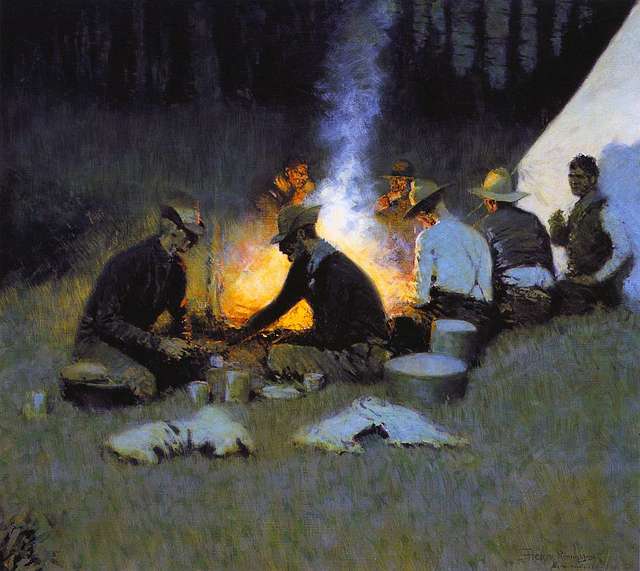
Painting: Frederic Remington
🚨 PLEASE HELP!!!🚨 This is a good friend of mine and fellow Iowan. His account @JoshuaBarzon was hacked and the hacker changed all of the credentials to lock Josh out.
Please share and help him get his account back!
@Danjo5string Oh. Well that’s good, my guy was insinuating it. 😬
Although, poor 1st Century church…if only they had a KJV then their Word would be perfect. This seems to be the logical conclusion. If the KJV corrects the Greek then the originals had errors?
@Danjo5string The thing I cannot seem to understand about this “belief” is how one can truly believe that the very language and words in which God gave His Word are somehow inferior to a particular translation of that Word.
“Potius ergo tempus a creatura, quam creatura coepit a tempore; utrumque autem ex Deo.”
“Time began with the creature, rather than the creature with time; both, however are from God”
-Augustine