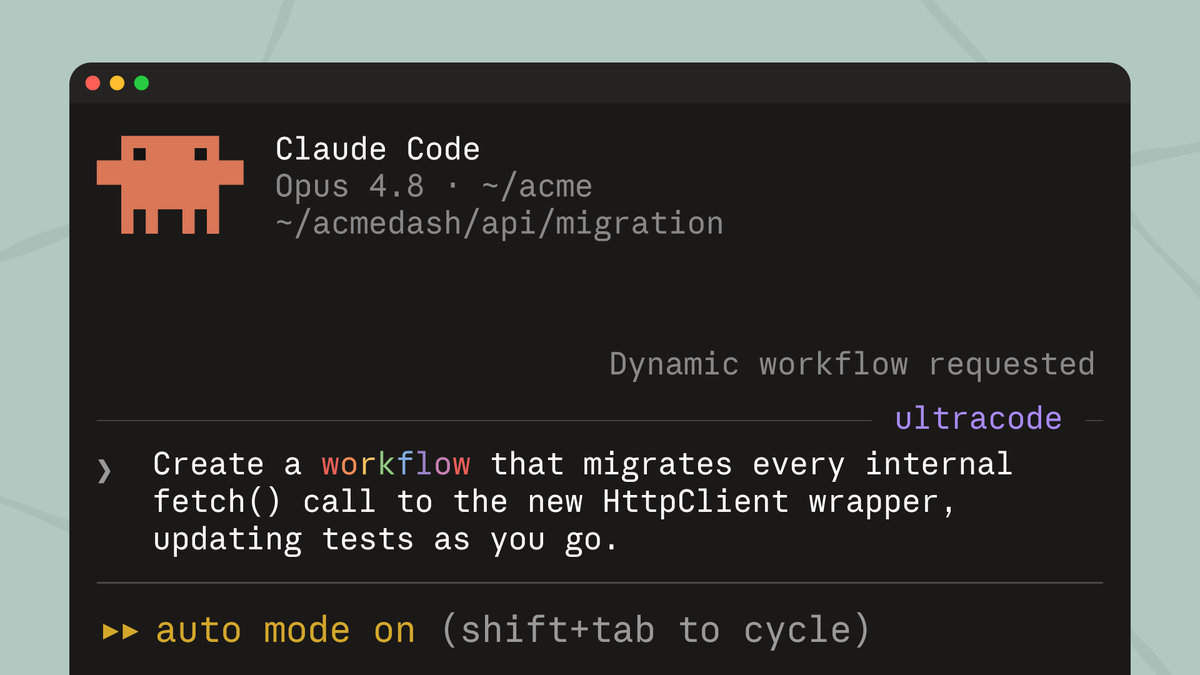
Super excited to finally share Dynamic Workflows in Claude Code!!
We built this a couple months ago, and it has slowly become a daily driver for a bunch of people at Anthropic. A few tips for getting the most out of it 🧵
https://t.co/WtwkSd3JPp
New in Claude Code (research preview): dynamic workflows.
Claude writes an orchestration script on the fly, then spins up a large fleet of coordinated subagents in parallel to take on your most complex tasks.
Use the word "workflow" in a prompt to get started.
You can now mod Claude Code:
- Change how it behaves
- Customize the UI
- Swap in your own features
Write one with a few lines of TypeScript, or have Claude build it for you. Mods ship inside plugins, so you install them with /plugin in the CLI or desktop app.
A few examples:
Opus 5.5 has been the most enjoyable model I’ve used in a long time. It’s a big step up in coding (understands intent better and writes better code), but an even bigger step up in communication imo
Give it a shot, and tell us what you think
Introducing Claude Opus 5.5, the first model in our new Claude 5.5 family.
It performs at the level of Claude Fable 5.1 for most tasks, and costs 40% less to run than Opus 5.
my first biiiiiig launch at anthropic is finally here!! 🫶
projects are a huge labor of love from the claude code team - it's the only way i've been working with claude for the last several months (including using projects...to build projects!!)
spam the coordinator with any and all tasks you have on the fly, and watch claude smartly delegate your work to threads and report back to you with only the things that need your attention. enjoy <33
Today we’re releasing an early preview of the /design command in Claude Code!
from CC Desktop or CLI, try something like "/design a few options for {feature}" before you build — pick your fave artboard, edit it and implement.
I think a lot of people don't realize- if you connect a Claude Connector (e.g. your gmail, calendar, slack, etc), Claude Code will also be able to use them, including in Artifacts.
This is your reminder to be more ambitious with fable. Give it larger tasks than you've ever given an LLM before, let it figure out the details for you, experiment!
You can only feel the frontier by going past it first
hello there the jacobian conjecture is false thanx to my close friend akhil for asking about it and my other close friend fable for working during the world cup final
((1+xy)^3 z + y^2 (1+xy) (4+3xy), y + 3 x (1+xy)^2 z + 3 x y^2 (4+3xy), 2 x - 3 x^2 y - x^3 z): \C^3\to \C^3, has jacobian determinant -2, and sends (0, 0, -1/4), (1, -3/2, 13/2), and (-1, 3/2, 13/2) to (-1/4, 0, 0)