𝗧𝗵𝗮𝗻𝗸 𝘆𝗼𝘂, 𝗩𝗶𝗿𝗮𝘁 𝗞𝗼𝗵𝗹𝗶! 🙌
An era ends in Test cricket but the legacy will continue FOREVER! 🫡🫡
@imVkohli, the former Team India Captain retires from Test cricket.
His contributions to #TeamIndia will forever be cherished! 👏 👏
@scotiabank I’m surprised you charge $5 per month for each savings account statement requested that’s older than 18 months. Disappointing to see this from a company of your size.
The court clerk who demanded bribes and Judge Rita Kaushik must be immediately suspended. Also, anyone who has dealt with this judge should be asked to come forward if they were asked or paid bribes.
This is very messed up. Atul deserves justice. @ndtv@aajtak@narendramodi
It was people like #RatanTata who fueled India's growth in the past century.
Rest in Peace to The Titan and a man with zero haters, your absence will be felt as we witness end of an era.
My last meeting with Ratan Tata at Google, we talked about the progress of Waymo and his vision was inspiring to hear. He leaves an extraordinary business and philanthropic legacy and was instrumental in mentoring and developing the modern business leadership in India. He deeply cared about making India better. Deep condolences to his loved ones and Rest in Peace Shri Ratan Tata Ji
I am unable to accept the absence of Ratan Tata.
India’s economy stands on the cusp of a historic leap forward.
And Ratan’s life and work have had much to do with our being in this position.
Hence, his mentorship and guidance at this point in time would have been invaluable.
With him gone, all we can do is to commit to emulating his example. Because he was a businessman for whom financial wealth and success was most useful when it was put to the service of the global community.
Goodbye and Godspeed, Mr. T
You will not be forgotten.
Because Legends never die…
Om Shanti
🙏🏽
18 experiments to test a new product idea:
(without losing millions of USD)
1. 14 Quick Product Validation Experiments
Experiments in this group focus on validating how the market will engage with your product idea. My favorite approach is the XYZ Hypothesis (expressed as “at least X% of Y will do Z”) as defined by Alberto Savoia in The Right It.
They allow you to test:
• Value proposition
• Viability (including pricing)
• Messaging
All experiments in this group can be considered MVP Prototypes or Pretotypes.
Please note that none of them are products.
1.1 Email Campaign
Send a targeted email to potential customers. This allows you to test your value proposition and messaging.
Tips:
• Include a call-to-action, such as a survey or sign-up form.
• You can use tools like Mailchimp, GetResponse, or HubSpot.
• Email Campaign is typically combined with a Landing Page.
1.2 Paid Ads Campaign
Create a paid ads campaign targeted to a specific audience. This allows you to test not only your value proposition and messaging but also cost-per-click (CPC).
Tips:
• Include a call-to-action, such as a survey or sign-up form.
• You can utilize tools like Google Ads, LinkedIn Ads, or Meta Ads.
• Paid Ads Campaign is typically combined with a Landing Page.
1.3 Social Media Campaign
Publish a social media post. This allows you to test your value proposition and messaging.
Tips:
• Include a call-to-action, such as a survey or sign-up form.
• Consider working with influencers to reach a broader audience.
• Social Media Campaign is typically combined with a Landing Page.
1.4 Landing Page
Create a simple webpage that communicates the value proposition, capabilities, and benefits of your product idea.
By driving traffic to a landing page, you can gather leads, collect feedback, and test willingness to pay.
Tips:
• Include a call-to-action, such as a sign-up form, and limit other navigation options.
• The user should demonstrate interest in the product by paying for it in some form (see Skin-in-the-Game points)
• You need traffic, so a Landing Page is typically combined with Paid Ads, Email, or Social Media campaigns.
• While a landing page might be a Fake Door, it doesn't necessarily have to be. This depends on whether you suggest the product is currently available.
1.5 Fake Door
Test the interest in a non-existing product by suggesting it exists and is available. A great way to test your value proposition, messaging, and pricing.
Tips:
• Apologize or offer something else for free if someone orders it.
• A Fake Door might be a Landing Page, but it doesn't have to be. E.g., you might add a non-existing product to the cart in a restaurant.
• Also known as “Mock Sale.”
1.6 Façade
Test the interest in an existing but not yet broadly available/scalable product or service by creating artifacts that suggest greater availability (or scale).
Tip: Applicable typically to physical products.
1.7 Pinocchio
Create a non-operational version of your product and use your imagination to pretend it works to see if and how you would use it.
Tips:
• It tests only your own experience. It might be helpful at a very early stage.
• Applicable typically to physical products.
• Also known as “Pretend to Own.”
1.8 Explainer Video
Create a video to demonstrate how your product will work. Explainer videos are typically short online videos. The goal is to create something that conveys the core value proposition and can be shared to gather feedback.
Tips:
• Video Explainer is typically placed on a landing page but might also be shared on social media.
• Also known as “YouTube.”
1.9 Pre-Order
Offer your product for pre-order before it’s ready. Communicate your value proposition, problems you are solving, and differentiators, and target an offer to your potential customers.
Tip: In this type of experiment, you collect money. This not only validates the demand but also might provide funds to support development.
1.10 Letter of Intent
Ask the customer to sign a formal note indicating their interest in purchasing a product in the future.
Tips:
• The Letter of Intent is not legally binding but, arguably, involves a lot of “Skin-in-the-Game points.” You don't sign a letter of intent with just anyone.
• It’s a great way to validate the willingness to buy for B2B products. This often engages all decision-makers, helping you understand their needs and objections.
• The Letter of Intent is often preceded by other Market Engagement experiments to generate leads.
1.11 Provincial
Before launching a new product to the broader market, test it with a small group of users to gauge its viability.
Tips:
• This approach is typically applicable to services and physical products. For example, you might open a pop-up shop in a tent before committing to a full network of stores.
• For digital products, you'd need to develop the product first. In such cases, consider this approach part of a Go-To-Market (GTM) strategy.
1.12 One-Night Stand
Offer a basic version of your product for a limited time to gauge interest before fully committing to its development or launch.
Tips:
• This approach is typically suitable for services and physical products. For digital products, the product would need to be developed first.
• This method is also referred to as a "Pop-Up Store."
1.13 Infiltrator
Put a sample or even just a box of your product in another store (physical or online) to see if people are interested in buying it.
Tips:
• This strategy can be combined with the Fake Door technique, but it leverages explicitly an existing sales channel.
• I love the example of the founder of Upwell Labs. Using a shirt from eBay to pose as an IKEA employee, he secretly placed his product pretotypes in an IKEA store. When people bought them, he confirmed the willingness to buy without having his own store.
• More information: pretotyping techniques.
1.14 Crowdfunding
Validate a demand for your product by launching it on a crowdfunding platform, such as Kickstarter or Indiegogo. This approach might provide evidence of market demand and help you secure delivery funding.
Tip: Be careful, as the people investing in your product might not necessarily be your target customers. In such cases, crowdfunding simply becomes a financing mechanism.
2. 4 Minimal Products
The experiments in this group can deliver significant customer value. They are cheaper to perform than full-feature products but involve higher costs than experiments from the previous category.
Through these, you can evaluate:
• Value proposition
• Viability (including pricing)
• Usability (including messaging; note that the scope of validation using Minimal Products is limited)
• Messaging
Remember that when using those techniques, you should focus on getting maximum validated learning with minimum effort, not making profits.
2.1 Piecemeal
Leverage existing tools and platforms to simulate the user experience.
By combining off-the-shelf components and no-code / low-code solutions like Bubble, you can quickly create a functional prototype.
Tips:
• Also known as “Impostor.”
• Another variant, “Mash-Up,” involves using many existing products to simulate a product experience.
2.2 Concierge
Create a high-touch, personalized service to your customers, simulating the experience of a fully automated product.
Let’s say you're building a personalized learning app. You might start by manually creating learning plans based on a simple form people fill in. This will allow you to validate your idea and understand your customers better before investing in an automated solution.
Tip: Unlike in the Wizard of Oz, the user is fully aware of your manual work.
2.3 Wizard of Oz
Create an illusion of an automated product.
This will help you validate demand and gain insights into user behavior without investing in developing a full-scale product.
For example, suppose you're developing a chatbot. In the initial stage, you could use human operators to respond to inquiries, emulating an AI-powered chatbot's user interactions.
Tip: Unlike in Concierge, users are unaware of what happens behind the scenes.
2.4 Single Feature Product
Create a limited version of a product that satisfies only one customer need.
Tips:
• In most cases, this is more of a GTM strategy. You don't want to build a product to validate your idea.
3. Recommended resources and books
Download a free PDF (no email, no paywall): https://t.co/F2krfOf0VB
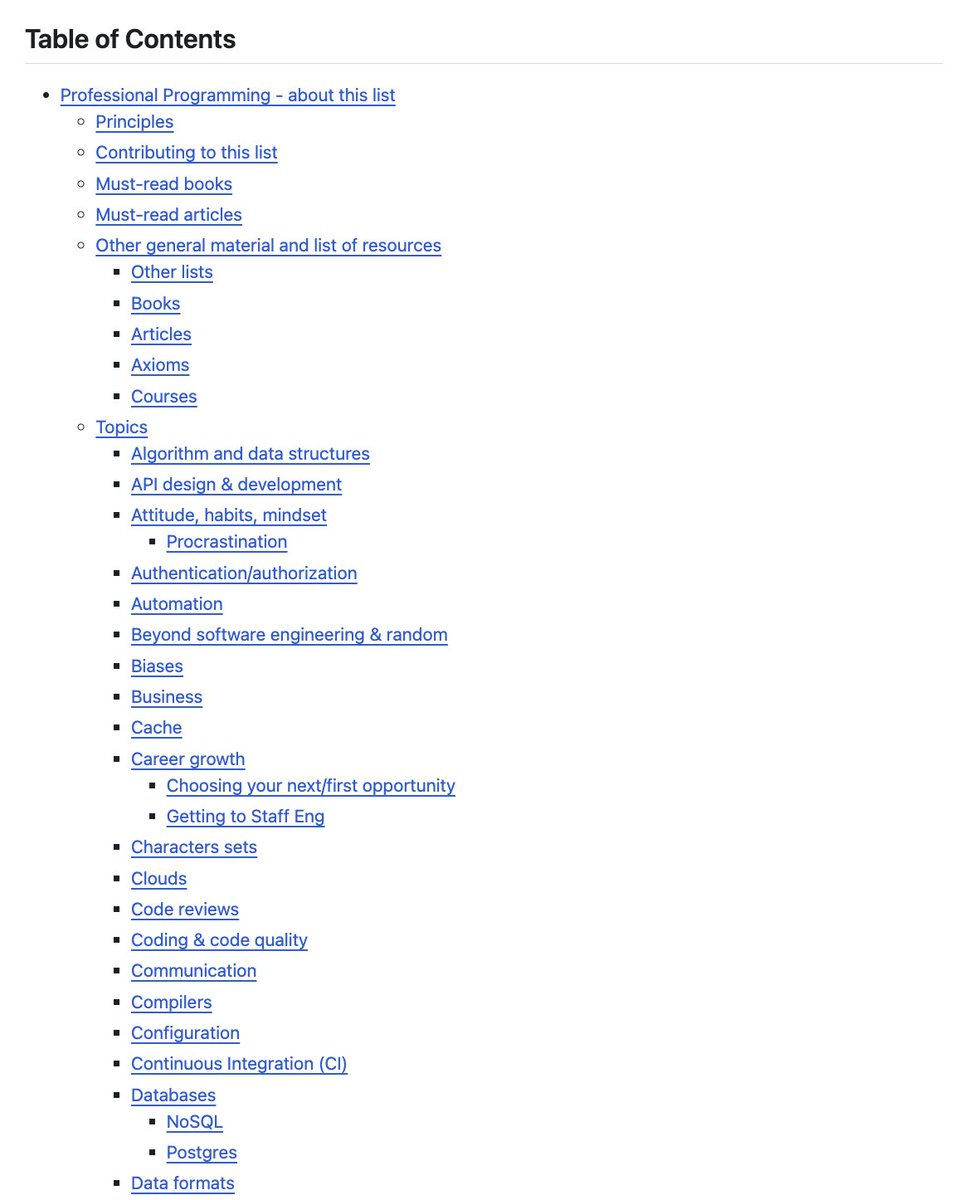
My first manager at Uber started a GitHub page back at the time with resources to become a more proficient developer - ones he personally found helpful (he did not have a CS degree).
I realized he is *still* updating it, 7 years later! A neat list: https://t.co/QtWeltMDWz
12-Month MBA for PMs (better than any $127K course)
Month 1:
- Introduction: Inspired by Marty Cagan
- Leadership: Empowered by Marty Cagan and Chris Jones
- Startups: The Right It by Alberto Savoia
Month 2:
- Product Discovery: Continuous Discovery Habits by Teresa Torres
-Interviews: The Mom Test by Rob Fitzpatrick
- Product-Market Fit: The Lean Product Playbook by Dan Olsen
Month 3:
-Business Model Generation by Alexander Osterwalder and Yves Pigneur
-Value Proposition Design by Alexander Osterwalder and others
-Testing Business Ideas by Alexander Osterwalder and David Bland
Month 4:
- Setting goals: Radical Focus by Christina Wodtke
- Leading with context: No Rules Rules by Reed Hastings
- Teams: Team Topologies by Manuel Pais and Matthew Skelton
Month 5:
-PLG: Product-Led Growth by Wes Bush
-Retention: Hooked by Nir Eyal
- Product-led Certification Course by Pendo with our dedicated 100% discount code not available elsewhere (I’m not an affiliate)
Month 6:
- Marketing: This is Marketing by Seth Godin
- Marketing for tech startups: Crossing the Chasm by Geoffrey A. Moore
- Product Growth: Hacking Growth by Sean Ellis
Month 7:
- Public speaking: Talk Like TED by Carmine Gallo
- Copywriting: The Copywriter's Handbook by Robert W. Bly
- Negotiating: Never Split the Difference by Christopher Voss and Tahl Raz
Month 8:
- Making decisions: Thinking, Fast and Slow by Daniel Kahneman
- Effectiveness: The 7 Habits of Highly Effective People by Stephen M. R. Covey
- Networking: Superconnector by Ryan Paugh and Scott Gerber
Month 9:
- Leadership: The Making of a Manager by Julie Zhuo
- Financial Intelligence: The Psychology of Money by Morgan Housel
- Accounting: Accounting for Non-Accountants by Wayne A. Label
Month 10:
- Product Analytics: Lean Analytics by Alistair Croll and Ben Yoskovitz
- A free North Star Framework Compendium: Free PDF
- Product Analytics Certification course by Pendo with our 100% discount code not available elsewhere (I’m not an affiliate)
Month 11:
- JTBD: Jobs-to-be-Done by Tony Ulwick
- What to build: Escaping the Build Trap by Melissa Perri
- Building products: Build by Tony Fadell
Month 12:
-Strategy: Playing to Win by Roger Martin
-Business portfolio: The Invincible Company by Frederic Etiemble, Alan Smith, Alexander Osterwalder, Yves Pigneur
Bonus (recommended):
- Career: The Ultimate Guide to Getting a PM Job by Aakash Gupta
- Learning from the best: Working Backwards by Colin Bryar and Bill Carr
- 600+ Free Product Management Learning Resources
- Product Manager Competencies Map
- Product Management Skills Assessments
- Top 16 Free Product Management Courses & Certificates
[All links in the thread 🧵]





![PawelHuryn's tweet photo. 12-Month MBA for PMs (better than any $127K course)
Month 1:
- Introduction: Inspired by Marty Cagan
- Leadership: Empowered by Marty Cagan and Chris Jones
- Startups: The Right It by Alberto Savoia
Month 2:
- Product Discovery: Continuous Discovery Habits by Teresa Torres
-Interviews: The Mom Test by Rob Fitzpatrick
- Product-Market Fit: The Lean Product Playbook by Dan Olsen
Month 3:
-Business Model Generation by Alexander Osterwalder and Yves Pigneur
-Value Proposition Design by Alexander Osterwalder and others
-Testing Business Ideas by Alexander Osterwalder and David Bland
Month 4:
- Setting goals: Radical Focus by Christina Wodtke
- Leading with context: No Rules Rules by Reed Hastings
- Teams: Team Topologies by Manuel Pais and Matthew Skelton
Month 5:
-PLG: Product-Led Growth by Wes Bush
-Retention: Hooked by Nir Eyal
- Product-led Certification Course by Pendo with our dedicated 100% discount code not available elsewhere (I’m not an affiliate)
Month 6:
- Marketing: This is Marketing by Seth Godin
- Marketing for tech startups: Crossing the Chasm by Geoffrey A. Moore
- Product Growth: Hacking Growth by Sean Ellis
Month 7:
- Public speaking: Talk Like TED by Carmine Gallo
- Copywriting: The Copywriter's Handbook by Robert W. Bly
- Negotiating: Never Split the Difference by Christopher Voss and Tahl Raz
Month 8:
- Making decisions: Thinking, Fast and Slow by Daniel Kahneman
- Effectiveness: The 7 Habits of Highly Effective People by Stephen M. R. Covey
- Networking: Superconnector by Ryan Paugh and Scott Gerber
Month 9:
- Leadership: The Making of a Manager by Julie Zhuo
- Financial Intelligence: The Psychology of Money by Morgan Housel
- Accounting: Accounting for Non-Accountants by Wayne A. Label
Month 10:
- Product Analytics: Lean Analytics by Alistair Croll and Ben Yoskovitz
- A free North Star Framework Compendium: Free PDF
- Product Analytics Certification course by Pendo with our 100% discount code not available elsewhere (I’m not an affiliate)
Month 11:
- JTBD: Jobs-to-be-Done by Tony Ulwick
- What to build: Escaping the Build Trap by Melissa Perri
- Building products: Build by Tony Fadell
Month 12:
-Strategy: Playing to Win by Roger Martin
-Business portfolio: The Invincible Company by Frederic Etiemble, Alan Smith, Alexander Osterwalder, Yves Pigneur
Bonus (recommended):
- Career: The Ultimate Guide to Getting a PM Job by Aakash Gupta
- Learning from the best: Working Backwards by Colin Bryar and Bill Carr
- 600+ Free Product Management Learning Resources
- Product Manager Competencies Map
- Product Management Skills Assessments
- Top 16 Free Product Management Courses & Certificates
[All links in the thread 🧵]](https://pbs.twimg.com/media/GFcSp7rXMAASQcR.jpg)


