Around 12 noon today, a couple rushed into Medicine Casualty holding their 3-year-old. The child had fallen off a table; his wrist was visibly deformed, likely a clean break. He was crying inconsolably, surrounded by 4 or 5 frantic relatives.
"Doctor, treat my child fast!" they shouted.
I immediately assessed the situation. As a Medicine resident, I am neither an orthopedician nor a pediatrician. I knew that I was not in a position to manage this situation.
I calmly told them: "This is Medicine Casualty. Please turn left, the Orthopedic Casualty is right there. Since you have many people with you, have one person take the child there immediately while another goes to the counter for a ticket so the doctors can order X-rays and meds."
That’s when the shouting started.
"You good-for-nothing doctors! Can’t you see this is an emergency? Why do we need a ticket?"
My junior rushed over to help, only to be met with threats: "Treat him immediately or things will get bad for you." Then, the phones came out. Cameras were shoved in our faces. "Look at these doctors refusing to treat a child!"
Here is the context a 30-second viral video would miss:
1. I was directing them to the correct specialist only 3 minutes away.
2. Without a hospital ID/ticket, the Ortho team can't even log an X-ray request into the system.
3. Staying in Medicine Casualty was actually delaying the child's care.
To de-escalate, I eventually had to leave my own post unattended to personally escort them to the Ortho wing and explain the situation to the doctors there.
Hours later, after the child was stabilized, the family returned to apologize. I appreciate the apology, but the damage of those "recorded" moments lingers. This is the daily reality for doctors: being vilified for following the very protocols that ensure a patient gets the right treatment from the right specialist.
Before you share a "doctor refusing treatment" video, ask yourself: Are they refusing, or are they trying to get the patient to the help they actually need?
Our study in @FrontPsychiatry shows:
#Stigma and family conflict drive higher depression/anxiety
#Opioid agonist therapy (OAT) helps but stigma blunts its benefit
Poor mental health = lower quality of life & greater disability.
@SiddharthPsy@yatan_balhara
Unitree Introducing | Unitree H2 Destiny Awakening!🥳
Welcome to this world — standing 180cm tall and weighing 70kg. The H2 bionic humanoid - born to serve everyone safely and friendly.
The @eNDDTC, AIIMS Delhi, in partnership with #ECHOIndia, launched the Management of Tobacco, Alcohol and Other Substance Use Disorders Program for medical officers on 22nd July.
“Kahan jaana hai bhaiya?” the auto driver asked.
“Delhi Cant,” I replied.
Without hesitation, he said, “Chalo.”
I asked about the fare. He quoted ₹150, but I bargained it down to ₹130, and we set off.
I’ve taken countless autos in Delhi, but this one led to chaos I never saw coming.
The driver, a middle-aged man with a mustache, long hair, and a thick Haryanvi accent, struck up a conversation about trains. He asked if my train had a second-class coach because his kids needed to visit their grandparents the next day. I told him no—it was a superfast train with only AC chair cars.
As we continued talking, the roads blurred past, and before I knew it, the auto pulled up at a station. But something felt off.
I looked around, my gut sinking. This wasn’t Delhi Cantt. This was New Delhi Railway Station.
“Bhaiya, yeh lo, aa gaya aapka station,” he said casually.
I froze. “Maine Cantt bola tha, bhaiya. Yeh toh New Delhi hai!”
It was 6:10 AM—exactly when my train was departing from New Delhi. At Delhi Cantt, it was scheduled for 6:38 AM.
I pulled out my phone. Google Maps showed 30 minutes to reach there. I had no chance.
Panic. Pure panic.
I turned to the auto driver. “Bhaiya, mujhe Cantt tak chhod do, please!”
He shook his head. “Gas nahi hai auto mein, aur Cantt yahan se 15 km hai.”
I felt helpless. It was my dad’s birthday, and I had promised him I’d be there.
Just then, an act of kindness changed everything.
The driver, instead of charging me, stopped another auto and requested the driver to take me. But the second auto already had a passenger—a woman in her 60s who had booked the ride through an app.
“Bhaiya, aise allow thodi hota hai? Maine personal auto book kiya hai!” she argued at first.
I quickly explained my situation, desperation evident in my voice.
She looked at me for a moment before smiling warmly. “Beta, aap baitho. Aapko train pakadni hai, na?”
As we rode, she kept reassuring me, “Chinta mat karo, time se pahunch jaoge.” At her stop, she turned to the driver and said, “Isko jaldi se chhod dena. Iski train nahi chhutni chahiye. Yeh mere bacche jaisa hai.”
For some reason, her words and kindness gave me a strange sense of calm. But the auto driver—a man in his 60s, with long hair and a thick sweater—seemed doubtful. He was focused, as if calculating every second to the station.
Google Maps was not on my side. It predicted 6:45 AM—9 minutes too late. I tried to push the thought away and closed the app.
And then I remembered something a friend told me yesterday, in a completely different context:
“If something is not in your hands, leave it to God. Whatever is meant to happen will happen.”
The auto finally screeched to a stop outside the station at 6:39 AM.
I stepped out and immediately heard the train’s horn.
I reached into my wallet and handed the driver ₹500 his fare was ₹200. He shook his head, saying he had no change. I only had ₹100 in cash and he accepted it without a word.
I insisted on giving him ₹500, but he refused.
“Bhag beta, train chhut jayegi!”
And so, for the first time in my life, I ran for a train.
As my foot landed on the train’s step, it started moving. I sat down, breathless, feeling relieved and grateful for all the kindness I had just experienced.
Today, I saw what kindness truly looks like - from a rickshaw driver who didn’t charge me, from a stranger who shared her ride, and from an old auto driver who treated my urgency as his own.
I’ve always tried to be kind, even to people who didn’t deserve it. But today, the universe reminded me once again:
“When you are kind to the world, the world finds a way to be kind to you”.
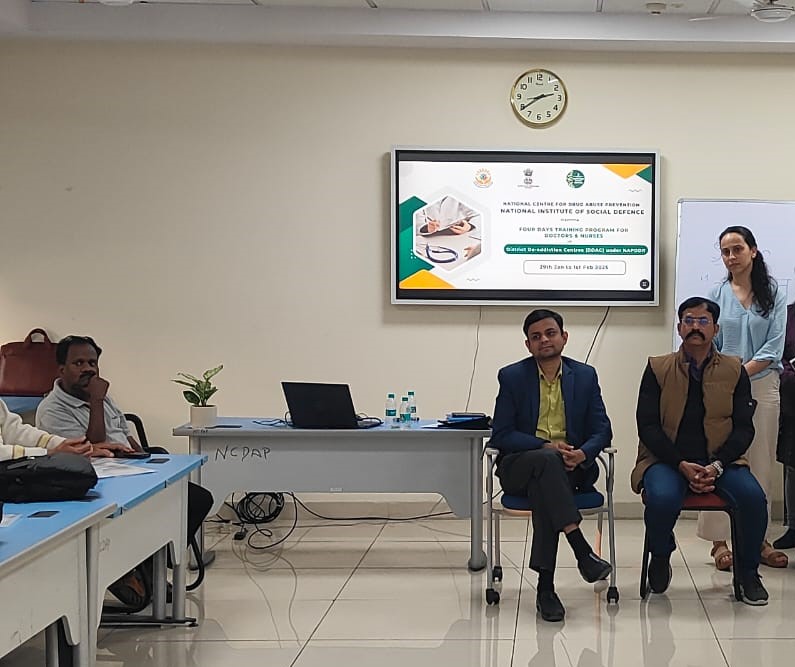
Training for Doctors and Nurses of District De-Addiction Centers on Management of Drug Addictions 📷
NISD India is conducting a Four Day Training for the Doctors and Nurses of District De-Addiction Centers on Management of Drug Addiction from January 29-February 1, 2025.
Factor structure, reliability and validity of an Indian Scale for Assessment of #Nomophobia #(ISAN) among college students: A multicentre #Indian study https://t.co/Y1AVtbTYTy
@SiddharthPsy@Dr_ArpitParmar