🤖 Introducing RoboColosseum: Evaluating Physical Intelligence at Scale In-The-Wild!
We ran 5,699 real-world robot comparisons across 124 sites, evaluating 5 VLA policies and 3 frontier AI agents.
What did we learn about the state of robot foundation models and agentic models? 🧵⬇️
#robotics #ai #benchmarking #evaluation #foundationmodels #agents
Our new robot OpenDubs worked a 6 hour shift autonomously handing out candy to trick-or-treaters for Halloween this year @uwcse 🤖🍬🎃
Thanks to the many folks who made this fun side project into a reality 😄 We took quite the full stack approach to this endeavor - literally building this robot from the ground up in just under a month and a half! @sidharthtalia@arc_hitter@siddhss5@uw_robotics
Stay tuned to see more of what OpenDubs can do! 🦾
VLAs can do a lot zero-shot. But when one fails, there's no way to tell it what went wrong - you collect more demos and retrain.
What if you could just say something?
Introducing ARCHITECT 🤖👷: a robot coding agent that synthesizes policies from free-form language instructions.
https://t.co/stE4uAdTwT
🧵1/N
🤖How do we evaluate robots?
Fixed benchmarks.
Same tasks.
Predefined success.
‼️But this doesn’t tell us what robots actually understand.
➡️We built **RoboPlayground**.
✨TLDR: Evaluation should be a space anyone can define, not a fixed benchmark.✨
🧵1/n
#robotics#ai#robot
If you visited the @uwcherryblossom, did you “spot” an unusual visitor among the blooms? Researchers in the @UW#UWAllen’s #Robotics group recently took advantage of some nice weather to take our @BostonDynamics robot dog for a stroll around campus. #AI 1/4
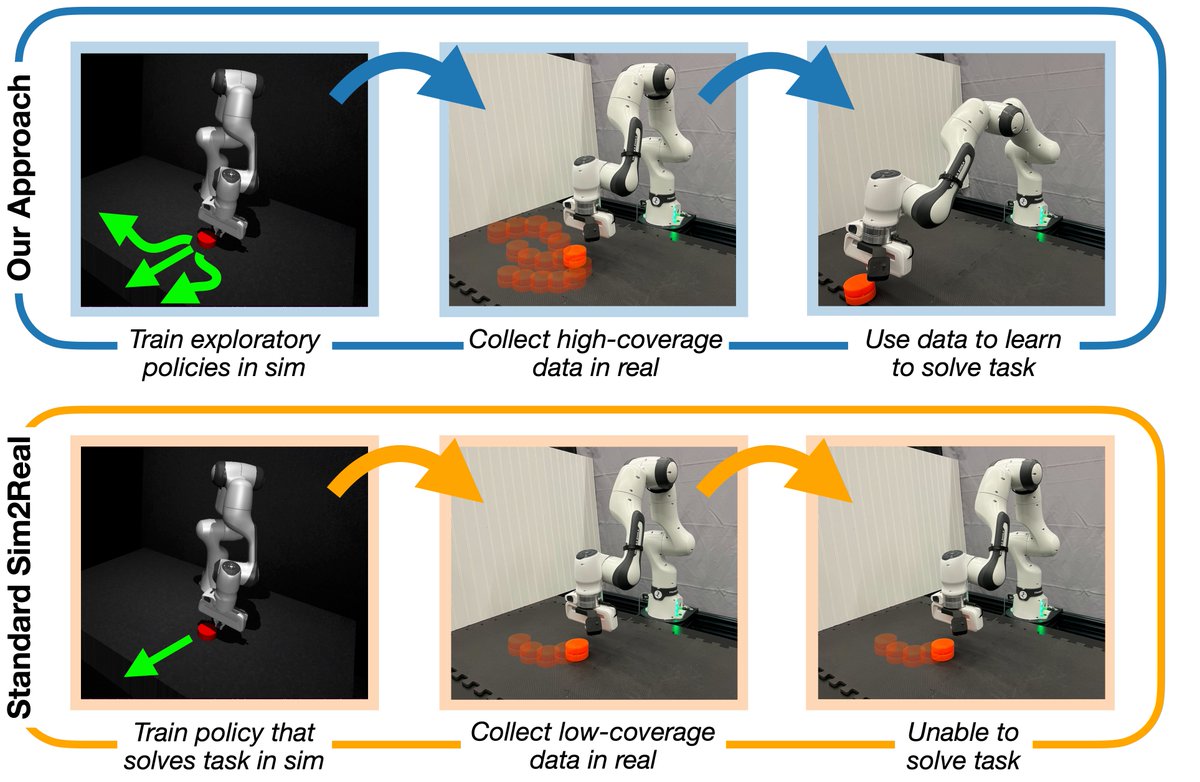
Over the last year, we’ve been investigating how simulation can be a useful tool for real-world reinforcement learning on a robot. While simulation captures inherently incorrect dynamics, it can still be useful for real-world learning! In our #NeurIPS2024 work, Andrew W. theoretically showed how naive sim2real transfer can be inefficient, but if you *learn how to explore* in simulation, this can be provably efficient in transferring to the real world! We then pair this theory with robot experiments to validate this for real-world settings. 🧵 (1/6)
For the last guest lecture of the semester, we had @TapoBhat who gave an overview of recent research on assistive robotics. Really important work motivated by deep insights from stakeholders!
https://t.co/DLTRjZtfcf
So I heard we need more data for robot learning :) Purely real world teleop is expensive and slow, making large scale data collection challenging. I’ve been excited about getting more data into robot learning, going beyond just real-world teleop data. To this end, we’ve been scaling up data generation with RL in realistic simulations generated on the fly from crowdsourced videos. Enables realistic data collection, much more cheaply than purely real world teleop. Importantly, data collection becomes even*cheaper* with more environments, allowing training with over 100x more data. Transfers to real robots for generalizable manipulation. A 🧵 (1/N)
Robot learning is fundamentally limited by data – human teleoperation on real robots is expensive! 🤖👨💻We propose an alternative – scalable data collection in simulation by crowdsourcing video scans of homes. In our latest work, we study how we can scale up policy training over 100+ environments through a large scale real-to-sim-to-real paradigm. Interestingly, we find that the amount of human effort required scales sublinearly with more environments. A thread (1/N)
How can we enable transferable decision-making for *any* reward zero-shot? MBRL is task-agnostic but suffers from compounding error, while MFRL is task-specific. We propose a new class of world models that transfers across tasks zero-shot and avoids compounding error! A 🧵 (1/9)
How can we train RL agents that transfer to any reward? In our @NeurIPSConf paper DiSPO, we propose to learn the distribution of successor features of a stationary dataset, which enables zero-shot transfer to arbitrary rewards without additional training! A thread 🧵(1/9)
If this information became available to a GPS receiver it could really improve performance in urban areas. I wonder if ublox or some other manufacturers are already trying this.
We @maticrobots do this already. It enables all kinds of use cases and allows users to interact with robot naturally. Here's the video of how we've done it.
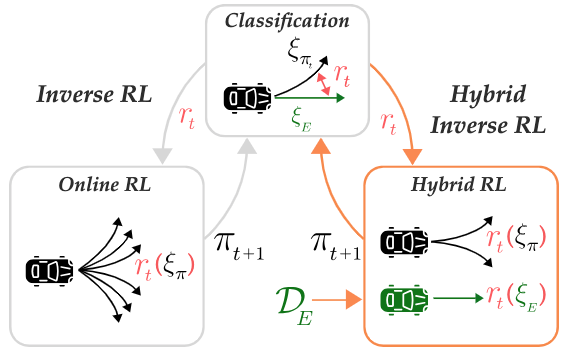
It took a lot of work over multiple years but I'm proud to be able to finally share my first #ICML2024 paper: a new, fundamental framework for designing efficient inverse RL algorithms that we're in the process of scaling to real robots: https://t.co/Ebo9Kzsmtq! 1/
@imgeorgiev I believe you cut off the first sentence too early here? "... And find that backproping through contact is..?". Interested in reading this paper in detail btw.
@haqhuy 2/2 did you consider mounting iPhone on gripper and pose tracking at high freq? The dog pose control can use low passed version to get around the jitter due to backlash error after transform.
@haqhuy 1/2 Good point regarding vibrations. It seems like the robot arm's end effector pose is affected by backlash, making pose tracking not trivial? From the video it looks like gripper pose tracking can suffer under sudden movement of body.