Right now, anyone with a couple hundred bucks can buy your location history, purchases and browsing habits from a data broker – all without you knowing.
Combine that with a frontier AI model, and a stranger can figure out where you go, what you buy, who you love, where you worship.
If this isn't a wake-up call, I don't know what is.
Today in the Wall Street Journal, CivAI’s Andrew Yoon argues that open-weight AI models could very soon pose considerable national security risks.
Because these models can easily be modified to remove their guardrails, once open-weight models catch up to the capabilities of frontier models like Mythos and Sol, there could be significant cybersecurity and biosecurity ramifications.
That being said, there are policy solutions that could meaningfully reduce these risks, while preserving the many benefits of open-weight models.
Read the full op-ed below.
AI agents are becoming increasingly capable of taking actions beyond the chat window and interacting with tools in the real world, such as web browsers.
We explored this capability by having an AI agent present one of our interactive web-based demos. In this video, it's presenting our election interference demo.
This agent is a Cursor coding agent and is equipped with tools to read and interact with the browser (using Playwright) and perform text-to-speech (with ElevenLabs), in addition to the standard Cursor tools.
Our co-founder Sid showing the Australian Parliament how publicly available models make the jobs of online scammers and bioterrorists easier.
Much of our work is simply showing lawmakers around the world what AI can do right now.
PSA: Be careful when logging into the OpenAI Atlas browser with your Google account.
When you first open the OpenAI Atlas browser, it asks you to log in with your OpenAI account. If you're like me, your OpenAI account uses Login with Google.
That means you have to enter the password to your Google account—your most important account—into software that is controlled by a company other than Google.
I'm confident that OpenAI are not intentionally saving your credentials and don't have any plans to. But they are a young company with young security practices. Some inadvertent logging here or there is all it takes to store the password of your most important account.
On top of that, OpenAI has the world's biggest target on their back. Everyone wants to hack them.
Better to use an alt.
(Or to switch to password-based login on your OpenAI account, but we tried that and it gave an error.)
Prompt injection isn’t a new problem. It’s a classic vulnerability under a new disguise.
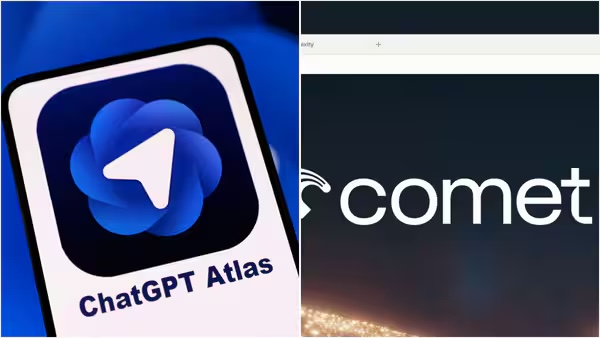
The new AI browsers like OpenAI Atlas and Perplexity Comet are dealing with it big time.
The core problem occurs when data is inadvertently treated as code. 🧵
The key idea:
(1) Websites are fed into prompts
(2) Prompts are code executed by the LLM
(3) Whenever you let an untrusted party (i.e. a random website) run code without your consent, things can go very very bad.
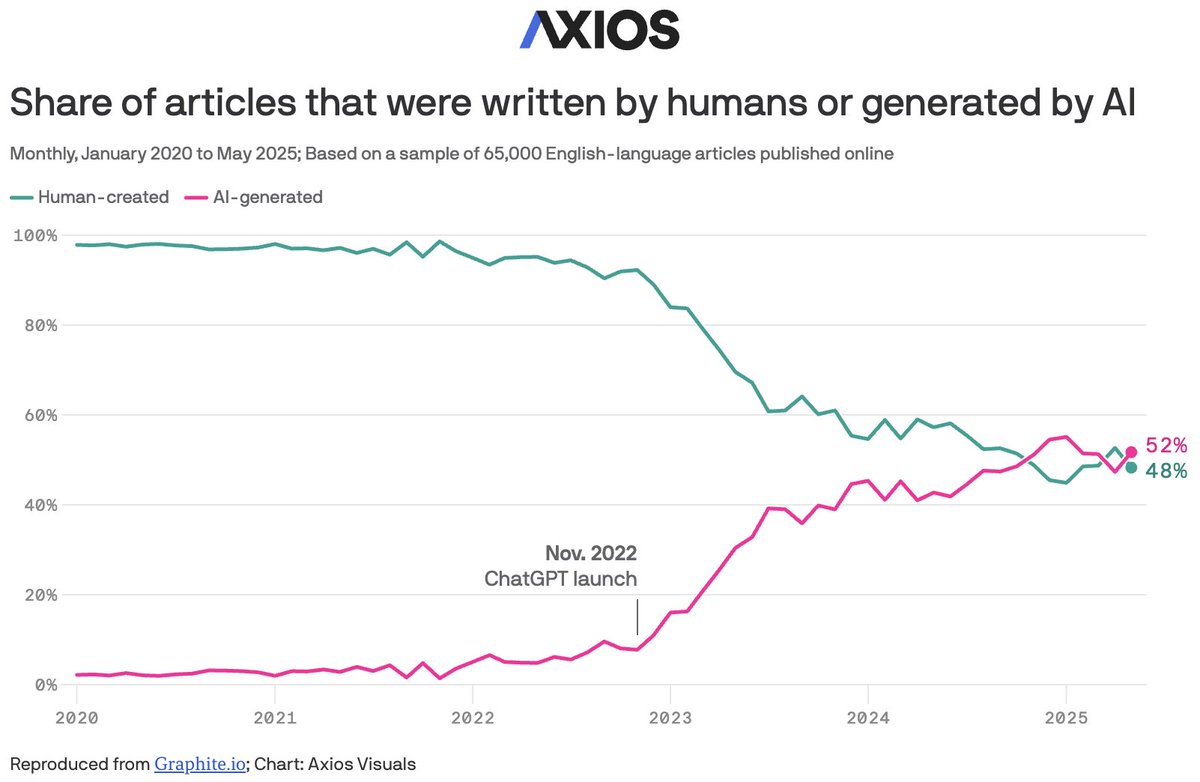
Maybe the dead internet theory is (partly) true?
Of course we can expect AI generated content to grow at a faster rate than human content, so it’s likely AI content will vastly outnumber human content soon. And the numbers in this report don’t even include AI-assisted writing, like AI drafts with human editing, which are probably also significant.
This impact of AI on the internet is likely now a permanent feature.
Watercooler conversation at @civai_org:
Sora is helpful for AGI. Not just the model itself — the social media app too.
OpenAI wants to build a world simulator. A model that understands how physics works, how a robotic arm will interact in a factory. It would get them closer to their ultimate goal: “highly autonomous systems that outperform humans in most economically valuable work”.
Making TikTok for AI videos is an effective way to do that.
For LLMs, ChatGPT is (among other things) an easy way for OpenAI to get a ton of feedback from users, in order to make their text generation LLMs even better.
The Sora app is exactly this but for video. OpenAI gets data from likes, views, comments, etc, which gives them a lot of very rich info. That all could feed back into the Sora video model — the world simulator.
From this POV, the Sora app makes more sense strategically.
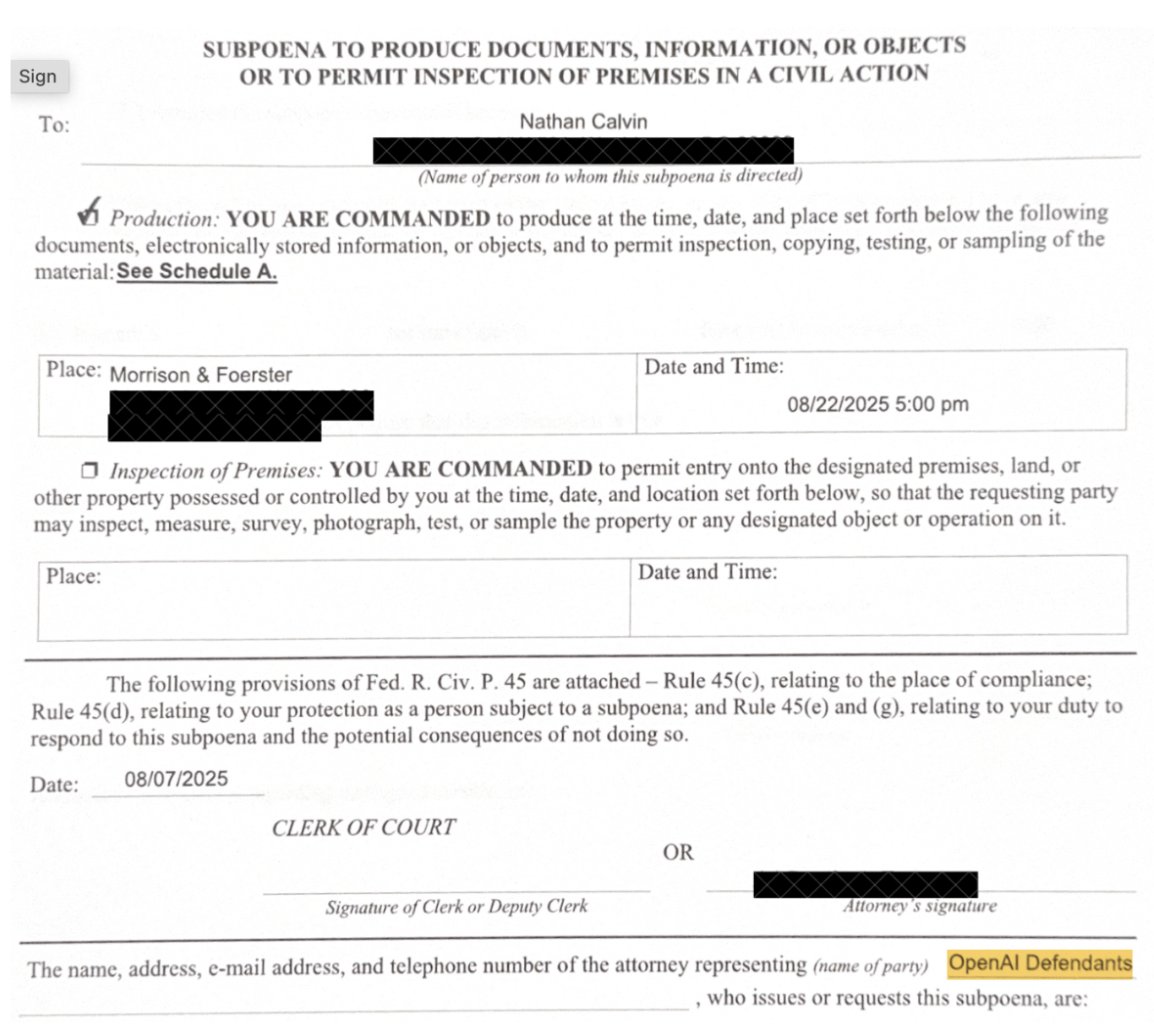
One Tuesday night, as my wife and I sat down for dinner, a sheriff’s deputy knocked on the door to serve me a subpoena from OpenAI.
I held back on talking about it because I didn't want to distract from SB 53, but Newsom just signed the bill so... here's what happened:
🧵
When do you think AI will crack the top 5 of this public opinion poll? (Click to see the original poll in thread.)
The poll asks: "How much of a problem do you think each of the following are today?" The options are Crime, Immigration, Climate Change, Inflation, AI, etc.
We've spent the past 6 months pushing AI voice tech to its limits and thinking of most intuitive + fun ways to use it to convey the AI tidal wave that is coming.
The culmination is We Need To Talk: The AI Voice Game. You can play it now at the link below.