>started reading about LLM inference
>accidentally built an inference engine
>added paged attention
>added prefix caching
>added chunked prefill
>added continuous batching
> achieve 14% speedup vs vLLM
wrote the whole journey here ↓ https://t.co/UfzzVpqwAd
Introducing Claude Opus 5.5, the first model in our new Claude 5.5 family.
It performs at the level of Claude Fable 5.1 for most tasks, and costs 40% less to run than Opus 5.
Jev this. Jev that.
Here’s Jev playing Pac-Man 👻
The harness sends it the board, legal moves, food distances, and ghost positions each turn. Jev picks a move; a small route rule keeps it heading for food when the map gets sparse.
@SergeStack Deterministic checks test for things like for eg max_num_tool_calls or max_cost
Llm as judges are used for quality checks like correctness, user goal following etc
Both things test different things and are treated separately
Adding another Jev post to your already Jev filled TL
Evalon is an eval + observability harness I built a while ago
it tracks LLM calls, latency, tokens, cost, exceptions, and runs evals over datasets with deterministic checks or LLM judges
now I’m adding Jev as an evaluator
a surprising number of evals are basically binary decisions:
-> did the agent finish the task?
-> is this answer grounded?
-> was the tool call correct?
-> does this output satisfy the rubric?
Jev is a pretty natural fit for these
you give it the context + rubric, it gives you the verdict
and at Jev’s speed + price, this gets especially interesting at scale
Github:
https://t.co/bC0TnZH4Hi
>started reading about LLM inference
>accidentally built an inference engine
>added paged attention
>added prefix caching
>added chunked prefill
>added continuous batching
> achieve 14% speedup vs vLLM
wrote the whole journey here ↓ https://t.co/UfzzVpqwAd
>started reading about LLM inference
>accidentally built an inference engine
>added paged attention
>added prefix caching
>added chunked prefill
>added continuous batching
> achieve 14% speedup vs vLLM
wrote the whole journey here ↓ https://t.co/UfzzVpqwAd
saw this and thought: why isn’t there an open-source version?
So I built one in a few hours. It uses your AirPods to blur your Mac when you look away no camera, no recording.
try it out now link in the comments ⬇️
A friend gave me a brutal benchmark for Ares, my self-improving RLM harness:
-> build an ML/DL library from scratch in C
-> then implement + train XGBoost from scratch on Boston Housing dataset
Ares did it with GPT-5.6 Sol for <$0.20 and ~1% context usage.
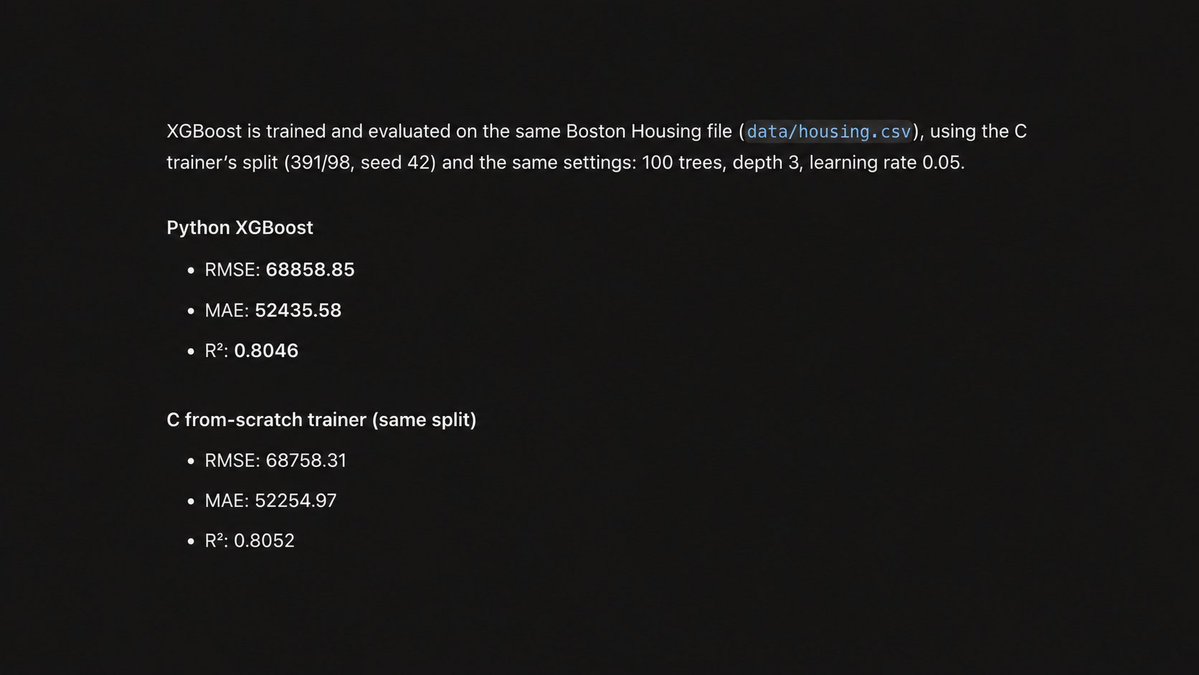
I compared the implementation against python XGBoost using the same dataset split and hyperparameters
result difference: ~0.35%
I have found this to be a great benchmark for both agent accuracy and efficiency
checkout Ares:
https://t.co/Bj51ucXTjA