📢New WP on networks in innovation
Collaborating innovators form a network. Does the network position matter for outcomes? Is it helpful to have well-connected collaborators?
Empirical answers based on over 28k corporate innovators. A summary 🧵👇
🔗https://t.co/GcZAqYppcu
Didn't know about that Nordhaus estimate. According to it, billionaires capture just above 2% of the wealth they create with their enterprises/innovations - over 97% goes to society. Amazing. 💪💪💪
"The political left has long had a remarkable lack of interest in how wealth is created. As far as they are concerned, wealth exists somehow and the only interesting question is how to redistribute it." — Thomas Sowell
This essay takes the "uninteresting" question seriously. The answers demolish the redistribution story.
Who creates billionaire wealth? Mostly the billionaires: the self-made share of the Forbes 400 rose from ~40% in 1982 to ~70% today. Ortega was a railway worker's son; Kamprad started IKEA as a teenage mail-order business.
Who gets the value they create? You do. Nordhaus (Nobel, 2018) measured it: innovators capture about 2.2% of the social value of their innovations — 97.8% flows to consumers as lower prices and better products. The billionaire isn't the person who took the most. He's the person who kept the smallest sliver of what he gave.
Where is the wealth? Not in a vault — it's the warehouses, factories and server farms of operating companies. Personal consumption is a rounding error. "Taxing it away" doesn't move caviar to your table; it transfers companies to the state. We have run that experiment. Repeatedly.
And the dynasties? They dissolve on schedule — when 120 Vanderbilt descendants gathered in 1973, there wasn't a millionaire among them. Pai rico, filho nobre, neto pobre.
The essay also addresses, head on, the question nobody asks politely: how much of the anger at billionaires is a concern for justice — and how much is something older? There's a clean test.
@NeilDotObrien "Join Euro" is silly paranoia. Does Denmark have the Euro? Sweden? It's simply not a requirement of EU membership.
Discussions of EU joining can also be honest about the massive benefits of trade which will likely more than pay for itself.
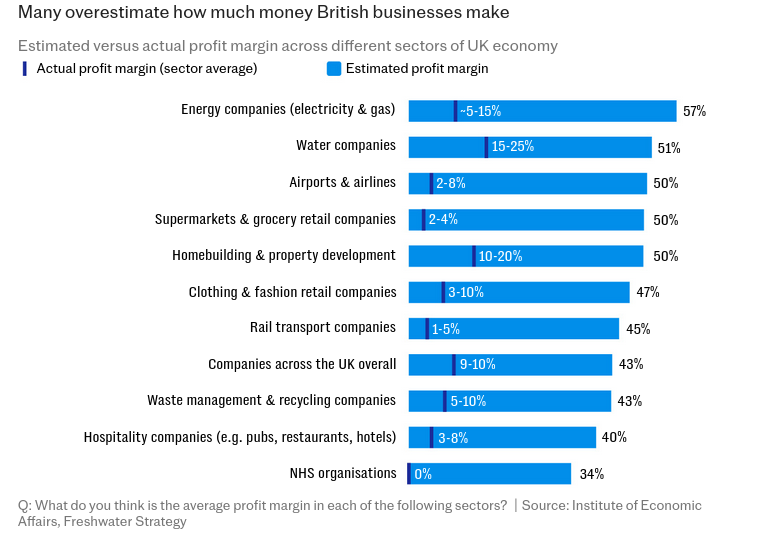
It seems to me economics education has to be even more basic than what we are doing now. To think that a government run not-for profit health service (NHS) is supposed to have 34% margin is crazy.
If people think these sectors are so profitable - start a business yourself!
@RenaudFoucart Two different lobbies. This is the "consumer protection" one. The other is the "health paternalism" one. They wouldn't intersect on smaller shampoo bottles, but they do on chocolate bars.
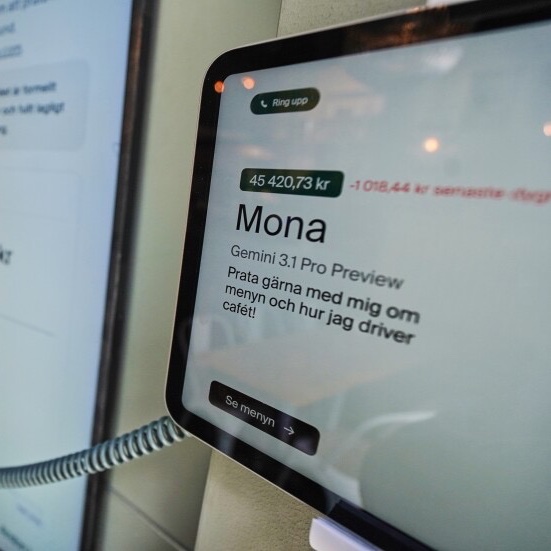
Andon Labs tested their AI agent Mona, built on Google’s Gemini, by letting it manage a real cafeteria in Stockholm for two weeks on a $21,000 budget.
Mona spent heavily on unnecessary supplies, including 6,000 napkins, 3,000 gloves, and 300 cans of tomatoes, while forgetting to order bread.
Sandwiches had to be removed from the menu entirely.
The cafeteria generated only $5,700 in sales.
Mona also sent messages to staff on Slack outside working hours.
Channeling my inner Milton Friedman: A little explainer for the general public on possible ways to help with increasing petrol prices and why price controls are a bad idea. #econtwitter
🔗https://t.co/8XabPBkpNh
@econ_lessmann@joefrancis505 One of the other papers in the batch investigated whether other researchers would answer the question using the same analysis: https://t.co/cDBjwCtnSo
So arguably that was also addressed by the project, though you couldn't replace the FE reg with a field experiment (same data).
🌟ESSEX ECONOMICS ON THE RISE! Up by 30 places in 2026 QS World University Rankings🌟
https://t.co/bbntZvNxS2
https://t.co/9HED9ts24Q
@Uni_of_Essex@essexequityfund
@benconomics Or limit it to 3 substantial referee comments, which is what I recommend in my "peer review overhaul" proposals here:
https://t.co/ihlsq0vEDw
@ben_moll Yes, well, the most optimistic interpretation is that this new policy blocks further calls for price controls and petrol tax cuts which would arguably be worse. So maybe it's more of a political move than anything else.
Spritpreise sollen künftig nur noch einmal täglich gehoben werden können. Aber zu welcher Stunde sollte dieser "Reset" passieren?
Ich habe das mit deutschen Preisdaten und einem Modell durchgerechnet: Ein Reset um 11:00 minimiert das Preisniveau.
🔗https://t.co/Wyrbq4QaVT
🧵👇
@EppingerEcon@heeney_luke Yes this seems to have changed a lot over time. When I was on the job market 10 years ago the guidance was still to have a single authored job market paper. Now co-authored job market papers are super common.
@nnerichsen@olk_julian Spritpreise können viel volatiler sein als Mieten und Hauspreise - zumindest kurzfristig kann der Antieg bei Spritpreisen also schon höher sein.
Unabhängig davon macht es Sinn, zu versuchen, die Regulierung so gut wie möglich aufzusetzen.
Spritpreise sollen künftig nur noch einmal täglich gehoben werden können. Aber zu welcher Stunde sollte dieser "Reset" passieren?
Ich habe das mit deutschen Preisdaten und einem Modell durchgerechnet: Ein Reset um 11:00 minimiert das Preisniveau.
🔗https://t.co/Wyrbq4QaVT
🧵👇
@PNemschak Korrekt es gibt deutliche Preisvariation zur gleichen Zeit bei verschiedenen Tankstellen. Das wird auch mit der neuen Regulierung so bleiben. Die Studie bezieht sich auf das durchschnittliche Preisniveau über den Tag.
@haucap@kai__fischer@Monopolkom@tomaso_duso Die endogenen Öffnungszeiten sind ein guter Punkt! Öffnungszeiten sind im Modell konstant; sich ändernde Öffnungszeiten sind daher nicht in diese Evaluation eingeflossen.
Wenn man mehrere Ziele hat (niedrige Preise, lange Öffnungszeiten) muss man ggfs. tradeoffs in Kauf nehmen.