What evidence would make you reopen a gate youʼve already passed?
Most gates are treated as one-way doors. The best programme leaders decide in advance what would bring them back.
#engineering#PMO
Your test window just disappeared. Which proof do you protect?
Validation capacity is finite. When a slot moves, something has to wait.
Safety qualification, customer acceptance or certification evidence: which would you protect, and why?
#Engineering#PMO
The programmes that slip are not the ones without process.
Status reports, gate reviews and risk logs can all look orderly while the live dependency picture stays hidden.
From Signetra Foresights.
#ProgrammeManagement#SignetraSystems
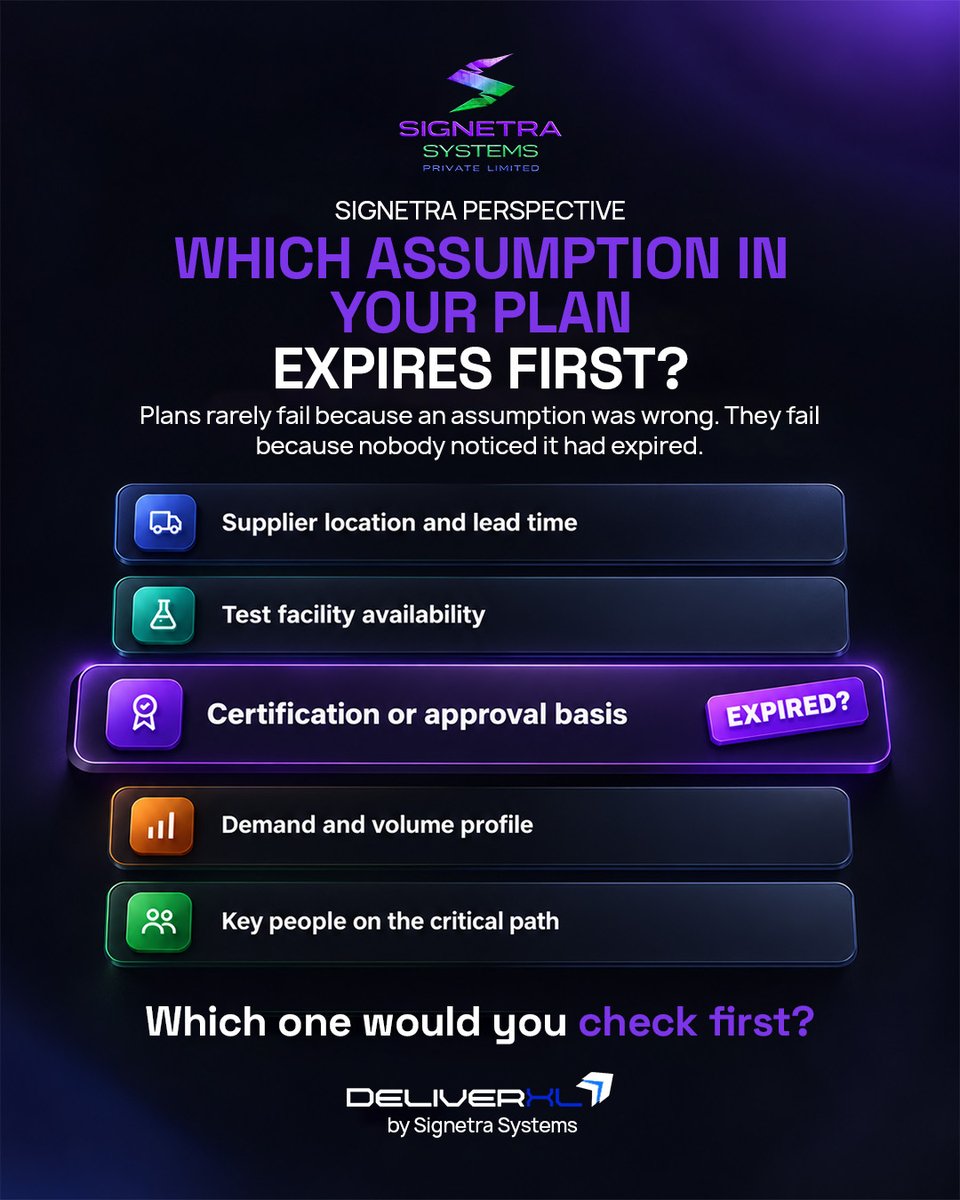
Your plan may still look right, even when its assumptions are outdated.
Supplier lead times, test availability, approvals or demand can change.
Which assumption would you check first?
#SignetraSystems#DeliverXL#EngineeringLeadership
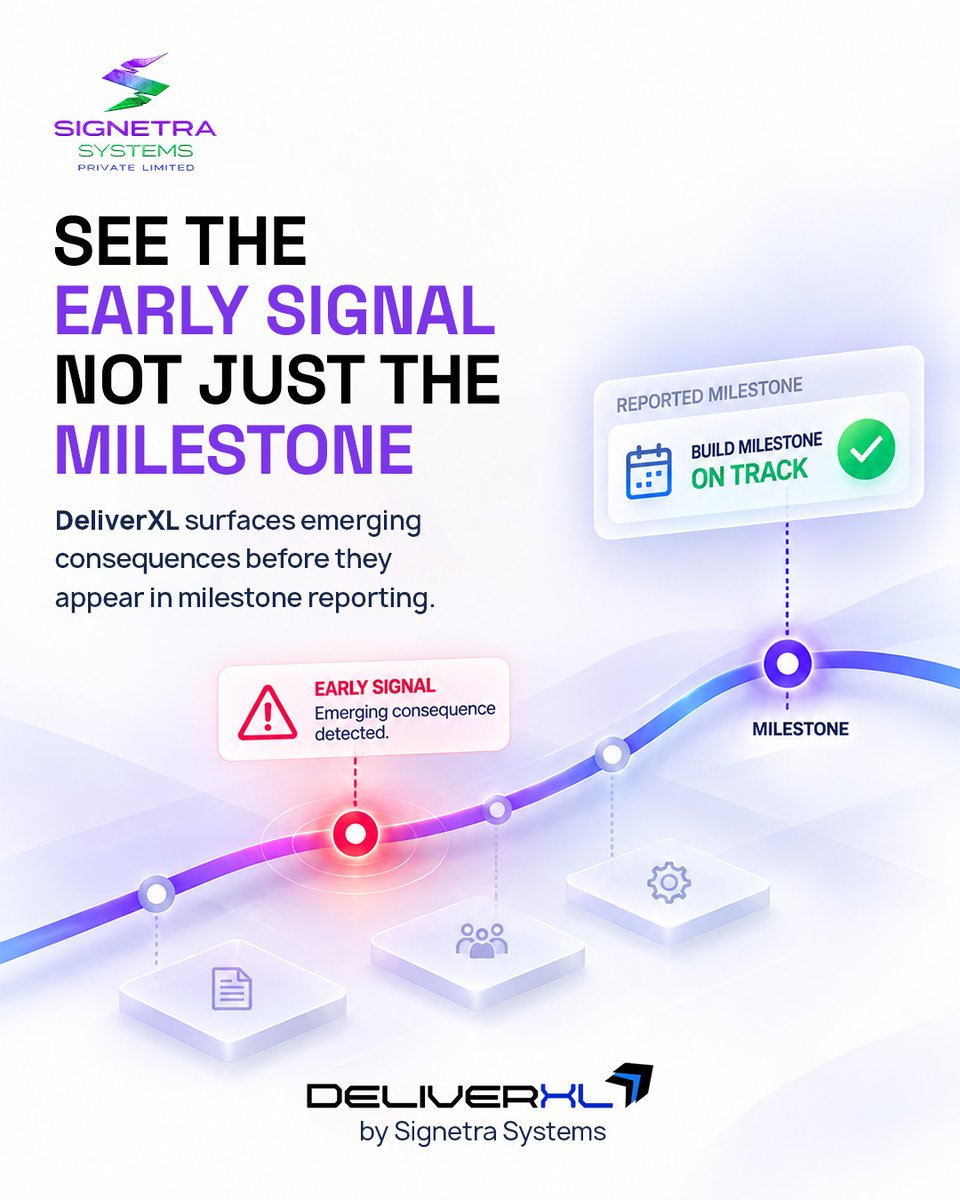
For those leading complex engineering programmes: what is the earliest warning sign that a programme is losing its ability to recover—even when its reported milestones remain green?
A programme can be GREEN while its recovery options are disappearing.
What if execution risks became visible before the damage?
We're exploring this with DeliverXL—and seeking industry leaders willing to challenge the thinking and shape what comes next.
Teaser: https://t.co/nLmtJOfuAq
#SignetraSystems #DeliverXL
An issue can be marked closed while its downstream consequences remain.
Closing the record doesn't automatically restore the commitments it affected.
DeliverXL helps reveal the difference.
#DeliverXL#ProgrammeManagement#SignetraSystems
Every task can have an owner, yet the handoff between teams can still fall through the cracks.
Real programme control means understanding what happens between responsibilities, not just within them.
#DeliverXL#ProgrammeManagement#EngineeringLeadership
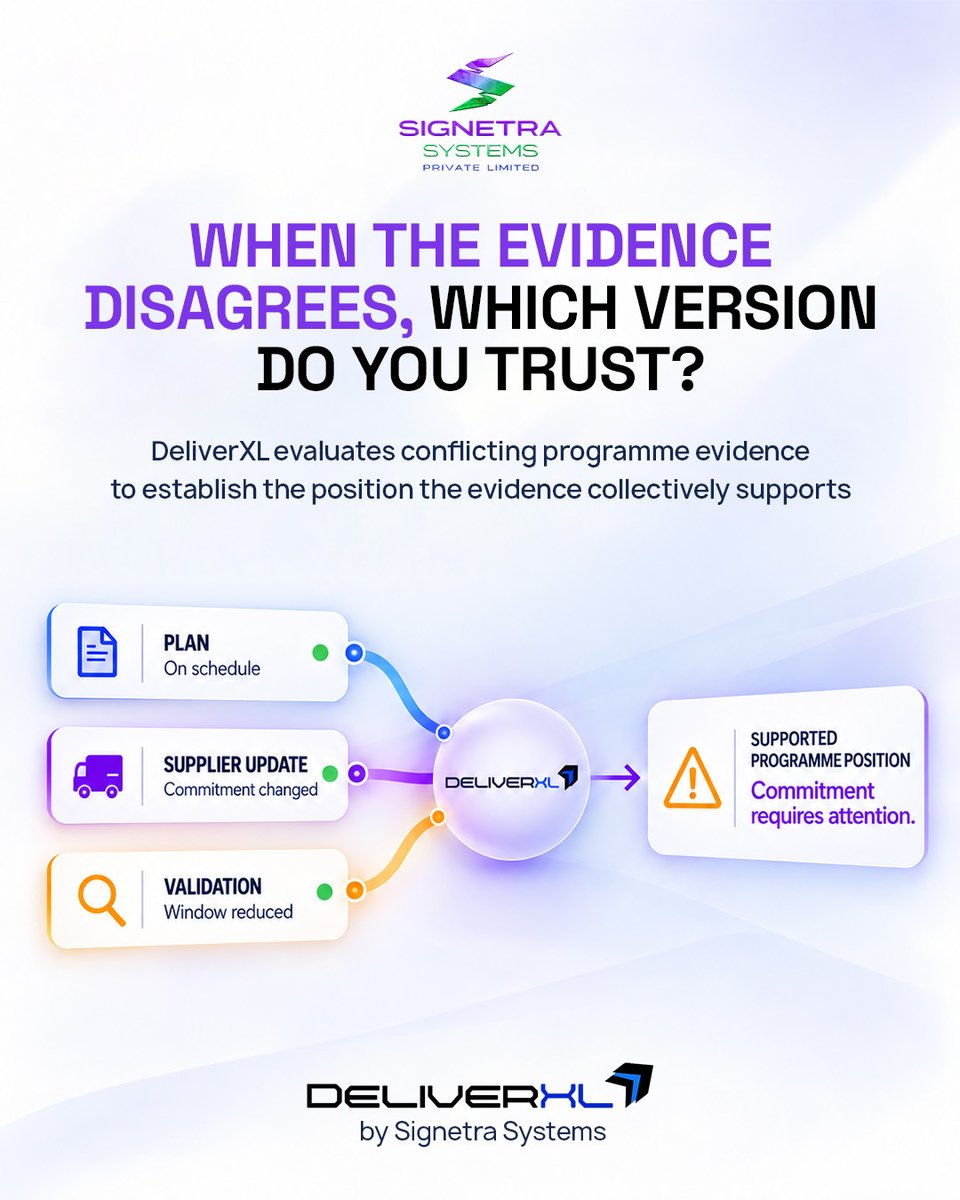
What happens when your programme evidence tells different stories?
The plan says on schedule. The supplier commitment has changed. The validation window is shrinking.
DeliverXL evaluates the evidence together to establish the programme position that actually needs attention.
#DeliverXL #ProgrammeManagement #EngineeringLeadership #SignetraSystems
Risk tells you what’s exposed. Recoverability tells you how much room remains to act.
DeliverXL reveals the remaining intervention window before dependencies and lead times limit your options.
#DeliverXL#ProgrammeManagement#SignetraSystems
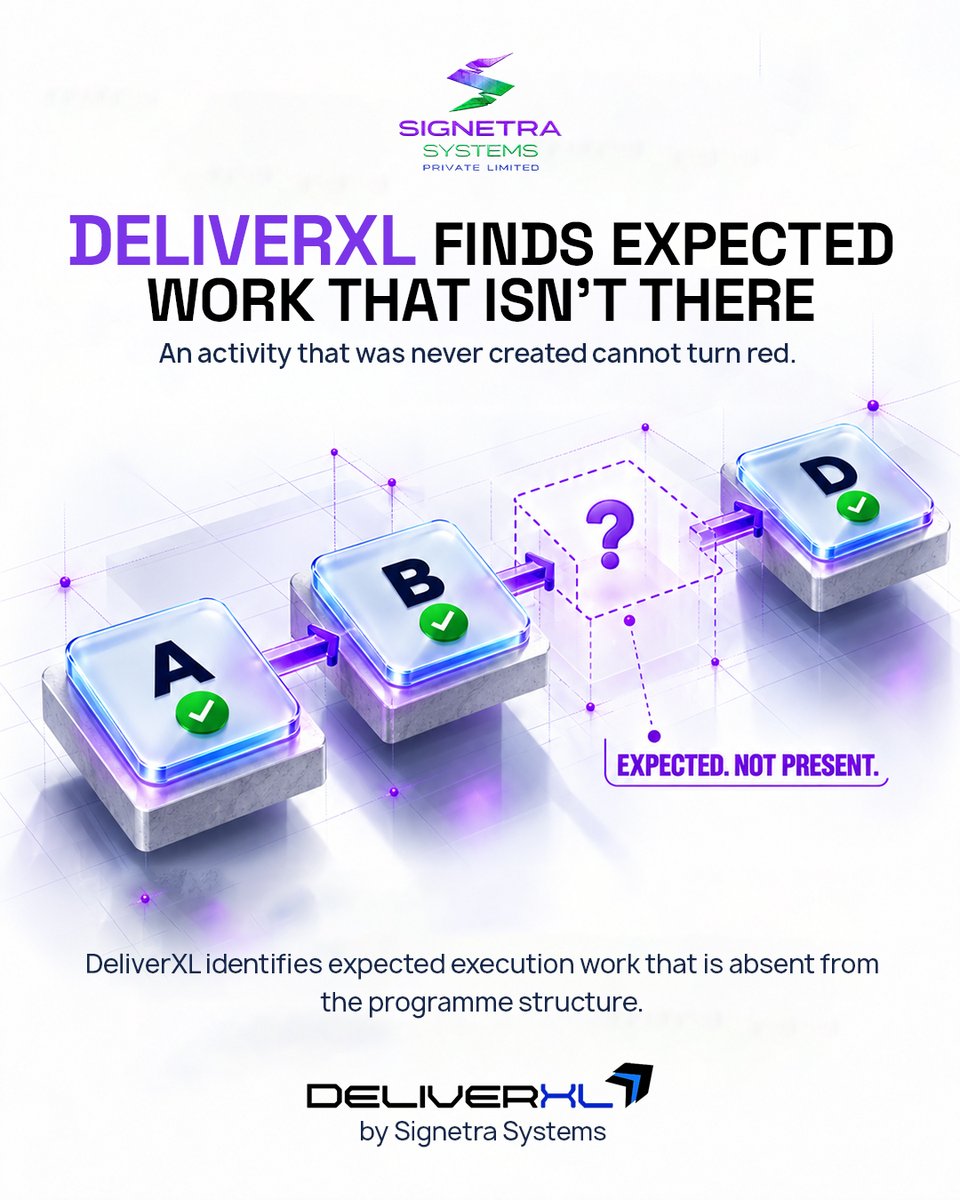
Some programme risks never turn red because the activity was never created.
DeliverXL identifies expected execution work that is absent from the programme structure.
You can’t RAG-rate what doesn’t exist.
#DeliverXL#ProgrammeManagement#EngineeringLeadership#SignetraSystems
The $4.9 billion charge is the headline. The deeper problem is how the aerospace industry manages complexity.
Programmes this large are still governed through fragmented engineering, certification, manufacturing, supplier and commercial views. Each function can be “under control” while the programme as a whole is steadily losing options.
That has to change.
The industry needs execution systems that continuously connect technical change, certification evidence, supplier readiness, production consequence, cost exposure and schedule impact — not reconcile them after the damage becomes visible.
A delay should not first become obvious when an aircraft is being reworked, a certification date moves or billions are written down.
By then, the programme has already been telling you something for months.
The future of aerospace programme management is not better reporting.
It is earlier computation of consequence.
#Aerospace #ProgrammeExecution #ProjectControls #SignetraSystems #DeliverXL
Enterprise risk is broader than compliance and cybersecurity. But there is still a bigger problem.
Most organisations still observe risk by category, function and reporting line.
Execution does not behave that way.
A supplier constraint can become an engineering problem.
An engineering delay can become a certification problem.
A certification issue can become a commercial problem.
A commercial response can create an entirely new delivery risk.
The industry needs to stop treating risk as a collection of registers and start treating it as a connected system of dependencies, consequences and remaining options.
Until that happens, leadership will continue receiving neatly classified risks while the real exposure is moving across organisational boundaries.
Risk management has to become execution-aware.
#RiskManagement #EnterpriseRisk #ProgrammeExecution #SignetraSystems #DeliverXL
The industry has a visibility problem.
We still manage complex programmes through functions, workstreams and milestone reviews, then act surprised when a “local” change creates a programme-level delay.
That model is no longer good enough.
In aerospace, a software change is not just a software event. It can alter validation, certification evidence, integration readiness, supplier timing and downstream programme confidence.
If these delays are to reduce materially, the industry has to stop managing execution in pockets.
What must change is simple:
Every significant change must be assessed against the full dependency chain, in real time, with the impact on critical activities, recovery options and downstream commitments made visible immediately.
Until programmes operate as one connected execution system rather than a collection of reporting silos, these “late surprises” will keep happening.
#Aerospace #ProgrammeExecution #ProjectControls #SignetraSystems #DeliverXL
The owner and date matter. But there is one more line every open decision needs:
What becomes constrained if this decision is late?
Because a nine-day delay is not really nine days if it blocks a design release, supplier nomination, validation build or downstream approval.
That is where decision latency becomes programme exposure.
The real control is not just knowing that a decision is overdue. It is knowing the chain of consequences while there is still time to act.
#ProgrammeExecution #ProjectControls #DecisionMaking #SignetraSystems #DeliverXL
Exactly. And the real cost of that “small yes” is often much larger than the task itself.
In complex programmes, one additional requirement can alter validation scope, supplier commitments, engineering capacity, release sequencing and downstream timing.
The dangerous part is that each individual yes still looks reasonable.
Scope creep becomes visible only when the programme can see the cumulative effect across dependencies, not just the latest request in isolation.
#ProgrammeExecution #ProjectControls #ScopeManagement #SignetraSystems #DeliverXL
The real danger is that programmes rarely suffer from one delayed decision in isolation. Decisions sit inside dependency chains.
One unresolved choice can quietly hold an engineering release, supplier commitment, validation activity, cost approval and downstream launch timing — while each individual tracker still looks manageable.
So the question is not only “Who decides, and by when?”
It is also:
“What becomes constrained if this decision does not happen?”
That is where decision management becomes execution intelligence.
#ProgrammeExecution #ProjectControls #DecisionMaking #SignetraSystems #DeliverXL
A risk register becomes useful when it changes action. But in complex programmes, the harder problem is often what never reaches the register at all.
Dependencies shift. Recovery options disappear. Supplier or cross-functional constraints accumulate. Yet the formal risk can still look unchanged because the underlying execution state has not been reconciled.
The next evolution of risk management is not just better recording of known risks. It is detecting emerging exposure early enough that teams still have options.
#RiskManagement #ProjectControls #ProgrammeExecution #SignetraSystems #DeliverXL