🚀 Humanfia × Geometrization: Perelman's Proof, Now Fully Formalized in Lean
The Humanfia team and Yuan Liao, Ziyang Qin, Ayush Khaitan , Ben Chow, and have completed a full Lean formalization of the Hamilton–Perelman proof of Thurston's Geometrization conjecture! It goes beyond Poincaré and classifies every 3-manifold. Mathematicians needed years to digest this proof. Now a machine has verified it line by line within weeks!
The progress of Humanize agentic math:
26-07: Perfect score in IMO 2026
26-08: 670/672 in PutnamBench
26-09: 100% in PutnamBench and 1st place in LeanEval (Surpassed by Axiom later)
26-10: 1st place again in LeanEval with upgraded Humanize workflow
26-10: Completed the Lean formalization of the Hamilton–Perelman proof of Thurston's Geometrization conjecture.
We are increasingly convinced: when everyone has tokens of similar intelligence, the agent workflow is what decides how far AI can go in frontier mathematics.
Tokens are「transforming」 the math.
🌌Geometry library: https://t.co/Uf9nkj7FSJ
⚙️ Humanize: https://t.co/rTfrdGIDB6
#AI #LLM #Humanize #Mathematics #Lean4 #Agent #Humanfia #Geometrization
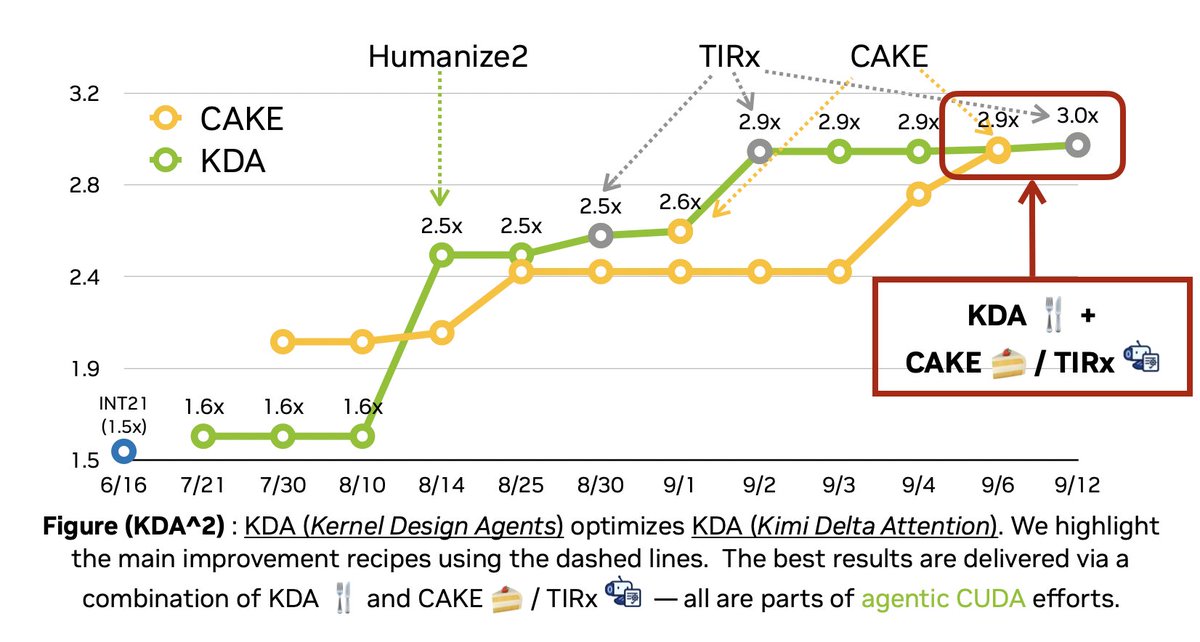
🚀 Kernel Design Agents to Optimize Kimi Delta Attention (upto 2.96x)
When the KDA (Kernel Design Agents) project was initiated, its name happened to coincide with another KDA (Kimi Delta Attention). More than once, people asked us , "Can we use KDA to write a version of KDA?" Today, right at a moment with a full moon good for shooting, we are thrilled to share the latest results of KDA(gent)-v0.6: using KDA(gent) to optimize KDA(ttn)!
KDA-v0.6 achieves this through
* Humanize2 Flow & LLM Collaboration Optimization: Introducing multi-round iterative evolution with Flame Chase, GPT-5.6-Sol, and Fable-5, paired with an automated Workspace cleanup mechanism to significantly broaden the operator search space.
* Multilingual Domain-Specific Skill Stack Support: Fully supporting CuTe-DSL, CUDA C++, as well as recent Agent-Native CAKE IR and TIRx. Combined with customized diagnostic tools (such as CuTe's dedicated IKET pipeline analyzer and TIRx's CPU-side numerical simulation and static checks), achieving deep performance bottleneck diagnostics.
* Self-Evolving Kernel Wiki: Building a dynamically updated knowledge base that automatically cleans up invalid/erroneous implementations, corrects classification tags, and streamlines search indexing, significantly improving the Agent's knowledge retrieval quality and code generation accuracy.
KDAgent ultimately optimized the KDAttn kernel to 2.96x of FlashKDA, and we face a lot of unexpected hacks during the optimization. More details shared in our blogs https://t.co/IQT9WcLktx
Release results of KDA for KDA: https://t.co/d5njJtzfL5
Community & Production Deployment:
All kernels are open-sourced for community verification! For deploying NVIDIA Agentic CUDA acceleration in production environments, we recommend using the production-level version rigorously verified by FlashInfer.
By the Team: Dongyun Zou, Yixin Dong, Hongyi Jin, Junxian Guo, Yahui Cui, Avery Huang, Zihao Ye, Junru Shao, Changye Li, Zijian Zhang, Sihao Liu, Song Bian, Ligeng Zhu.
Humanfia team ranks #1 on lean-eval by token-ma...xing. Uha, well, not that maxing, the total token cost is less than 50k :) We use a smart agent flow to launch the loop to get the good ranking, while most of authors are not majoring in math. https://t.co/ys0TcgWZO5
Databricks ranks #1 on NVIDIA’s SOL-ExecBench kernel leaderboard, in the L1 single operation track, powered by KDA (Kernel Design Agents) 🎉
What’s crazy is: we 100% leveraged AI agents to beat the competition.
This is a sneak peek at recursive self-improvement. The core frameworks we used were KDA, Humanize, and Omnigent: Claude writes code, Codex reviews. Together, they enabled agents to run autonomously for as long as possible. The key is setting up the right framework to let the agents cook.
This work was driven by @leshenj15 at Databricks, in collaboration with NVIDIA and MIT HAN Lab’s @LigengZhu and @DongyunZou03 .
Databricks AI is like a neolab. Join us if you’re cracked!
@sterlingcrispin hi Sterling, nice work! I really like the Claude Work and Codex Review mode as you built, so I put them in the loop. And it works really well. You may want to try https://t.co/tIBG9MOeO8?
@RobertTLange Hi, the generated code use `const int threadsPerBlock = 256;` but the kernel code use `const int row = blockIdx.y * blockDim.y + threadIdx.y;`. You cannot use 2D kernel while starting it as 1D. `row` is always zero and there is no computation done -- so that's why it is faster