The Finance Act, 2026 amended Section 37E of the Tax Procedures Act (TPA) to provide for tax amnesty on penalties and interest relating to tax debts incurred up to the year of income ending 31 December 2025.
The Amnesty will run from tomorrow to Dec 2026
What you do with this information is entirely up to you. 😎
🚨 NEW: NTSA Camera Fines: Quick Guide
Speeding
• 1–5 km/h over: Warning
• 6–10 km/h: Sh500
• 11–15 km/h: Sh3,000
• 16–20 km/h: Sh10,000
⚠️ Over 20 km/h: Likely court process, not a minor offence.
Other fines
• No number plates: Sh10,000
• No inspection certificate: Sh10,000
• Seatbelt/phone use offences: Sh500–Sh3,000
Drivers have 7 days to appeal an automated fine.
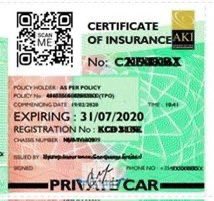
EVERYTHING YOU NEED TO KNOW ABOUT MOTOR VEHICLE INSURANCE CERTIFICATES IN KENYA
1) Private Car - C certificate
* Private cars used for social, domestic, pleasure purposes & the owner's business only.
2) Private Motor Cycle - D certificate (non fare paying passengers)
* Private Motor cycles & motorized three-wheelers used for social, domestic, pleasure purposes & the owner's business only.
3) PSV Motor cycle - D certificate (fare paying passengers)
* Restricted to public service motor cycles and motorized three-wheelers for carrying fare paying passengers.
4) Commercial Vehicles - B certificate
* Commercial vehicles used for business such as tractors,worries,trucks,pickups,trailers,institutional & school vehicles & motor trade.
5) PSV - A (Matatu Certificate)
* Restricted to public service vehicles operated as matatus and carrying between 7 and 35 passengers
6) PSV - A(Bus Certificate)
* Restricted to public service vehicles operated as buses and carrying 36 passengers & above.
7) PSV - A(Taxi Certificate)
* Restricted to public service vehicles operated as taxis
8) PSV - A(Unspecified Certificate)
* This category is for public service vehicles for private & public hire (self-drive and chauffeur driven)
Motor Insurance Sticker Colors
- Kenya.
1) Motor Private Insurance : Green
2) Motor Commercial : Blue
3) purple : Motor Cycle
4) Orange/yellow : PSV
Call us on : 0727497935 for questions & further clarification
@bungomaduke install small Roof cyclones are wind-driven devices installed on rooftops to extract hot air, moisture, and fumes without electricity. They operate 24/7 using natural wind (rising hot air), creating a continuous vacuum that improves indoor air quality and prevents condensation.
The beyond-elasticity of law @KRACorporate board (led by chairman Ndiritu Muriithi) took to sweeten @PSCKenya into obvious nod for Adan Mohammed’s pick as KRA-CG. It’s telling how KRA, with mandate to appoint its CEO, have to purport to beg PSC to hire its CEO. Read the bloated lies about the candidates ability. Indeed, we are under a bandit leadership. As a country, we lost it long time ago. Hope the good people of Laikipia are reading …
More companies are applying to generate their own electricity as Kenya’s industrial firms move to cut power costs through captive solar projects.
EPRA has received generation licence applications for three self-consumption solar PV projects in Kilifi:
— Corrugated Sheets Ltd: 6.3 MWp
— Standard Rolling Mills Ltd: 2.25 MWp
— Nyumba Agri Products Ltd: up to 10 MWp
Public comments or objections are due within 14 days from 10th June 2026.
The government now says househelps should earn at least KSh 18,047 following the latest 12% minimum wage increase.
On paper, that sounds progressive.
In reality, many househelps are still earning between KSh 3,000 and KSh 10,000, while some of the
people employing them take home less than KSh 25,000 themselves.
Kenya doesn't just need wage orders. It needs a proper Domestic Workers Bill covering registration, contracts, minimum standards, background checks and enforcement.
Because here's the reality: a Kenyan earning KSh 15,000 per month may still need domestic help because of work, children or other responsibilities.
If the law says the househelp should earn KSh 18,047, what happens next?
A friend of mine earns Ksh 150,000 per month and works in a good IT job. He asked me if he should take a Ksh 10 million mortgage so he can stop “wasting money on rent.” Right now, he pays Ksh 65,000 rent for a 3-bedroom house in Nairobi.
Here’s how I explained it to him in a simple way:
If he takes a 30-year loan at 13%, his monthly payment will be about Ksh 110,000. At first, that sounds okay. But when you look deeper, it’s not.
Over 30 years:
— He will pay about Ksh 39.6 million
— That means Ksh 29.6 million is just interest
Now think about his salary:
If he earns 150K and pays 110K to the bank, he is left with only 40K.
That 40K must cover everything:
- Food
- Transport
- Family needs
- Emergencies
- School fees
- Savings
That is very tight. One small problem, and he can’t keep up with payments.
Now compare with renting:
If he continues paying Ksh 65,000, he remains with Ksh 85,000 every month.
That extra money can:
- Be invested
- Build savings
- Buy land
- Help him plan better for the future
So yes, owning a house sounds good. But if it leaves you with no money, it becomes stress, not success.
My advice to him was simple
Wait until your income grows or the house can make money for you.
Sometimes, renting is the smarter move for now.
@georgenjoroge_@iamkipro@KeNHAKenya Bana what are these trash roads and sidewalks we have on the main highway of our capital city?! Incompetence pro max
Justice is not a commodity. Open courts must mean open judgments. Kenyans funded these cases through their taxes — now @MyKenyaLaw wants them to pay again via @eCitizen just to read a ruling? That is extortion dressed in robes. @CJMarthaKoome end this racket. NOW. #OpenJustice@NelsonHavi