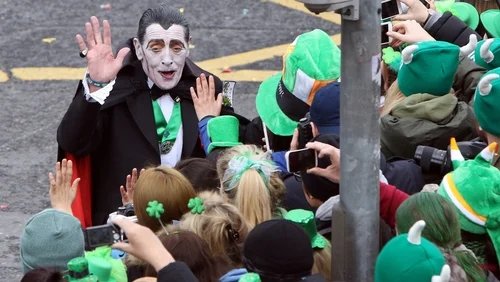
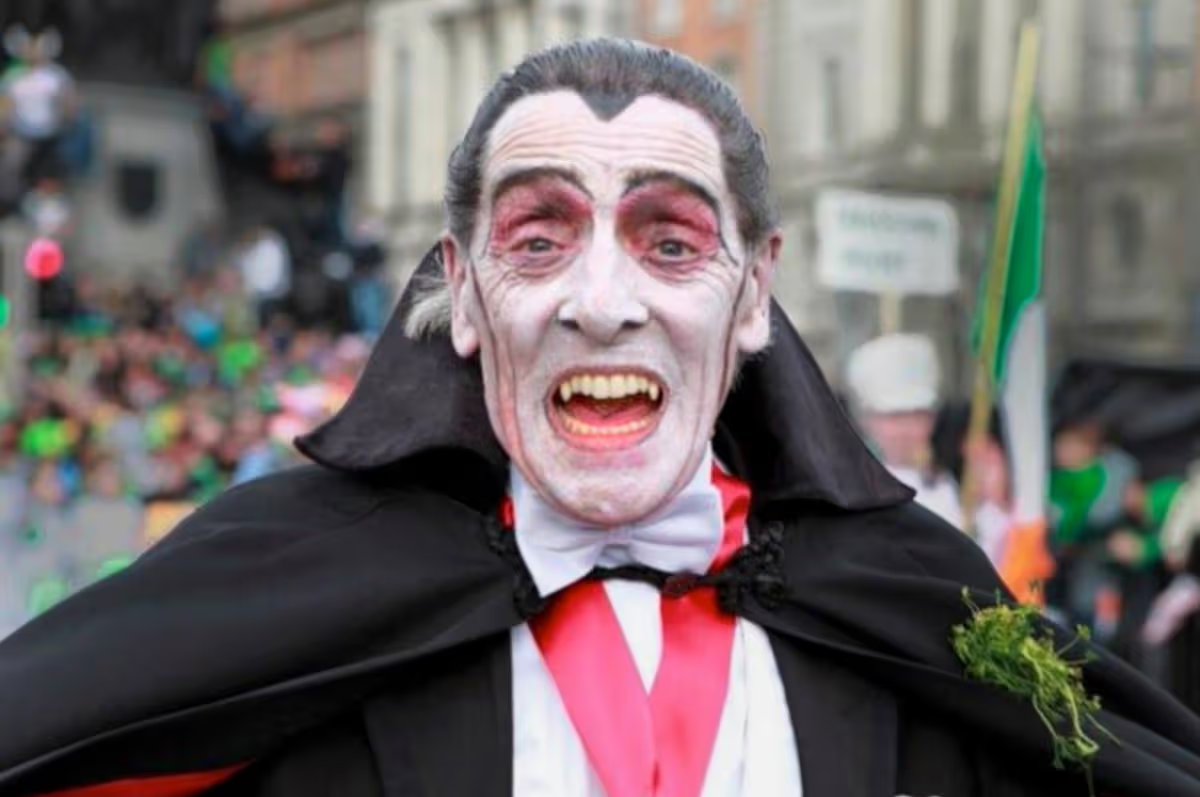
Dublin has produced two vampires I`ve had to pleasure of meeting, and Paddy Drac was by far the more charming. Born Patrick Finlay in 1945, he became a beloved fixture of Dublin life for half a century. But this creature of the night was more obsessed with giving charity and hugs than taking blood.
His legend began in 1969 whilst on a jaunt to Dalkey where a friend noting his chiselled cheekbones which a modern day Looksmaxxer would envy. But being an Irish mate instead of calling him handsome he remarked that he looked like bleedin Dracula.
Soon after, a local travel agent hired him to don a cloak and fangs to promote flights to Transylvania, a tongue-in-cheek act that planted the seed of a persona that would capture the imagination of St Patrick's Parade audiences for decades.
Paddy Drac’s first public appearance was chaotic and improvised. He sneaked into the Paddys Day parade with a homemade cloak and paper fangs. Some say it was 1968, others 1969. Whatever the year he became a parade fixture for 49 consecutive years, building his fanbase and becoming a highlight for kids and adults and people watching at home. Getting a squeeze of him was as good as meeting an "official" celebrity.
In his everyday life, when not being the prince of darkness, Patrick Finlay worked as an undertaker for Rom Massey & Sons, later as a porter at Tallaght Hospital. At home in Tallaght, he lived in a gaff he christened “Alucard", Dracula spelled backward.
And it was his charity work that cemented his legend. Paddy Drac raised tens of thousands for children’s charities, especially those supporting children with special needs. He was also a fixture at the Dublin Taxi Drivers’ Outing for children.
In 2017, those real blood suckers in Dublin City Council briefly tried to clip his bat wings. Security changes initially barred him from the St. Patrick’s Day Parade, igniting a public outcry that reinstated him as a guest of honour.
A tribute mural in Tallaght, part of the Dublin Canvas project, immortalises his image. The Irish band The Pale penned a musical ode to him, and in 2018 Dublin City Council Culture Company officially recognised him as a “Local Hero.”
Patrick Finlay passed away in April 2019 at 74. The funeral of this beloved gentleman and character drew a massive crowd, and in accordance with his wishes also raised thousands for charity, that last one being the Irish Cancer Society https://t.co/Pa6k48ZNIj
@RobLooseCannon Paddy lived on my nanas road, had a Coffin in his garden too!! Good mate lives there now. he looked after me in tallaght hospital after a leg break in '11. Absolute Gent .
they broke the mould after Paddy.
The Bachelor's Walk Massacre took place today in 1914, when British soldiers opened fire and fixed bayonets on a crowd of unarmed protesters. It was a beautiful summer's day, but the heat in the city was stirring the passions for revolution.
That morning, 1,500 Mauser rifles had been smuggled into Howth harbour aboard the Asgard, a private yacht skippered by Erskine Childers. The guns had been purchased in Hamburg as a direct counter to the Ulster Unionists' own gun-running operation, and the landing was a triumph for the Irish Volunteers.
When the Volunteers were coming home to Dublin after the pickup they were met with roadblocks of Dublin Metropolitan Police and King's Own Scottish Borderers soldiers. The soldiers were ordered to intercept and disarm the Volunteers, with force if necessary.
A confrontation at Clontarf ensued, and many DMP officers refused to follow orders to disarm the Volunteers, for which they were later disciplined. A chaotic struggle between the two sides followed. The soldiers confiscated some guns but the majority of the Volunteers escaped back to Dublin with their newly acquired weapons.
The Scottish soldiers marched back to Dublin and were met with protests practically all the way. Crowds of women and children jeered them in Clontarf, crowds on the North Strand mocked them for their defeats in South Africa. From Amiens Street to Liffey Street the unarmed civilian protesters shouted and laughed at the soldiers.
They had no way of knowing the barbarity they would face. In Talbot Street the mood started to turn sinister when some soldiers, with bayonets levelled, ran at civilians who chanted at them for being cowards, and followed them along Sackville Street (O'Connell Street) till they met the final crowd of protesters on Bachelor's Walk.
Irish Trade Union Congress witness Thomas Johnson testified how the unarmed crowd's conduct did not justify an armed response, saying "More stones were thrown at a football match in Belfast without interruption of the game." Another witness to the massacre, Professor Eoin MacNeill, wrote to Roger Casement describing the events in similar fashion, noting that from Amiens Street to Liffey Street you could not find a missile of any kind. However the soldiers became visibly furious. Shockingly, they opened fire around 6:30pm beside the Ha'penny Bridge.
The testament of a former British soldier present at the massacre paints a terrible image of the violence:
"I heard the officer, a young man, give the order to load. I tried to get a couple of women and a girl out of the way. I got the little girl clear, and the women lay down on the pavement. I saw the soldiers load their rifles with ball cartridge. They seemed to be very excited. They were within ten yards of me, and I saw one man fire. He reloaded, and as he put in his second cartridge he pointed his rifle downwards without taking aim. He pulled the trigger, and I was shot in the leg."
Three civilians were shot dead on the day. Over 38 more were seriously injured, some bayonetted in the back as they frantically fled. The three killed outright were a cross section of Dublin working class life. Mary Duffy was a widow, aged 50. The cruel irony of her murder by British soldiers was that her son was actually serving in the Royal Dublin Fusiliers. He would attend her funeral in British Army dress uniform, but the eulogy he gave condemning the carnage, in which he spoke of soldiers shooting down helpless women and children in his native city, left no doubt of his anger.
Patrick Quinn, aged 46, was a father of six and a coal porter. One can only imagine the catastrophic effect his murder had on his large family. 18 year old James Brennan was a messenger boy. Many children were among the dozens of seriously injured. The youngest victim was nine year old Luke Kelly, who was shot in the back and taken to Jervis Street Hospital with a bullet wound to the lung. ->>cont
20 years ago the quite wonderful #BrendanGleeson stated the truth, and what did we do..? We did exactly what he warned would happen if we "vote for this crowd to get back in" and we have the same "bloody moron who screwed the place from the time he came in until he left [@MichealMartin]". This mess is on us, the electorate are screwing us all in expecting different outcomes but entrusting it to the same morons while 200 die every week waiting on hospital admission, children are subjected to unlawful surgical procedures, and 15,000 more people homeless since this shower came into government. #IrelandIsBroken
For centuries the site of St Stephen's Green was Dublin's principal execution ground. It was also a stinking marsh, plagued by mosquitoes and fringed by peat bog. Dubliners called it a "common," a scrappy patch where sheep and cattle grazed and a handful of ghosts are said to haunt.
In 1663 Dublin Corporation looked at the mucky wasteland and saw an opportunity. Cash. The corpo enclosed the centre of the common, carving 27 acres into a reserved green and dividing the perimeter into 96 building plots. The plots went by lottery in 1664, the same year a wall went up around the whole enclosure. Basically Georgian Dublin began life as a seventeenth-century property scheme.
Before the developers moved in, though the Green had a darker use. Right up until the 1770s, it was our cities main place of execution. Prisoners were carted out from Newgate Gaol to be hanged in public, sometimes before a substantial crowd.
In 1773, a woman named Mrs Herring was burned there after being convicted of murdering her husband, a punishment the law reserved specifically for wives who killed spouses, a crime treated as a form of treason against the domestic order (!) Decades earlier, in 1640, a Church of Ireland bishop was hanged on the Green on a criminal charge, and a Catholic priest followed him to the same fate in 1642.
You'll sometimes read that witches were burned on the Green too, but theres not much evidence. Ireland's witch trials were few and far between compared to Scotland's bloody tally, and there's no solid record of anyone being burned there specifically for witchcraft. The notorious Darkey Kelly, a brothel-keeper often remembered as a witch burned alive in 1761, was in fact convicted of murder.
Anyway by the time the last hangings faded out, the Green's transformation was already underway. The marsh had become a fashionable square, then a private park for keyholders, and eventually, thanks to Lord Ardilaun's money in 1880, the public green Dubliners know today.
Buy the Dublin Time Machine a pint and support the DTM Book https://t.co/U7jtCrOTtb
It's surprising what was once the most important building in our city no longer exists and a lot of Dubliners wouldn't even know what it was for. The Tholsel started as a basic wattle and mud structure, built sometime after 1164 but before the 13th century. Like me haircut, its first "modernisation" came in 1311. By the time of its final rebuild in 1682, the old Dublin Tholsel was already ancient history.
The name comes from old English words for toll and hall, and every large town and city had one. But Dublin's Tholsel was never just a tax office. It doubled as a guildhall for merchants, a courthouse and an ad hoc city hall. And maybe some secret brotherhoods were hanging around it like cornerboys too....
It stood on what was then Skinner's Row, later widened into Christ Church Place, on the corner of Nicholas Street next to the Church of Saint Nicholas Within. Trade and religion are always fierce cozy.
Oh it was also a prison too! And it ran two gaols, the upper and lower Keeps, for debtors and violent criminals respectively. The devestating 1597 gunpowder explosion on the quays, which we've visited in the DTM before, only added fresh cracks to walls that were crumbling already.
Between 1641 and 1648 it even temporarily replaced Dublin Castle as home to the Parliament of Ireland. The city then was was thick with intrigue. People were expecting assassinations and what we could call terrorism.
There were real fears that rogue parliamentarians could use their access to get their hands on the arsenal stored in the Castle. That they chose a building already falling apart says something about how much prestige still clung to it or maybe they didnt mind it getting blown up!
The Tholsel's biggest moment on the world stage came in 1775, when 3,000 Freemen of the City gathered there to draft an address to King George III, urging conciliation with the American colonies rather than war. It's a strange footnote that our city tried, and failed, to talk sense into the mad king before the whole thing blew up into a revolution.
By the Georgian era the building was increasingly unfit for purpose, and it was demolished in 1820. Its functions passed to the new City Hall. The site is now the so-called Peace Park, opposite the cathedral, designed in 1988 and locked up about as often as it's open, thanks to antisocial behaviour and amateur pharmaceutical testing.
One relic does survive. The stone likenesses of Kings Charles II and James II, which once stood on the Tholsel's facade, now sit in the crypt beneath Christ Church Cathedral, keeping each other company in the dark.
Buy the Dublin Time Machine a pint and support the DTM Book https://t.co/U7jtCrOTtb
Rest in peace Anne Widdecombe. One of Britains last conviction politicians.
I met her once - she looked me up and down and with a look of motherly concern - said.
“Are you sure they won’t take you back into acting?”
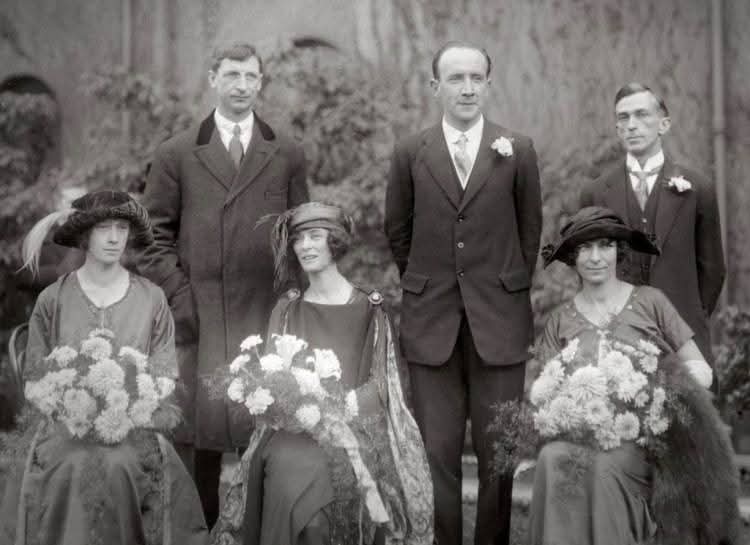
This morning in 1927, Kevin O’Higgins, the 35 year old Minister for Justice and Vice-President of the Executive Council of the Irish Free State, stepped out from his home in Booterstown County Dublin, and began the short walk to Mass along Cross Avenue. Unarmed and alone, he had dismissed his police protection some time earlier.
Three lads on bicycles passed him, turned, and doubled back. They then opened fire at close range. O’Higgins was hit by at least five bullets. Bleeding and staggering, he miraculously managed to stumble a short distance back towards his gaff before collapsing. A local butcher boy raised the alarm, and among those who rushed to assist him was the famous surgeon, senator and gobshite Oliver St. John Gogarty, who tried in vain to provide care.
O’Higgins lingered for hours in agony, conscious and lucid. He reportedly identified his attackers, who had long escaped. Around 5 p.m., he died from his wounds. In his dying breaths, he forgave his killers and told his wife he loved her.
The assassins were members of the anti-Treaty IRA. But the identities of Timothy Coughlan, Archie Doyle and Bill Gannon would remain officially undisclosed for nearly sixty years. It was only in 1985, in an interview with The Irish Press, that Harry White, a former IRA Chief of Staff, publicly confirmed what had long been rumoured:
“Bill Gannon told me that he and Archie Doyle were two of the assassins… By naming them at this stage, I’m finishing a chapter of Irish history.” The third man, he said, was Tim Coughlan. Harry White said their motive was clear. “As Minister for Justice, he ordered the murder of his former friends… That’s why he was killed.”
Like all the fraternal slaughter of the Civil War, it was not without tragic irony. O’Higgins had, in 1922, signed the execution orders of four captured anti-Treaty IRA men, including Rory O’Connor, who had once been his closest friend and best man at his wedding.
The executions were a reprisal for the fatal shooting of TD Seán Hales and the wounding of Pádraic Ó Máille, and they marked the start of a bitter and merciless tit for tat campaign of state retaliation during the Irish Civil War. In total, 77 republicans were executed by the Free State, under laws O’Higgins helped draft and enforce.
But the decision had not been taken lightly. O’Higgins, when questioned in the Dáil, had replied: “We have no higher aim than to place the people of Ireland in the saddle in Ireland, and let them do their will, but we will not acquiesce in gun-bullying… One of these men was a friend of mine.”
O’Higgins' killing sent shockwaves through the fledgling Free State. It was the most high-profile political assassination since the death of Michael Collins. Though the IRA did not officially sanction the hit, the act deepened the divide between Republicans and the pro-Treaty establishment.
In the immediate aftermath, W.T. Cosgrave’s government moved swiftly. Within weeks, the Electoral Amendment Act was passed, requiring all candidates for the Dáil to take their seats or forfeit them. The move was clearly aimed at Éamon de Valera’s Fianna Fáil, who had been practising abstentionism. Faced with exclusion from the political system, Fianna Fáil entered the Dáil for the first time on the 12th of August 1927.
Buy the Dublin Time Machine a pint and support the DTM Book https://t.co/U7jtCrOTtb
Excuse the language but….Holy Fucking Shit….I realise not everyone is into Tennis but Novak Djokovic has to be in the conversation for one of the greatest sportsmen of all time across all sports.
He has just played for 5 hrs 15 minutes straight in horrible, humid, draining heat in London (I’m here and it’s bloody horrible)…..and he won…again. Against the number 3 ranked player. Novak is 39 yrs old. Messi is 38 and everyone is lauding him as a god for his performances in the World Cup. To put it into perspective Djokovic just played three and a half entire football matches on the spin in that heat. It’s insane, it should be impossible, but for him it’s not.
And bear in mind not only the greatest ever on the court but a full blown legend off it. He did not buckle to the Covid and vaccine bullies, he stood his ground, defended his morals and refused to buckle. He defends his faith, loves his family and has never had a moments scandal. A genuinely perfect example of what a sportsman…and a man should be👏👏👏 @DjokerNole #tennis #wimbledon #GOATDebate #goat