Nine Helmets, Centuries of Military Innovation 🛡️
Ancient Greek helmets were far more diverse than the familiar face-covering Corinthian design.
From conical Kegelhelm forms to open-faced Illyrian helmets, each design reflects different approaches to protecting a warrior's head while balancing visibility, comfort and battlefield needs.
The Corinthian helmet, recognizable by its narrow eye openings and prominent nose guard, emerged around the 7th century BCE. The Chalcidian type offered a more open face, while the Illyrian design featured long cheekpieces and a distinctive ridged crown.
Another fascinating variation is the Apulo-Corinthian helmet, developed in southern Italy. Many examples resembled a cap rather than covering the face like a traditional Corinthian helmet.
The Pilos and Boeotian types demonstrate how helmet design also adapted to different military roles and preferences.
These forms did not all belong to one army or one period. Their dates overlap, and styles evolved across the Greek world and neighbouring regions.
Which design would you choose for its combination of protection and practicality?
Sources: The Metropolitan Museum of Art and the British Museum.
Most people in ancient Rome lived in rented apartments.
Today, a 1,900-YEAR-OLD Roman apartment block is still standing in Rome, at the foot of the Capitoline Hill.
Records from the 4th century say the city had about 46,000 apartment blocks, called “insulae.” In comparison, there were fewer than 2,000 private houses.
Some of these buildings were so tall that Augustus banned anything higher than 70 Roman feet (about 20 meters). Later, Emperor Trajan lowered the limit to 60 Roman feet.
The floors worked the opposite way from today. Shops were on the ground floor, and rich tenants lived on the first floor. The higher you went, the cheaper the rent and the worse the living conditions: there was no running water, there were fewer windows, and there were a lot of stairs to climb.
The Roman #Gold aureus (Early to Mid-Empire) contained approximately 0.23 troy ounces of pure #Gold.
In terms of purchasing power, that would make the equivalent price of #Gold around $17,000 to $20,000 USD per troy ounce.
A rare 1400 year-old Byzantine-era hoard consisting of 97 pure gold coins and jeweled gold earrings unearthed at the ancient city of Hippos (Sussita) near the Sea of Galilee...
The hoard contained 97 pure gold coins and dozens of jewelry pieces, including earrings inlaid with pearls, semi-precious stones and glass. A team found the treasure while investigating the ancient city of Hippos (also known as Sussita), which is on the slope of the Golan Heights. It is among the five largest gold hoards of that period found in the region.
Edie Lipsman, a metal detectorist, discovered the hoard in July while walking by a large stone and two ancient walls. "The device went crazy, I couldn't believe it — gold coins started appearing one after another," Lipsman said in a statement.
The coins feature different emperors, dating from the reign of the Byzantine emperor Justin I (518 to 527) to the early reign of Emperor Heraclius (610 to 613, although Heraclius ruled until 641). Some of the coins had remnants of fabric on them, indicating that the treasure had once been wrapped in cloth.
#archaeohistories
An archaeological artifact from eastern France consisting of a roughly 2,070-year-old human bone pierced by a Roman iron spearhead from the Gallic Wars....
A single iron spearhead, fired or thrust during the Roman-Gallic Wars, pierced straight through a warrior's bone and remained lodged there. More than 2,000 years later, archaeologists discovered the injury exactly as it occurred, preserving a brutal split-second of ancient combat.
The Roman-Gallic Wars were a series of campaigns in which Rome expanded into Celtic territories across Western Europe. Battles were often fought at close range with spears, swords, and shields, making severe skeletal injuries common. Finds like this provide rare physical evidence of the violence described in ancient accounts.
What makes this artifact remarkable is that it transforms history from words on a page into a real human experience. The embedded spearhead reveals not only the lethality of ancient weapons but also the fate of an individual warrior whose final battle was permanently recorded in bone and iron for over twenty centuries.
#archaeohistories
Attention!
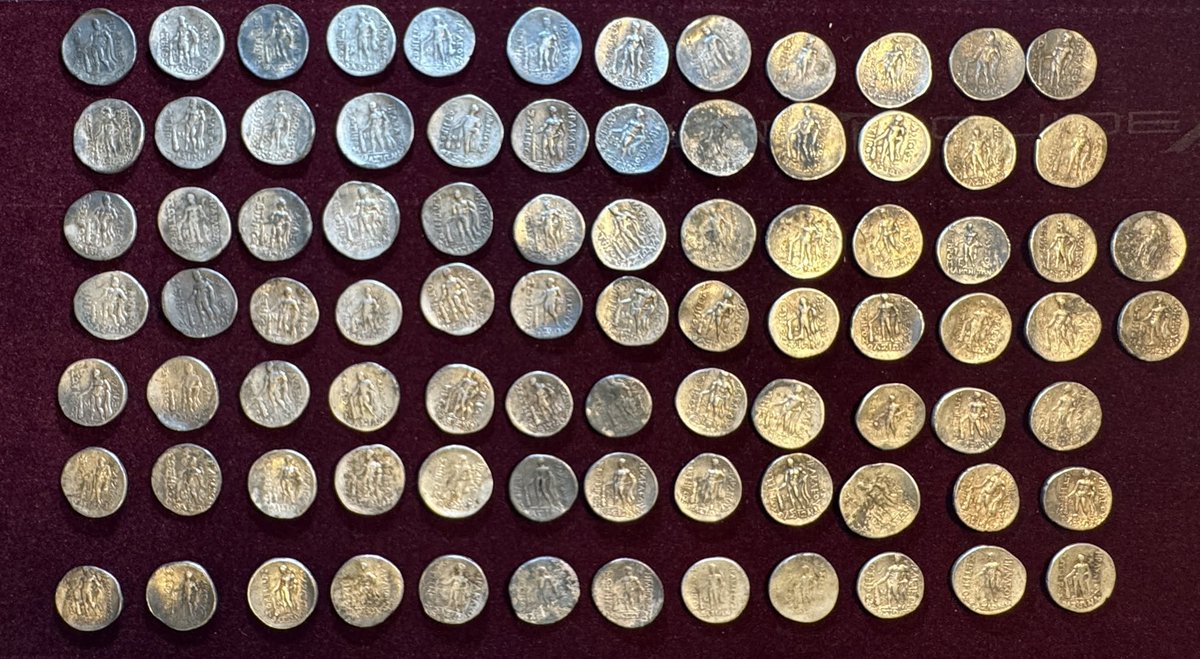
#metaldetection - A hoard of ancient silver from Romanian 🇷🇴 detectorist Teo Teodorescu.
86 tetradrachms of the Geto-Dacian tribes, struck as copies of the famous Thasos coins.
Young Dionysos on one side, Herakles with club and lion skin on the other.
Late 2nd–early 1st century BC. The silver of the Lower Danube.
The hoard has gone to the town hall, the county culture office, and the museum.
@TheSilverLion1 When property is unattainable and gold unaffordable, desire does not disappear it simply lowers the definition of wealth. Find some shiny scrap, hoard it, then dignify the compromise by calling it an asset.
@iyikihis@haritaseviyoruz Beni güldüren, Avrupalıya yaranmak için dininden bile sıyrılmaya çalışman; sen ona yaklaşmak için kendinden kaçıyorsun, o ise yüzüne tükürüyor. Acınası bir hâl gerçekten… İnsan öfkelenemiyor bile, sadece sana acıyor.
@iyikihis@haritaseviyoruz Komşularınız sizden nefret ediyor; Yunanlardan Bulgarlara, Ermenilerden Kürtlere, Araplardan Ruslara… Hatta Avrupa bile. Kendine bir sor: Neden herkes senden nefret ediyor?
@FarsiHaitham بالكويت اسمها عانيه انقرضت بعد ان كافحها المجتمع بنجاح خلال العشرين عام الماضية… لا فائدة من مبلغ تحصل عليه.. ثم تقضي طيلة حياتك وانت تدفعها حتى تموت وتقبر..!