Le anunciaron a Édith Piaf que su tiempo había concluido. Entonces entonó «No me arrepiento de nada» y ofreció una interpretación que no solo se volvió legendaria, sino que quedó grabada en la memoria cultural para siempre.
En diciembre de 1960 estaba agotada, gravemente enferma y con la orden estricta de sus médicos de no volver a pisar un escenario.
El Olympia estaba al borde de la quiebra. Para la mayoría, su trayectoria artística ya era cosa del pasado.
Aun así, decidió presentarse.
Semanas antes, Charles Dumont y Michel Vaucaire le habían entregado una canción recién nacida: Non, je ne regrette rien.
La escuchó una sola vez y la hizo suya de inmediato: sin dulzura, sin adornos, solo una marcha feroz y una convicción moral que no admitía titubeos.
Su estilo escénico era célebre por su austeridad: permanecía erguida, inmóvil, con su vestido negro sin pretensiones, dejando que sus manos y su voz cargaran con todo el peso emocional. No interpretó la pieza. La habitó.
Aquella noche rescató un teatro y convirtió un ajuste de cuentas íntimo con la pérdida en una de las grandes proclamaciones de resistencia del siglo.
Frágil en el cuerpo, inagotable en el espíritu, sigue siendo una de las voces más emblemáticas que alumbró el siglo XX.
El Gorrión no voló lejos.
Simplemente se negó a descender.
@azucenau No lo entiendo, en todos los colegios particulares, por lo menos en CDMX, hay inspección de la SEP, por lo menos, 3 o 4 veces al año, revisan hasta por debajo de las piedras, papel por papel, clases, instalaciones, etcétera y todo se registra.
Una madrugada de 1988, cerca de las 3 de la mañana, el cantante hawaiano Israel Kamakawiwo'ole llamó a un estudio de grabación.
-“Por favor, ¿puedo pasar?
Tengo una idea que no me deja dormir”, le dijo al ingeniero.
Entró, tomó su ukelele y en una sola toma grabó esa versión mágica de Somewhere Over the Rainbow que terminó conquistando al mundo entero.
Solo su voz cálida y el sonido suave del ukelele... una combinación que emociona hasta hoy.
Aunque Iz nos dejó en 1997 con apenas 38 años, su música sigue tocando corazones en todo el planeta.
Su vida corta, pero llena de luz, dejó un legado hermoso.
Y cada vez que suena, uno siente que los sueños sí pueden hacerse realidad...
“En algún lugar más allá del arcoíris
los pájaros azules vuelan...
y los sueños que soñaste de verdad se cumplen.”
A capella.
Sin auto tune.
¿Ven por qué DESPRECIO a Bad Bunny y todos los reguetoneros (entre otros)?
"Es que es otro contexto porq...".
No, no me vengan con esas MAMADAS.
Es que estoy SÍ ES TALENTO.
Descanse en paz, Bonnie Tyler.
Mongkol is a 61-year-old former logging elephant. His captive-held life was spent hauling trees in the Thai forest. His body shape is deformed through hard labor, and he lost his right eye and tusk in this brutal logging practice. Mongkol was rescued and brought to Elephants World to spend the rest of his days relaxing peacefully in freedom by the River Kwai. He is an extremely gentle and sensitive elephant who enjoys music, especially this slow movement by Beethoven, which is often played for him during the day and night.
El casuario es conocido como el ave más peligrosa del mundo por sus potentes ataques cuando se siente amenazado. Tienen patas extremadamente fuertes y garras afiladas en forma de daga de hasta 10 cm, capaces de perforar la carne y causar heridas mortales
@alcapotitone@LizbethCaro07 Es la cara poniente de Bellas Artes, a la derecha de la imagen está la Alameda, al fondo es Avenida Juárez.
Es una vista desde lo que hoy es el teatro Hidalgo.
Está tocando una banda de rock y el cantante ve a un niño con un cartel pidiendo tocar la guitarra con ellos. El cantante le pregunta:
- Realmente sabes tocar la guitarra?
- Sí!
- Cual es tu banda favorita?
- Guns N Roses
Esto es lo que sucede después.
Dr. Frank Mayfield was visiting the Tewksbury Institute when, on his way out, he accidentally bumped into an elderly cleaning lady. To make conversation, he asked, “How long have you worked here?”
“I’ve worked here almost since it opened,” she said.
“What can you tell me about the history of this place?” he asked.
“I don’t know much,” she said, “but I can show you something.”
She led him down to the basement under the oldest part of the building and pointed to a small, rusted cell. “That’s where they used to keep Annie Sullivan,” she said.
“Who’s Annie?” he asked.
The maid explained that Annie was a young girl who had been brought there because no one could control her. She screamed, bit, and threw her food. The doctors and nurses couldn’t even examine her.
“I was just a few years younger than Annie,” the maid said. “I used to think, ‘I’d never want to be locked in a cage like that.’ I wanted to help her, but if the doctors couldn’t, what could I do?”
“One night I baked some brownies after work. The next day, I put them outside her cage and said, ‘Annie, I made these for you. You can take them if you want.’ Then I walked away, afraid she’d throw them. But she didn’t. She took the brownies and ate them. After that, she was a little kinder to me. I started talking to her, and one day, I even made her laugh.”
“One of the nurses saw this and told the doctor. They asked if I’d help them with Annie. So whenever they needed to see her, I went in first to calm her, explain things, and hold her hand. That’s when they discovered Annie was almost blind.”
After a year of slow progress, Annie was sent to the Perkins Institute for the Blind, where she learned to read, write, and later became a teacher herself.
Years later, Annie came back to Tewksbury to visit and help. The Director told her about a letter he had just received from a desperate father. His daughter was blind, deaf, and thought to be “crazy.” He didn’t want to send her to an asylum and asked if anyone could come teach her.
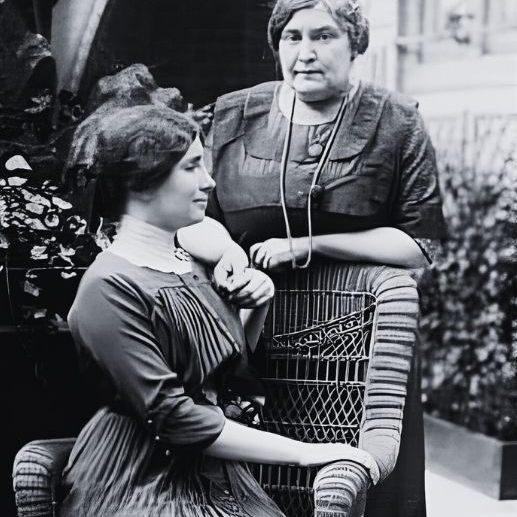
That’s how Annie Sullivan became the lifelong teacher and companion of Helen Keller.
When Helen Keller later received the Nobel Prize, she was asked who had most influenced her life. She said, “Annie Sullivan.”
But Annie replied, “No, Helen. The woman who changed both our lives was a maid at Tewksbury who once brought a little girl some brownies.”