In the flood of short videos, long videos compete with them by saving search costs for highlights using features like "Most Replayed" on YouTube.
My paper at the latest issue of @MISQuarterly studies how such features affect video consumption.
https://t.co/ZSXcl5FhjF
Is the problem (too) advanced artificial intelligence or distorted intelligence?
Repeated security debacles from OpenAI and Anthropic are now followed by AI safety researchers leaving these companies. They claim they now (finally!) realize that the breathless race these companies are engaged in is irresponsible.
Broadly construed, the problem can be interpreted as one of lack of alignment – models are doing things that are not in line with human objectives.
But the alignment discussion often veers toward the presumption that the problem is AI models becoming too advanced, too fast.
A different interpretation is that models aren’t too advanced. Nor is there any compelling evidence that they are marching toward a superintelligence humans can’t keep up.
The problem rather may be that the way that frontier labs are training these models is leading to distorted intelligence.
The problem isn’t the capabilities (though those are clearly real), but more that the capabilities are in service of some imperfect quantitative metrics – user approval, user engagement, simple task completion metrics, various benchmark scores – over which reinforcement learning optimizes relentlessly. That this process then leads to distorted behaviors in the form of gaming the evaluation of simple completion metrics, cheating, overconfidence in wrong answers, sycophancy shouldn’t perhaps be surprising.
An analogy may help. It isn’t that we have in our hands a super car that has its own mind and wants to take control of driving because it is superior to the driver.
It is more that we have a car where the steering and the brake system don’t work. It has many of the capabilities of very good cars, and its engine, acceleration and graphic interface may be very impressive.
But if you cannot steer it properly and if you cannot hit the brakes when necessary, what could does a car do? Perhaps we shouldn’t drive it until it’s fixed.
Congratulations to OPIM Professor Jing Peng, who has been awarded the 2025 Information Systems Society’s Sandra A. Slaughter Early Career Award. This is the second year in a row that an OPIM professor has received this international honor. Read More: https://t.co/fqGxg3hG43
I just found my Google Scholar citation reached 200 and hope the authors of these citations found my papers helpful😅
Like many other APs (maybe not all), I've been struggling to work on my stucked pipeline, but this gives me a little bit of encouragement. Stay strong, APs!
We are excited to announce that our MS in Supply Chain Management website is now live! This program is designed to meet the demand for skilled professionals; we'll equip you with the tools you'll need to thrive in this critical industry. Visit us: https://t.co/KEZdhgODin
"When a disaster occurs, we decide ‘that happened to them but it won’t happen to me’. It isn’t climate denial, it’s a psychological survival technique" https://t.co/SqtjeV5Fp0 @FT
Netflix had ZERO faith in Squid Game.
They buried it under 6,000+ other shows.
$0 marketing budget. 0 promotion. No push.
Then, 111 million viewers crashed their servers in 28 days.
Here's how an overlooked masterpiece silenced every doubter in Hollywood:
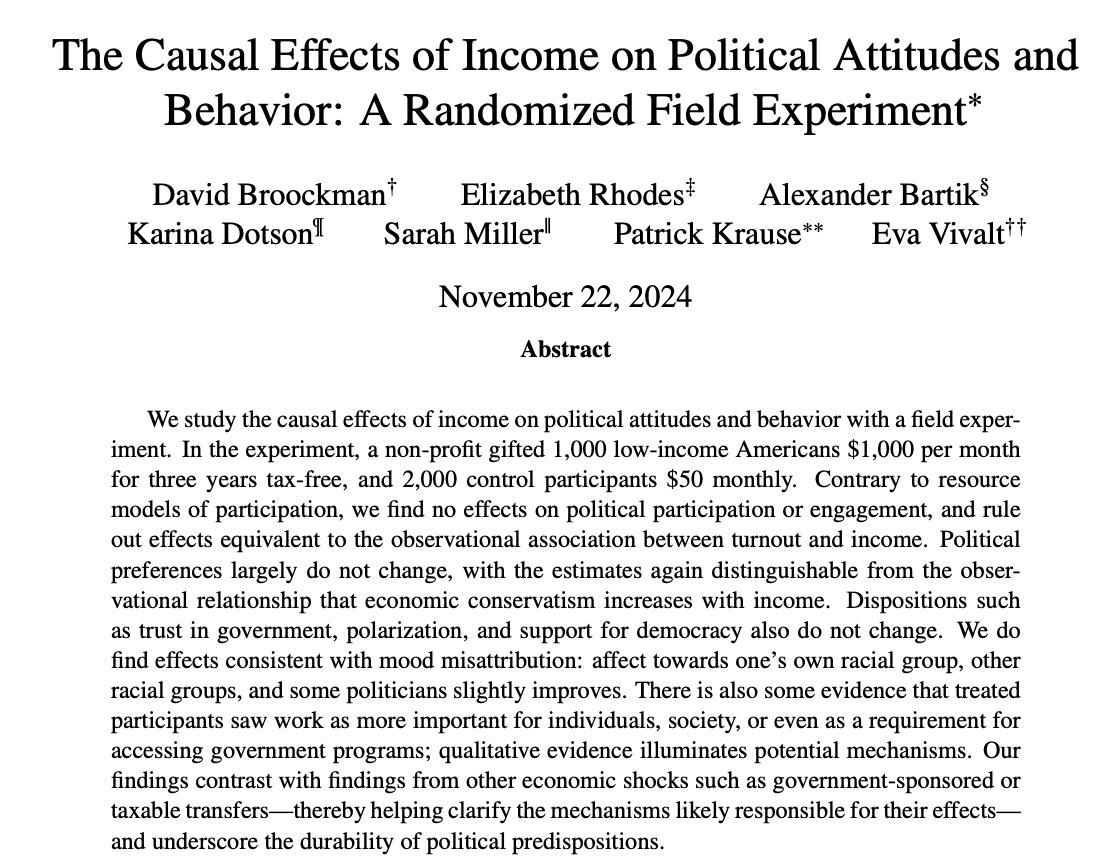
🚨 NEW PAPER: When low-income Americans get $1,000/month for 3 years, what happens to their political views & behavior?
The OpenResearch Unconditional income Study reveals surprising findings about the effects of income on politics... 🧵
🚨Working paper update!🚨
What is the impact of strict #privacy regulation on content supply and demand?
In Sept 2019, YouTube paid a record $170M to settle charges it violated children’s privacy law (#COPPA). We use this to study the "privacy-for-content" tradeoff. 1/11
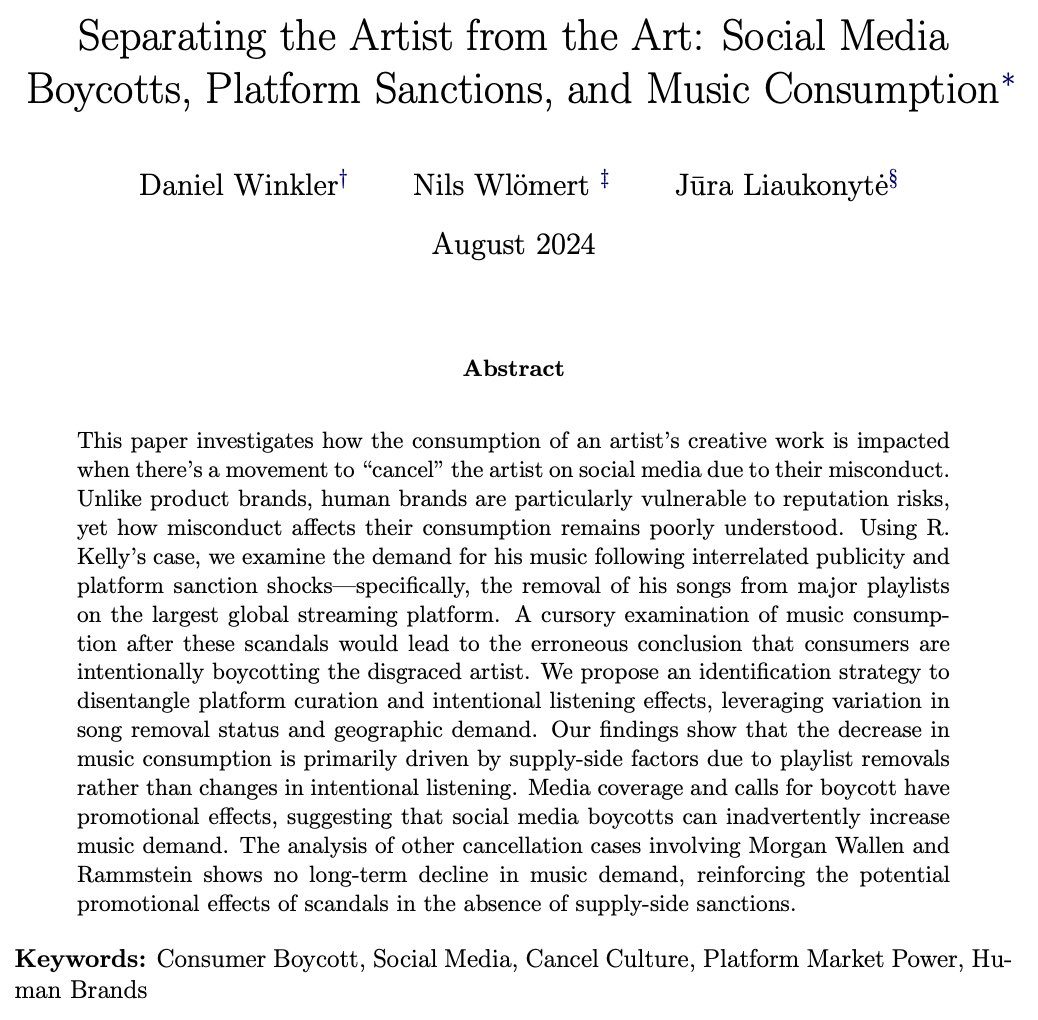
🚨New working paper alert!🚨
Does 'canceling' an artist on social media affect their music consumption? Daniel Winkler, @roamer_09, and I explore this in our new paper.
Spoiler: The answer is more complicated than you think.
It started as a dive into the relationship between smart devices and electrical comsumption. But School of Business professor Jaeung Sim's research uncovered a surprising link between race and the cost of heating. Read more about the discovery: https://t.co/Ap3uVMusEX
I couldn't find a shortcut other than journals, titles, and abstracts until now. I may inevitably keep relying on those heuristics, but I can make some effort to read papers if I have to judge someone. Otherwise, I'd better have a positive bias appreciating what I don't know.
Most people I've ever met have told me that the journal-based evaluation of research and researchers is problematic. I agree with them, but unfortunately, I still don't know how to assess research in a differently efficient way.
The only chance I could feel the true excellence of their research was attending their seminars and reading their papers very carefully. Although they are great ways to understand research capabilities, they are still inaccurate somehow and, more importantly, not scalable.