$SIMANTIC is live on @ponsdotfamily.
CA : 0x8d861715128C251038eFAadA98069cD6d54b7621
Simantic lets you run real firmware on simulated hardware, so embedded teams can test, debug, and verify systems without constantly relying on physical boards.
Its edge is deterministic simulation, real-hardware validation, reproducible tests, and tooling built for CI and AI-driven development.
Want to explore Simantic?
Start here:
Open the website
https://t.co/SqAXwfxmhG
Explore the dashboard and see how the platform works.
Read the documentation to understand the simulation, CLI, testing, and workflow.
https://t.co/SJfiJ4iqBg
Explore the source code and developer tooling on GitHub.
https://t.co/1S8E2eCaqx
Check out the Python SDK + pytest tooling for testing firmware without a physical board.
https://t.co/FyMrEuDDwy
Go through each layer and see how Simantic approaches real firmware, simulated hardware, and automated validation.
How does Simantic turn real firmware into something you can test without physical hardware?
Here’s a quick look at how the simulation works — from running the firmware to interacting with simulated hardware and verifying its behavior.
Real firmware. Simulated hardware. Reproducible testing.
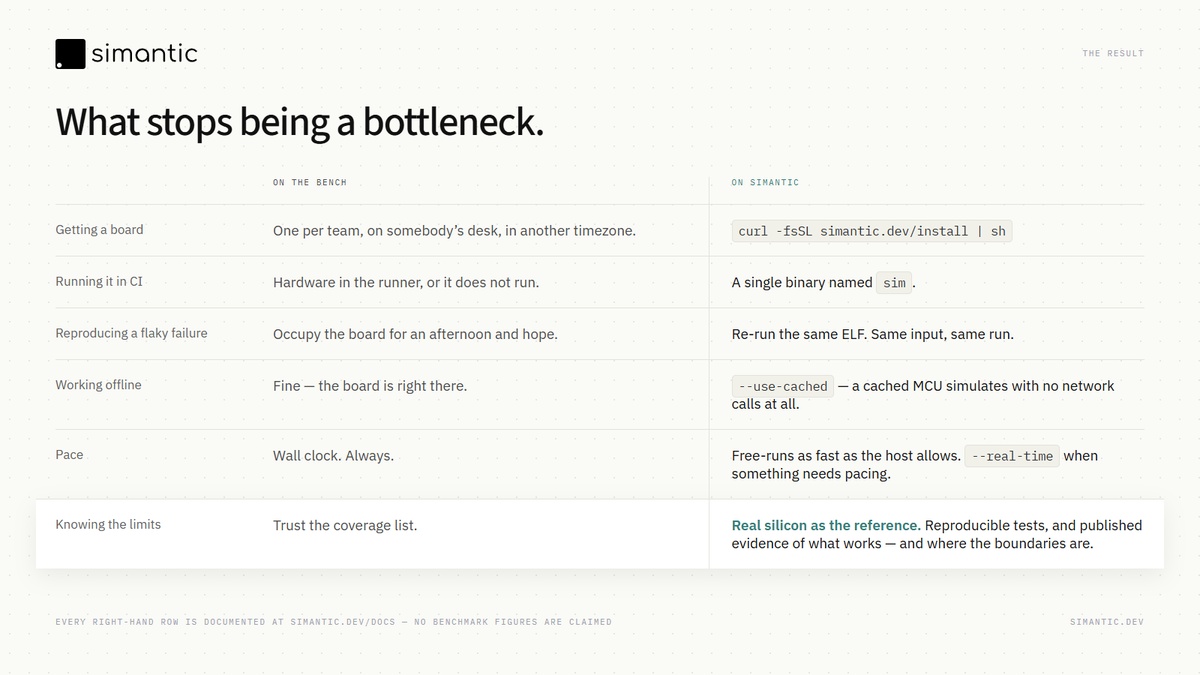
Most firmware testing still depends on physical hardware.
That means every iteration can require access to a board, making testing slower, harder to reproduce, and difficult to run continuously in CI.
Simantic takes a different approach: run real firmware on simulated hardware and interact with it like the real system.
Developers can reproduce scenarios, inspect behavior, and catch failures without needing a physical board for every test.
The goal is to move more of firmware development into a fast, repeatable, and testable environment — while still using real hardware as the reference where it matters.
Please be patient with us as we continue building behind the scenes.
We’re working on improving Simantic, refining the experience, and preparing more updates to share in the future. There’s more coming as we keep pushing the project forward.
We’re putting together a short demo video to show how Simantic works — from running real firmware on simulated hardware to testing and verifying the system.
More soon.
We’re putting together a short demo video to show how Simantic works — from running real firmware on simulated hardware to testing and verifying the system.
More soon.
Need a quick visual on how Simantic works?
I can share a short how-it-works demo showing how real firmware runs on simulated hardware and how the testing loop works.
Start here : https://t.co/nKoT7nEKa2
$SIMANTIC is live on @ponsdotfamily.
CA : 0x8d861715128C251038eFAadA98069cD6d54b7621
Simantic lets you run real firmware on simulated hardware, so embedded teams can test, debug, and verify systems without constantly relying on physical boards.
Its edge is deterministic simulation, real-hardware validation, reproducible tests, and tooling built for CI and AI-driven development.
The real advantage is the feedback loop.
Run the same firmware, reproduce the same scenario, inspect what happened, and iterate without waiting for someone to hand over a physical board.
Physical boards are useful for validation, but they shouldn’t be required for every iteration.
Simantic moves firmware testing into a reproducible simulated environment, making it easier to catch issues, automate tests, and iterate before hardware enters the loop.
Physical hardware shouldn’t be the bottleneck.
Simantic lets firmware run against simulated hardware, making testing faster, reproducible, and easier to automate before the real board is even involved.
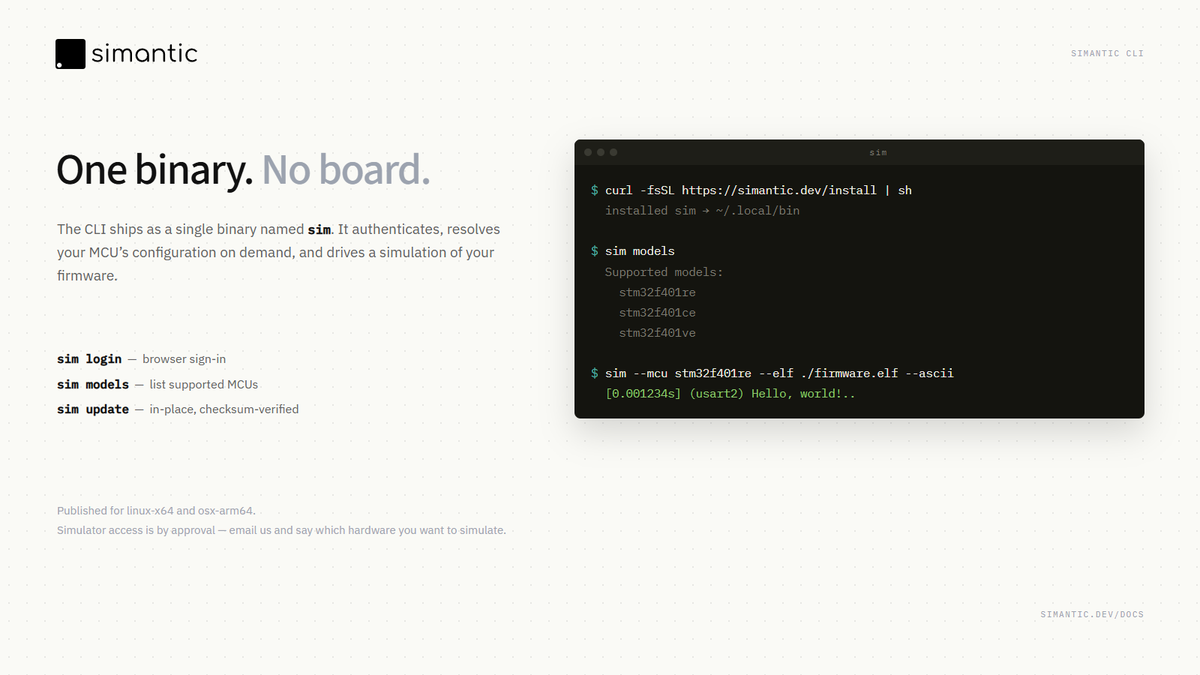
One binary. No board.
curl -fsSL https://t.co/BEmVcJSZqq | sh
The CLI ships as a single binary named sim. It authenticates, resolves your MCU's configuration on demand, and drives a simulation of your firmware.
sim models — stm32f401re, stm32f401ce, stm32f401ve
sim --mcu stm32f401re --elf ./firmware.elf --ascii
Pass --use-cached and a cached MCU simulates with no network calls at all. For a locked-down build machine, that is the difference between usable and not.
https://t.co/hBrUqdIlYO
Real firmware. Simulated hardware.
Run, inspect and test your embedded system — from a single MCU to connected devices, with no board on the desk.
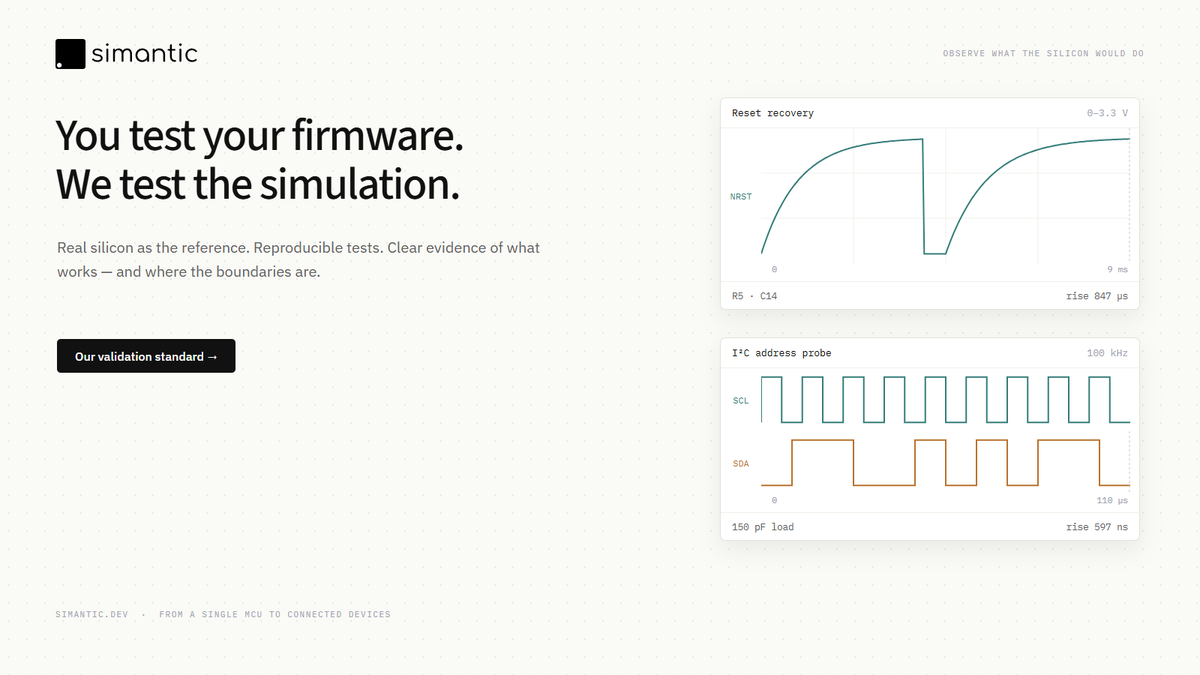
Real silicon as the reference. Reproducible tests. Clear evidence of what works, and where the boundaries are.
Reset recovery, rise 847 µs. I²C address probe at 100 kHz, 150 pF load, rise 597 ns. Observable, not asserted.
https://t.co/RspVWowv62